Most thermal scope questions we get are not really about thermal scopes. They are about money, and about the fear of spending it on the wrong thing. I have been on the manufacturing side of night optics for three decades, and the questions arriving in 2026 are sharper than the ones I fielded in 1996 — people now know the words, they just do not know which of the words costs them anything. This is the first of a running series where I take the questions readers and search engines actually ask and answer them with numbers off our own product cards. No hedging, no "it depends" as a complete sentence.
What readers ask most
The single most common question is "how far can it see", and it is the one that gets answered wrong most often. A detection range is the distance at which the optic tells you heat is present — a warm shape. Recognition is the distance at which you can tell it is an animal rather than a rock. Identification is where you can say which animal and where it is facing. Those are three different numbers, and only the first one appears on a spec sheet. The ATN ThOR 6 640x512 | 2-16x is rated at 3100 m detection. Nobody is identifying a coyote at 3100 m, and anyone selling you that idea is selling you something.

How a thermal scope works, in four steps
Understanding this much settles about half the mail we get.
- Everything warm radiates. Objects above absolute zero emit long-wave infrared. An animal emits more than the ground behind it. That difference is the entire picture.
- A germanium objective collects it. Glass is opaque in that band, so thermal optics use germanium — 35 mm at F/1.0 on the ThOR 6 640 2-16x.
- An uncooled array measures it. A 12µm VOx focal plane array of 640×512 pixels, refreshing at 50 Hz, rated to resolve differences down to ≤15mK.
- Processing and display turn it into an image. SharpIR© sharpens edges and contrast in real time, and the result reaches a 0.49-inch 1920×1080 OLED in whichever of six palettes you have selected.
What you can actually use one for
Detection first, everything else second. Thermal finds the animal that night vision and your eyes never see — in brush, in tall grass, in complete darkness, in light fog. ATN's support line is that a thermal will show a heat signature through thick brush or tall grass whenever there is a heat variation inside it, and that is the honest version of "sees through cover". It does not see through a tree trunk. It sees the warm thing between the trunks. Past detection, the ThOR 6 line adds the work items: ten reticle styles, Zeroing Freeze for precise adjustment after a shot, Picture-in-Picture, Recoil Activated Video that captures up to ten seconds either side of recoil, 64 GB of storage and Wi-Fi to a phone.
Thermal or night vision? The short version
Buy thermal if the job is finding. Buy digital day/night if the job is seeing what you already found, in colour, in daylight too, for less money. Thermal detects heat and does not care about light at all; a digital day/night scope amplifies and processes light, and in full dark it needs an infrared illuminator, which is why the ATN X-Sight 5 3-15x ships with an IR850. That scope runs a 4K+ 4056×3040 sensor, up to 14 hours of battery, and a list price of $659 against a promotional $599. The ThOR 6 640 2-16x lists at $3,625, promo $2,295. The gap is not margin — it is the cost of a germanium objective and an uncooled microbolometer. Our full breakdown of that decision lives in night vision vs thermal.

The terms behind the questions
- Sensor resolution. 256×192, 384×288, 640×512 — the number of detector pixels. More pixels means the same animal covers more of them at the same distance, so detail survives further out. It is the television upgrade argument, and it behaves the same way.
- NETD. Measured in millikelvin, this is how small a temperature difference the sensor can pull out of its own noise. ≤15mK on the ThOR 6 640 2-16x and on the THOR-6 384×288 2.5-20x; ≤20mK on the ThOR 6 Mini 256. Lower is better and it matters most when the scene is warm and flat.
- Detection range. A published figure for the first of the three distances above: 3100 m on the ThOR 6 640 2-16x, 3650 m on the 3-24x, 2300 m on the 384 2.5-20x.
- Field of view. How much world you see at once: 12.52° × 9.41° on the 35 mm ThOR 6 640, 8.78° × 6.59° on the 50 mm. The bigger lens reaches further and shows less.
- Refresh rate. 50 Hz across the ThOR 6 scopes named here. It is what keeps a running animal from smearing.
- Recoil rating. 6000 Joules on the ThOR 6 640 2-16x, the 3-24x, the 384 2.5-20x and the ThOR 6 Mini 256. Electronics on a rifle live or die on this number.
What to look for before you buy
Start with the distance you actually shoot, not the distance you would like to brag about. If that number is under 200 yards in timber, a 384 sensor with a wide field of view will serve you better than a long 640 you have to hunt through. If you work open ground and want to sort a coyote from a dog at distance, buy the pixels. Then check the three lines that quietly decide ownership: battery type, recoil rating and warranty. On the ThOR 6 640 2-16x that reads one internal plus one replaceable 18650 for about nine hours, 6000 Joules, and five years. Model-by-model comparisons live in our ATN thermal scope review.
The mistakes readers admit to
Buying magnification instead of sensor. Digital zoom on a 256 array does not create detail, it enlarges what is already there — the ThOR 6 offers 1×, 2×, 4× and 8× digital zoom on top of optical magnification, and the honest use of it is confirming a target, not finding one. Second: mounting a thermal and never running Zeroing Freeze, then blaming the optic for a shot that the reticle never owned. Third: buying for the one night a year at maximum range rather than the forty nights at ordinary range.
The optic behind these numbers

The ThOR 6 640x512 | 2-16x is what I point people at when they ask for one answer instead of a category. 640×512 on a 12µm VOx uncooled array at 50 Hz, ≤15mK NETD, a 35 mm germanium objective at F/1.0, 12.52° × 9.41° field of view and 3100 m rated detection. Magnesium alloy body, IP67, 830 g / 1.83 lbs, 6000 Joules, -30°C to 55°C, five-year warranty. Ten reticle styles, Zeroing Freeze, Hot Point Tracking, RAV, 64 GB, Wi-Fi and the ATN Connect 6 app. List price $3,625, with promotional pricing published at $2,295. Buy it if you want the current 640 core without an integrated rangefinder. Skip it if your shooting lives inside 150 yards and your budget does not — the ThOR 6 Mini 256 2-16x lists at $985, promo $689, and is rated to 1200 m detection.
Is a thermal scope worth it?
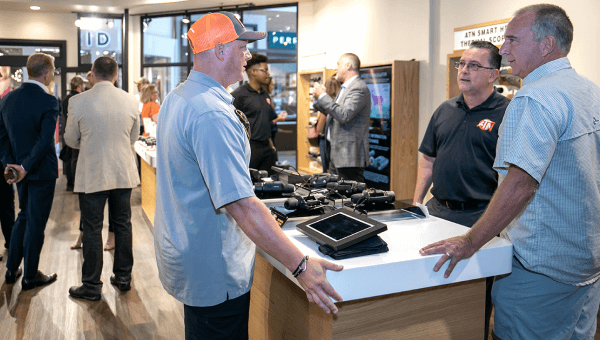
If you hunt at night more than twice a month, yes, and the argument is time rather than glamour. A thermal turns a night of walking into a night of hunting because you stop searching and start choosing. If you hunt at night three times a year, buy the digital day/night scope and spend the difference on ammunition. I have said that to customers standing in front of our own booth, and I will keep saying it.
Reader questions, answered
How far can a thermal scope really see?
Further than you can identify. The ThOR 6 640 2-16x publishes 3100 m detection and the 3-24x publishes 3650 m, but those are distances at which heat registers. Recognition and identification happen much closer, and depend on sensor resolution, lens and conditions.
Is 384 enough, or do I need 640?
384 is enough for most timber and most shots inside a few hundred yards; the THOR-6 384×288 2.5-20x carries the same ≤15mK sensitivity as the 640 and is rated to 2300 m detection. Choose 640 when you need to tell species apart at distance on open ground.
Can you use a thermal scope during the day?
Yes. Thermal imaging is not affected by natural or artificial light, and daylight often helps by revealing animals hidden in shadow, dense foliage or camouflage. The harder daytime condition is heat and humidity, which flattens the temperature difference the sensor reads.
Does a thermal scope need an infrared illuminator?
No. Thermal detects emitted heat, so it works in total darkness with no illumination at all. Digital day/night scopes are the ones that need IR at night, which is why the X-Sight 5 3-15x ships with an IR850 in the box.
Do thermal scopes work in rain, fog and snow?
They work in light fog and in most weather conditions, and the ThOR 6 640 2-16x is IP67-rated. Heavy heat and humidity hurt the image more than cold and wet do. A laser rangefinder will range in rain and snow but not in fog.
How much does a good thermal scope cost?
Across the ThOR 6 scopes in this Q&A, list prices run from $985 for the Mini 256×192 2-16x to $4,175 for the 640×512 3-24x, with the promotional prices published alongside them at $689 and $2,595. The 640 2-16x sits between the two at $3,625 list and $2,295 promo.
How long does the battery last?
About nine hours on the ThOR 6 640 2-16x, from one internal and one replaceable 18650, with USB Type-C external power as a backup. Expect less in extreme cold; ATN states that battery performance may decrease at very low temperatures.
Will a thermal scope survive my rifle?
The ThOR 6 640 2-16x, the 3-24x, the 384 2.5-20x and the ThOR 6 Mini 256 are each rated to 6000 Joules of recoil, measured as 1000 g of acceleration over 0.4 ms, in a magnesium alloy housing. That covers ordinary hunting calibers comfortably.
Send the next batch
This series runs on what readers actually ask, so the next issue is built from the questions that arrive between now and then. Bring the awkward ones — the price ones, the "is my old scope still fine" ones. Meanwhile, if you want the ranking rather than the reasoning, our guide to the best 640 thermal scopes does the sorting, or look through the current line of ATN thermal scopes and see which set of numbers matches the ground you hunt.
Quick spec reference
- Featured optic: ATN ThOR 6 640x512 | 2-16x, SKU TIWST6635A, list $3,625 (promo $2,295)
- Sensor: 640×512, 12µm VOx uncooled, 50 Hz, ≤15mK NETD; 35 mm (Ge) F/1.0; 12.52° × 9.41°; 3100 m detection
- Smaller sibling: ThOR 6 Mini 256×192 2-16x (TIWST6M215) — ≤20mK, 15 mm (Ge), 1200 m, 500 g / 1.10 lbs, list $985 (promo $689)
- Digital alternative: X-Sight 5 3-15x (DGWSXS3155P) — 4K+ 4056×3040 sensor, up to 14 hrs, IR850 included, list $659 (promo $599)
- Build: magnesium alloy, IP67, 830 g / 1.83 lbs, 6000 Joules, -30°C to 55°C, 5-year warranty