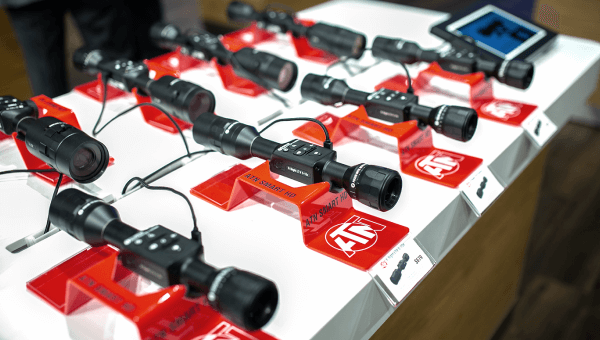
An ATN thermal scope review has to answer one question first: which generation and which sensor are you actually looking at, because ATN sells four active thermal scope lines — ThOR 6, ThOR 6 Mini, ThOR 5 / ThOR 5XD, and ThOR LTV — and they're built for different jobs, not ranked best-to-worst. The flagship is the ATN ThOR 6 640x512 | 2-16x, built around a 6th Generation ultra-sensitive 640×512 sensor with ≤15mK NETD on a 12μm pixel pitch. This review walks through what separates each ATN thermal scope generation, what the numbers on the spec sheet actually mean for a hunt, and which line fits which use case.
The ThOR 6 is ATN's current flagship generation, with the ThOR 6 Mini as its compact sibling, the ThOR 5 / ThOR 5XD as the previous-generation workhorse, and the ThOR LTV as the lightweight entry point. Sensor sensitivity, refresh rate, and smart-feature depth are what actually separate them — not just resolution.
Quick answer
- Best overall: ATN ThOR 6 640x512 | 2-16x (TIWST6635A)
- Best for the money: ATN ThOR 6 Mini 256x192 | 2-16x (TIWST6M215)
- Best lightweight: ATN ThOR 6 Mini 384x288 | 2.5-20x (TIWST6M325)
- Best long-range: ATN THOR-6 640x512 | 3-24x (TIWST6650A)
- Budget pick: ATN ThOR LTV 640 4-12x (TIWSTLTV650X)
Why the latest generation stands out
Every ATN ThOR generation uses a 12μm pixel pitch thermal core, but sensitivity has moved with each release. The ThOR 6 series holds NETD (Noise Equivalent Temperature Difference — the smallest heat difference the sensor can resolve as separate detail) at ≤15mK on the 640×512 models and ≤18mK on the 384×288 and 640×512 ThOR 6 Mini models. Lower NETD means the sensor pulls apart heat signatures that are close in temperature — a deer's body against warm ground, or a hog partly hidden by brush — instead of blurring them into one blob. That's a real, measurable step down from the ThOR 5's sensor generation.
The other change across the line is processing, not just sensing. SharpIR© AI-image enhancement runs on every ThOR 6 and ThOR 6 Mini frame in real time, sharpening edges and boosting contrast before the image ever reaches your eye. Combined with a 50 Hz refresh rate and a 0.49-inch, 1920×1080 OLED display shared across the ThOR 6 line, the result is a picture that holds up better on moving targets and in cluttered environments than earlier ATN generations, which ran lower-resolution displays and no AI enhancement layer at all.

Comparison table
| Model | Sensor | NETD | Magnification | Detection range | Battery | Weight | MSRP |
|---|---|---|---|---|---|---|---|
| ThOR 6 640 2-16x | 640×512 | ≤15mK | 2-16× | 3100 m | ~9 hrs | 830 g | $3,625 |
| ThOR 6 640 3-24x | 640×512 | ≤15mK | 3-24× | — | ~9 hrs | — | — |
| ThOR 6 Mini 384 2.5-20x | 384×288 | ≤18mK | 2.5-20× | 2300 m | ~7 hrs | <500 g | $1,975 |
| ThOR 6 Mini 256 2-16x | 256×192 | ≤20mK | 2-16× | — | — | — | $985 |
| ThOR 5 640 2-16x | 640×480 | — | 2-16× | 2700 yd | 10 hrs | 1.88 lb | $2,995 |
| ThOR LTV 640 4-12x | 640×480 | — | 4-12× | 2800 yd | 9+ hrs | 1.4 lb | $3,095 |
Best overall: ATN ThOR 6 640x512 | 2-16x
The ThOR 6 640 2-16x is ATN's current flagship for a reason: it pairs the most sensitive sensor in the active lineup with the deepest smart-feature set. At $3,625, it sits mid-pack in price but leads on sensitivity and processing.
Image quality
The 640×512 resolution, ≤15mK NETD sensor is built on a 12μm VOx uncooled focal plane array, and SharpIR© AI enhancement processes every frame to sharpen edges and boost target contrast in real time. Six color palettes — White Hot, Black Hot, Iron Red, Alarm, Green Hot, Sepia — mean you can match the display to whatever terrain or lighting condition you're working, and Picture-in-Picture keeps a wide-view window active while you zoom in for precision.
Range and magnification
Rated to a 3100 m detection range with 2-16× optical magnification and up to 8× digital zoom on top, the ThOR 6 640 2-16x covers everything from close brush work to open-field shots without needing a lens swap. Its 12.52° × 9.41° field of view is wide enough to track a moving target while scanning, not just after you've already found it.
Battery and build
Two 18650 batteries deliver roughly 9 hours of continuous runtime, and the redesigned magnesium alloy housing weighs 830 g — under 2.2 lbs — which keeps the balance point closer to the receiver than older, heavier scope bodies. It carries a 6000 Joule / 1000g recoil rating, an IP67 waterproof rating, and a -30°C to 55°C operating range, backed by a 5-year warranty.
Smart features
Zeroing Freeze pauses the image at the moment of impact so you can adjust the reticle without rushing. Recoil Activated Video automatically saves footage from 10 seconds before to 10 seconds after the shot. Built-in Wi-Fi and the ATN Connect 6 app — which includes an AI assistant trained on the product manual — handle live streaming, gallery management, and firmware updates from a phone or tablet.
Buy this if you want the sharpest sensor ATN currently ships in a full-size scope and plan to use it as your primary night optic across a range of distances. Skip it if you need something lighter for a crossbow or PCP platform, or if $3,625 is outside your budget — the ThOR 6 Mini or ThOR LTV lines cover those cases.

Best for the money: ATN ThOR 6 Mini 256x192 | 2-16x
At $985 MSRP, the ThOR 6 Mini 256 2-16x is the lowest-priced way into the current ThOR 6 generation, not a stripped-down older platform.
Image quality
The 256×192 sensor with ≤20mK NETD is less sensitive than the 640-class models, but it still runs SharpIR© AI enhancement and the same six-palette system as the flagship. For shorter-range work, that combination holds up well; the resolution ceiling shows up mainly when you're trying to positively identify small or distant targets rather than just detect them.
Range and magnification
2-16× magnification with 8× digital zoom mirrors the flagship's zoom range, so you're not giving up reach — you're giving up sensor resolution and detection distance compared to the 640-class models.
Battery and build
Like the rest of the ThOR 6 Mini line, it runs on a single 18650 battery in a magnesium alloy housing under 500 grams, with the same 3-button control layout and USB-C charging as its siblings.
Buy this if you want current-generation processing and smart features at the lowest ThOR 6 price point. Skip it if your shots regularly stretch past what a 256×192 sensor can resolve — step up to the 384 or 640 Mini instead.
Best lightweight: ATN ThOR 6 Mini 384x288 | 2.5-20x
The ThOR 6 Mini 384 2.5-20x is the middle sensor option in the Mini line, and it's built specifically around mobility.
Image quality
384×288 resolution at ≤18mK NETD splits the difference between the Mini 256 and the full 640-class sensors, with the same SharpIR© processing and 0.49-inch, 1920×1080 OLED display as the flagship ThOR 6.
Range and magnification
Detection range comes in at 2300 m with 2.5-20× magnification and 8× digital zoom — enough for most hunting scenarios without the size and weight of a full-frame scope body.
Battery and build
This is where the Mini earns its name: under 500 grams total, powered by a single 18650 battery good for about 7 hours, and built from the same magnesium alloy as its larger siblings. On a lightweight AR-pattern rifle or anywhere balance matters, that weight difference against the 830 g full-size ThOR 6 is noticeable the moment you shoulder it.
Buy this if weight and balance on the rifle matter as much as image quality. Skip it if you need the absolute longest detection range — the full-size 640 ThOR 6 outranges it.
Best long-range: ATN ThOR 6 640x512 | 3-24x
The 3-24× variant shares the flagship's 640×512, ≤15mK NETD sensor but trades the 2-16× model's lower-end magnification for reach at the top end.
Image quality
Same sensor, same SharpIR© processing, same six-palette system as the 2-16x model — the difference here is purely in the optical path and lens system tuned for higher native magnification.
Range and magnification
3-24× optical magnification with 8× digital zoom stacked on top pushes effective reach well past what the 2-16× model offers, at the cost of a narrower field of view at the low end — worth factoring in if you also do close-range scanning with the same scope.
Smart features
The full ThOR 6 smart suite carries over: Zeroing Freeze, Picture-in-Picture, Recoil Activated Video, Wi-Fi streaming through Connect 6, and hot point tracking to flag the warmest object in frame.
Buy this if your shots regularly stretch to the far edge of your rifle's practical range. Skip it if most of your hunting happens inside 150 yards — the 2-16× model's wider low-end field of view will serve you better.
Budget pick: ATN ThOR LTV 640 4-12x
The ThOR LTV line predates the ThOR 6 generation's SharpIR© processing and OLED display, but it remains ATN's lightest full-featured thermal scope platform and a genuine budget-conscious option among current-production lines.
Image quality
The 640×480, 12μm sensor feeds a 1280×720p HD display — a step below the ThOR 6's 1920×1080 OLED, but still enough resolution to identify game at practical hunting ranges. Black Hot, White Hot, and Color viewing modes cover the core use cases without the six-palette depth of the newer line.
Range and magnification
Detection range is rated to 2800 yards with 4-12× magnification — a narrower zoom range than the ThOR 6 line, reflecting its role as a simpler, lighter platform rather than a do-everything scope.
Battery and build
At 1.4 lb / 650 g, the ThOR LTV is built explicitly for platforms where weight is the deciding factor — crossbows, PCP air rifles, and other setups where a heavier scope body changes the balance of the whole rig. One Shot Zero simplifies sighting-in: take a shot, adjust the reticle, and you're zeroed without repeated recalibration passes. Battery life runs 9+ hours.
Buy this if you're mounting thermal on a crossbow, air rifle, or any platform where every ounce counts, or if you want a lighter, simpler control scheme than the full smart-feature ThOR 6 line. Skip it if you want SharpIR© AI processing or the six-palette color system — those are ThOR 6 and ThOR 6 Mini exclusives.

How to choose between ATN's thermal scope generations
Start with distance. If your shots regularly stretch past 150-200 yards, prioritize sensor sensitivity — the ≤15mK NETD on the ThOR 6 640-class sensors resolves detail at range that a ≤20mK sensor loses to noise. If most of your hunting happens closer than that, a 256 or 384 sensor keeps costs down without a meaningful loss in practical performance.
Next, think about rifle platform. A full-size ThOR 6 at 830 g rides comfortably on a heavier bolt gun or AR platform built for it, but the same weight on a lightweight carbine or a crossbow changes the balance point enough to affect handling. That's exactly the gap the ThOR 6 Mini and ThOR LTV lines are built to fill — both come in well under a pound.
Budget matters in both directions. The ThOR 6 Mini 256 2-16x gets you current-generation SharpIR© processing at $985, while the flagship ThOR 6 640 2-16x runs $3,625 for the most sensitive sensor and deepest feature set ATN currently ships. There's no wrong answer here — the question is whether you're paying for sensor sensitivity you'll actually use at your typical hunting distance, or for weight savings and simplicity you'll feel every time you shoulder the rifle.

Finally, weigh smart features against simplicity. Zeroing Freeze, Picture-in-Picture, Recoil Activated Video, and Wi-Fi streaming through Connect 6 are genuinely useful in the field, but they also mean more menu depth to learn. If you want the shortest path from unboxing to hunting, the ThOR LTV's simpler control scheme and One Shot Zero feature trade some of that depth for straightforward operation.
FAQ
What's the difference between ATN ThOR 6 and ThOR 5?
The ThOR 6 line uses a newer sensor generation with ≤15mK NETD on its 640-class models, adds SharpIR© AI-image enhancement, and runs a higher-resolution 1920×1080 OLED display, compared to the ThOR 5's earlier sensor generation and 1024×768 display.
Is the ATN ThOR 6 worth the price over the ThOR 6 Mini?
It depends on your priorities: the full ThOR 6 640 2-16x has a more sensitive sensor and longer detection range, while the ThOR 6 Mini trades some sensor resolution for a body under 500 grams and a lower price point.
How long does the battery last on an ATN thermal scope?
It varies by model — the ThOR 6 640 2-16x runs about 9 hours on two 18650 batteries, the ThOR 6 Mini runs about 7 hours on one battery, and the ThOR LTV runs 9+ hours, all with replaceable cells for hot-swapping in the field.
What does NETD mean on a thermal scope spec sheet?
NETD (Noise Equivalent Temperature Difference) measures the smallest temperature difference a sensor can distinguish as separate detail — a lower number, like the ThOR 6's ≤15mK, means the scope can pull apart heat signatures that are close in temperature instead of blurring them together.
Which ATN thermal scope is best for a lightweight rifle?
The ThOR 6 Mini 384 2.5-20x or ThOR LTV 640 4-12x are both built for weight-sensitive platforms, coming in under a pound and a half compared to the full-size ThOR 6's 830 g body.
Do ATN thermal scopes work in complete darkness?
Yes — thermal scopes detect heat signatures rather than amplifying ambient light, so they function the same in total darkness as they do at dusk or in daylight, unlike traditional night vision that requires some light source to amplify.
Can I mount an ATN ThOR 6 on an AR-15?
Yes, the ThOR 6 line mounts with standard 30mm rings on any Picatinny rail platform, including AR-15s, though the full-size 830 g body is worth test-fitting for balance on lighter carbine builds.
What's included when you buy an ATN ThOR 6 scope?
Standard included accessories are lens tissue, a USB-C cable, the printed manual, a battery charger, two 18650 batteries, a heating target for practice, and a portable carrying bag.
Whichever ATN thermal scope generation fits your rifle and budget, they all share the same engineering DNA — a 12μm thermal core refined generation over generation. Start with the ATN ThOR 6 640x512 | 2-16x product page for full specs, or browse the complete thermal scope lineup to compare every current model side by side before you buy.