For the hunter who never stops moving, thermal monocular vs binocular isn't a close call. A thermal monocular like the ATN BlazeTrek 6 lives in a chest pocket, comes up in one hand, and lets you walk, work a light, or shoulder a rifle without ever setting it down. A thermal binocular like the ATN Binox-6 trades that mobility for two-eye comfort and extra reach on a long sit. Both read the heat off an animal, so both find game in the dark your eyes miss. The question is whether you hunt on the move or park behind glass — and if you cover ground, the monocular is built for you. Here is the straight comparison, from the run-and-gun side first.
How a thermal monocular works
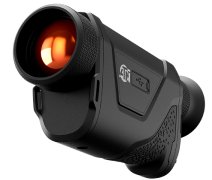
A thermal monocular packs the entire heat-imaging system behind a single eyepiece, and that one design choice is the whole story: it stays small, light, and instantly ready. The ATN BlazeTrek 6 pulls infrared heat through a 19mm germanium lens onto a 640x512 sensor, so you get plenty of dots in the picture and detail that holds as you zoom from 1.5x to 12x. That low 1.5x base throws open a wide 22.8 by 18.3 degree field of view — the monocular's signature strength, sweeping a huge slice of country in one pass and making a moving animal easy to catch. At 320 grams it vanishes into a chest pocket, and one hand always stays free for a light or your rifle. You draw it, scan, confirm a warm shape, pocket it, and keep walking. It is the mobile tool built for hunters who don't sit still.
How a thermal binocular works
A thermal binocular splits the view across two eyepieces so both eyes stay open while you glass. The ATN Binox-6 collects heat through a bigger 35mm germanium objective onto its own 640x512 sensor, and that longer optic stretches from 3x to 24x with a 3100 m detection range, so it reads detail out of far country a monocular can't touch. Two-eye viewing is its comfort payoff: neither eye fights the other, so an hour spent studying a distant tree line doesn't wear you down. The Binox-6 also layers on a laser rangefinder, a 4K day channel, and night and twilight modes, so it stands in as your daytime glass and reads distance for a shot. All of that reach and comfort comes at a real cost in bulk, weight, and price — and it asks you to stop and set up rather than move.
When to choose a thermal monocular
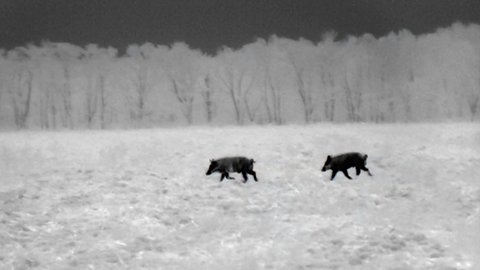
Reach for a thermal monocular any time you plan to move more than you sit — which, for most hunters chasing predators and hogs, is most of the night. If you still-hunt, walk fields, or push from stand to stand, the BlazeTrek 6 at 320 grams rides so light you forget it's there, and it comes up one-handed the instant a shape catches your eye. Its wide 22.8 by 18.3 degree view is the fastest way to sweep ground and lock onto a runner without hunting to reacquire it, and because one hand stays free you can keep a rifle up or a light going the whole time. It is also the lighter on the wallet and the easier to pack way into a real 640-class sensor, so you get serious thermal without the size, weight, or price of a full binocular. Best of all, it's the tool you actually carry — a pocketable scanner gets used every night, while heavier glass tends to stay in the truck. For run-and-gun hunters, the monocular isn't a compromise; it's the right tool.
When to choose a thermal binocular
A thermal binocular makes sense when the hunt keeps you planted and looking far. If you glass a stand or a field edge for an hour at a stretch, two-eye viewing keeps you comfortable and sharp long after one eyepiece would have your eye watering. The Binox-6 also brings the extra reach some ground demands, with 3-24x zoom, 3100 m of detection, and a low 15mK NETD that holds a clean picture through fog and damp air, plus a built-in rangefinder and a day channel that fold several devices into one. If your style is patient, stationary, and long-range, the binocular earns its weight. But note what you give up to get there: pocketability, one-hand speed, and the freedom to keep walking — the very things the monocular is built around.
Our recommendation
For the mobile hunter — the one who covers ground, travels light, and wants serious thermal without the bulk or the price of a binocular — our pick is the ATN BlazeTrek 6. Its 640x512 sensor, wide field of view, and 320-gram, pocketable body make it the fastest, most packable scanner of the two, and it's the one you'll genuinely carry every night. Save the ATN Binox-6 for the times you sit long and reach far, when two-eye comfort, more zoom, longer detection, and a built-in rangefinder are worth the extra weight. Plenty of hunters keep one of each, but if you're buying one and you move a lot, start with the monocular. Compare the full thermal monoculars range against the thermal binoculars range and match one to how you actually hunt.
How we compared them
Both options here are judged on the same measuring stick — image clarity (resolution, NETD), reach (detection range), handling, and battery — all seen through thermal monocular vs binocular. They are both ATN's own current-generation devices, so this is an honest in-house comparison rather than an independent review: the trade-offs and the "when NOT to pick this" calls are spelled out so you can decide for your own situation.
Frequently Asked Questions
What is the main difference between a thermal monocular and a binocular?
A monocular uses one eyepiece, so it is smaller, lighter, cheaper, and faster to bring up one-handed. A binocular uses two eyepieces for steadier viewing over long sessions and usually reaches farther. Both sense heat and find game in the dark the same way; they just fit different hunting styles.
Is a thermal monocular good enough for hunting?
Yes, and for a mobile hunter it's often the better choice. The ATN BlazeTrek 6 has a full 640x512 sensor and a wide field of view that makes catching moving predators and hogs easy, with a 1000 m detection range that covers most practical work. It is a serious hunting tool in a pocket-sized package.
Which is lighter and easier to carry all night?
The monocular, by a wide margin. At 320 grams the BlazeTrek 6 is less than half the weight of the Binox-6 and slides into a chest pocket, so you barely feel it on a long walk. That is the whole point of a one-eye design for the hunter on the move.
Which one scans a field faster?
The monocular, thanks to its wider field of view and one-hand speed. The BlazeTrek 6's 1.5x base opens a wide 22.8 by 18.3 degree view, so it sweeps more ground per pass and gets on a runner faster than a higher-power binocular you have to steady with both hands.
Do they see the same distance?
No. The Binox-6 reaches 3100 m and the BlazeTrek 6 reaches 1000 m, so the binocular sees heat much farther. If most of your scanning happens at practical predator and hog ranges, the monocular's 1000 m is plenty; only long, open-country glassing really needs the binocular's reach.
Should I buy a monocular or a binocular first?
If you move a lot, hunt light, or watch your budget, start with the monocular like the BlazeTrek 6 — it is cheaper, more packable, and the one you'll always have on you. Only if you already know you'll spend long hours planted and glassing distant country does the Binox-6 binocular make a better first buy.
Hunt on the move? The ATN BlazeTrek 6 puts a full 640 sensor and a wide, quick-scanning view into a pocketable 320-gram body you can carry all night and bring up one-handed — the mobile hunter's thermal. If your style is to sit long and reach far, the ATN Binox-6 answers with all-night two-eye glassing and a built-in rangefinder. Browse the full thermal monoculars and thermal binoculars lineups, match the weight and reach to your ground, and head into your next night hunt seeing every warm shape out there.
Created: July 7, 2026 · 08:31:01 UTC