Thermal hog hunting on your own ground is a different job from hunting hogs as a guest, and the difference shows up in how you count success. A guest counts animals on the ground. A landowner counts whether the sounder came back to the same field the following week. This page is the order of operations I would use on my own place: read the damage, plan the approach around it, put the right optic in each hand, work the group rather than the animal. The scope ranking lives elsewhere and I will point you at it.
Hogs are a population problem, not a trophy problem. Removing part of a sounder scatters the rest and teaches them your pattern, so plan each night around taking the whole group — and bring an optic that lets you count the group before you commit.
What eradication actually means on private land
It means removing enough animals, often enough, that reproduction cannot outrun you. Wildlife agencies put the figure at roughly 70 to 75 percent of a local population harvested annually just to hold numbers level, which is why the occasional opportunistic hog off a deer stand changes nothing. It also means accepting that every sounder you break up without finishing has been trained. Hogs shot at in a field at midnight do not stop using the field; they start using it at three in the morning, from a different side, in smaller groups. Partial pressure makes them harder, not fewer.

How a night runs, step by step
Work it in this order and you will stop burning fields.
- Walk the damage in daylight. Fresh rooting, overturned sod, wallows with wet mud on the rim, rub marks on fence posts and trees. Daylight tells you where they feed, how big the group is and which way they come from. Night tells you none of that.
- Pick your approach off the wind, not off the road. Hogs have poor eyesight and an excellent nose. Decide where you will stand before you decide where you park, and park far enough away that a door closing is not part of the plan.
- Glass before you move. Find the group from a distance with a handheld thermal and count it. You want the number of animals, their direction of travel and whether there are pigs small enough to need a second look before you shoot.
- Close to a distance where you can take more than one. Eradication shooting is a volume problem. Set up so a second and third shot are realistic — usually closer than you would choose for a single animal.
- Start with the animal that leads. Groups follow a lead sow. Taking her first tends to confuse the rest for a few seconds, and those seconds are the whole opportunity.
- Work the group, then stop. When the rest clear and are moving hard, let them go. Hunting the same field the next night rarely works; give the ground a week and re-read the damage.
What thermal hog hunting gives a landowner that nothing else does
Detection at a distance, in the dark, without light. A thermal channel reads the temperature difference between an animal and its background, which is why a sounder in standing grass shows up as six distinct heat signatures when a lamp would show you nothing but grass. For a landowner that means three things: you find groups instead of stumbling into them, you count them before you commit, and you check a field from the far fence line rather than walking into it. On the ThOR 6 line, Hot Point Tracking flags the hottest object in the frame, which on a cool, flat pasture is almost always what you came for.
Which optic does which job
- The handheld finds. A thermal monocular such as the ATN BlazeTrek 6 is what you sweep with on foot — one hand, no rifle pointed at anything, wide frame. Scanning and shooting are two jobs and they want two devices.
- The binocular glasses and measures. The ATN Binox-6 Dual 640x512 | 3-24x runs a 640×512 thermal channel at ≤15mK alongside a 3840×2160 4K day/night channel, with a built-in laser rangefinder specified at 1000 m and ±1 m. Two eyes are easier on long observation, and having the range before you move is worth more than any amount of magnification.
- The scope identifies and shoots. This is where resolution earns its money, because at 200 yards you are deciding between a mature sow and a shoat, not just spotting heat.
- Recoil Activated Video settles arguments. On the ThOR 6 scopes, RAV records up to 10 seconds before and after recoil automatically. For a landowner documenting removals, that is a record of every shot without touching a button.
- Palettes are a preference, not a performance setting. ATN publishes six on the ThOR 6 line — White Hot, Black Hot, Iron Red, Alarm, Green Hot and Sepia. Pick the one your eye reads fastest and leave it there.

What to check before you buy a scope for this work
Three things. Field of view, because you are looking for a group and not a single animal: the ThOR 6 640x512 | 2-16x shows 12.52° × 9.41°, while the 3-24x version narrows to 8.78° × 6.59° in exchange for 3650 m of rated detection against 3100 m. Battery, because a landowner's night is long: the full-size ThOR 6 scopes are rated at about nine hours on one internal and one replaceable 18650 cell, and only the second cell comes out, so carry it charged. And recoil rating, because hog rifles get used hard — the ThOR 6 scopes are rated to 6000 Joules in a magnesium alloy housing, IP67, from -30°C to 55°C, with a 5-year warranty behind them. Which model wins on which ground is settled in our ranking of the best thermal scope for hog hunting, and the stand-by-stand tactics for working a feeder are in thermal scope for hog hunting.
Common mistakes on your own ground
The first is hunting the same field every night because that is where the damage is; you will educate the group in a week and spend a season wondering where they went. The second is shooting at the first animal that clears instead of the one leading the group; the rest leave in the time it takes you to reacquire. The third is scanning with the rifle: slower, heavier, and it points a muzzle at everything you are curious about. The fourth is treating zoom as detail: digital zoom here runs 1×, 2×, 4× and 8×, and past a point it only makes a small blob a large blob. Scan low, zoom to confirm. The fifth is skipping the zero check at the start of a season.
The scope I would put on the rifle

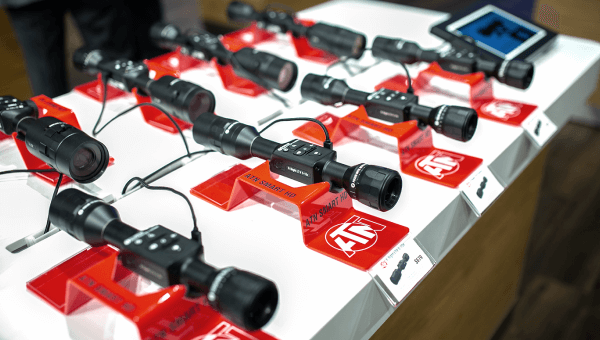
The ATN ThOR 6 640x512 | 2-16x is the one I would mount for group work. It runs a 640×512 12µm VOx uncooled array at 50 Hz with ≤15mK NETD behind a 35 mm germanium objective at F/1.0, giving 12.52° × 9.41° of field of view and 3100 m of rated detection range. Ten reticle styles with transparency control, Zeroing Freeze, Picture-in-Picture, Hot Point Tracking, Recoil Activated Video and 64 GB of internal storage. Magnesium alloy, IP67, 6000 Joules, -30°C to 55°C, 830 g / 1.83 lbs, about nine hours of runtime. It lists at $3,625 with a published promotional price of $2,295. The wide frame is the reason it goes on a hog rifle rather than the 3-24x: when six animals are moving in different directions, width beats reach.
Is thermal worth it for hog control?
If you own the damage, yes, and the arithmetic is unusually simple. A single sounder working a food plot can cost more in a season than the optic does, and lights and bait alone stop working on educated animals faster than thermal does. What thermal will not do is replace persistence: it makes each night more productive, not fewer in number.
Thermal hog hunting: common questions
Is it legal to hunt hogs at night on my own land?
In many states a landowner, or an agent with written permission, may take feral hogs year round at night on private property, often with lights, thermal or night vision devices. Rules differ by state and sometimes by county, so confirm your own regulations before planning a night.
How many hogs do I need to remove to see a difference?
More than most people expect. Agency estimates put annual removal at roughly 70 to 75 percent of the local population just to keep numbers flat, which is why whole-sounder removal matters more than the occasional single animal.
What is the best time of night to hunt hogs?
Whenever the damage says they are feeding, which in hot weather tends to be well after dark and again before first light. Let the rooting and the wallows set your clock, and give a burned field a week before you return.
How far away can a thermal scope spot a hog?
Detection range is a rated figure, not a promise: ATN publishes 3100 m for the ThOR 6 640x512 2-16x and 3650 m for the 3-24x. Detecting heat and identifying the animal are different distances, and identification always comes much closer.
Do I need a thermal binocular as well as a scope?
Not to start, but it changes how you work. Scanning with a handheld or a binocular keeps the rifle down and finds groups sooner; the Binox-6 Dual adds a 1000 m laser rangefinder so you know the distance before you move. We walk through a two-optic night in our field report from the blind.
Will shooting at night push hogs off my property for good?
Rarely. It usually pushes them to different hours and different entry points on the same ground. That is why the plan matters more than the rifle: work whole groups, rotate the fields you pressure, and re-read the damage between outings.
Can I record removals for my own records?
Yes. Recoil Activated Video on the ThOR 6 scopes saves up to 10 seconds before and after each shot automatically to 64 GB of internal storage, with audio, and you can pull the files over USB Type-C or review them in the onboard gallery.
The short version
Read the ground, plan the approach off the wind, count the group before you commit, take the lead animal first, and leave when the rest scatter. Thermal is what makes the counting possible — and counting, not shooting, is the part landowners get wrong. If you are still choosing the optic, start with the hog scope ranking or look at the current ATN thermal scopes and pick the frame width that matches your fields.
Quick spec reference
- Featured optic: ATN ThOR 6 640x512 | 2-16x, SKU TIWST6635A — $3,625 list / $2,295 promotional
- Sensor and optics: 640×512, 12µm VOx uncooled, 50 Hz, ≤15mK NETD; 35 mm (Ge) F/1.0; 12.52° × 9.41°; 3100 m detection
- Longer, narrower sibling: ThOR 6 640x512 | 3-24x (TIWST6650A) — 50 mm (Ge), 8.78° × 6.59°, 3650 m
- Glassing optic: Binox-6 Dual 640x512 | 3-24x (MSBNB6635A) — 640×512 thermal at ≤15mK plus 3840×2160 4K channel, LRF 1000 m / ±1 m, 730 g, ~8 hrs
- Build: magnesium alloy, IP67, 6000 Joules, -30°C to 55°C, 830 g / 1.83 lbs, ~9 hrs on one internal and one replaceable 18650, 5-year warranty