A landowner called me a few years back and did not ask what scope to buy. He asked how many hogs one rifle could realistically put down before sunup. That is the real question behind a thermal scope for hog hunting when the job is not a trophy hunt but damage control — a rooted-up hay field, a fence torn out under a feeder, a neighbor threatening to call the county. Hogs do not thin themselves, and one animal removed from a sounder of twenty barely moves the needle. The tool that matters here is the one that lets you work the whole group in the time you have, not just the one that gets you a clean first shot.
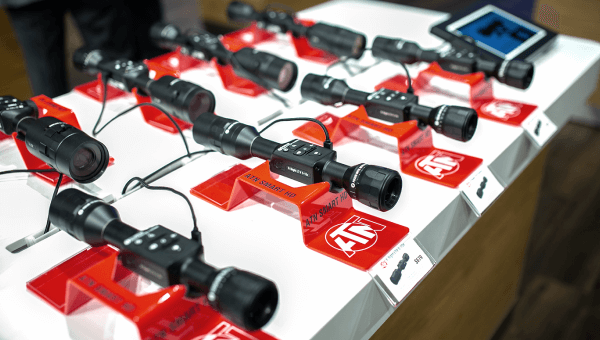
For depredation work the ATN ThOR 6 640×512 3-24x is the scope built for the job: a ≤15mK sensor that keeps individual hogs separable inside a crowded sounder, 3,650 m detection range to find them before they find the crop, and Recoil Activated Video that logs every shot when you are firing fast into a moving group.
Why hog hunting is a different problem than deer hunting
A sounder does not behave like a deer. Hogs travel in family groups of six to thirty, they feed together, and when the first shot goes off the group does not freeze — it scatters in three directions at once, sows first, young ones somewhere behind them. Your scope needs to do two things in the same ten seconds: hold enough resolution to tell a 200-pound sow from a 60-pound shoat in low light, and keep a wide enough view that you do not lose the rest of the group while you settle on one.
This is where NETD — Noise Equivalent Temperature Difference — matters more on hogs than on almost any other North American game animal. It is the measurement of how small a temperature difference the sensor can resolve, and a tight sounder is a wall of overlapping heat signatures pressed close together. A ≤15mK sensor keeps those bodies visually separate; a noisier one blurs them into a single warm shape, and a single warm shape is not a target you can ethically shoot into. Every ThOR 6 in the 640 and 384 lines runs ≤15mK on a 12μm sensor for exactly this reason.

Feeder work against open field: two different fights
The scope you want changes with where the hogs are working. Over a feeder, hogs come in tight and close — usually under 100 yards, often under 50 — and the fight is about magnification you do not need and light discipline you do. A wide field of view at low base magnification lets you keep the whole feeder pad in frame as animals shift in and out of the corn pile, rather than fighting a narrow tunnel of zoom to find them again after every shot.
A field is the opposite problem. Hogs working a hayfield or a planted crop can be anywhere across sixty acres, moving as a loose line rather than a tight cluster, and the shots that present are longer and less predictable. That is where the 3-24× range and 3,650 m detection of the 640 earn their keep — you need to find the group at distance first, then close the magnification gap once you commit to a shot. A scope built for close feeder work will get you there slower, and slower is the difference between two hogs down and eight.
Reading the sounder: sow, boar, or shoat
Identification, not detection, is where most cull hunts actually go wrong. Thermal shows you heat, not size directly — a shoat close to the lens can throw off the same amount of signal as a mature sow further back, and a sounder in motion does not hold still long enough for a careful size comparison. This is exactly the situation SharpIR is built for: it sharpens edges and boosts contrast on the live image in real time, so body outlines stay distinct enough to judge relative size and posture even as three or four animals cross paths in the frame.
Hot Point Tracking helps here too — it flags the hottest object in your field of view without you hunting for it, which matters when a sounder is spread wide and you need to decide where to look first. And Picture-in-Picture keeps a wide window live while you zoom in on one animal, so committing to a shot on the biggest hog in the group does not mean losing track of where the rest of the sounder went.

The series of shots, not the first one
On deer, most nights end after one shot. On hogs, the first shot is the start of the work, not the end of it. A sounder that scatters after the initial report will often re-group or slow down within thirty to sixty seconds if you stay still — long enough for a second and third shot if your scope keeps you oriented. This is where the ThOR 6's 8× digital zoom and step-and-smooth zoom function matter in a way they do not on a single-target hunt: you need to move between a wider view to reacquire the group and a tighter one to place the next shot, quickly, without losing your position behind the rifle.
Every ThOR 6 also runs Recoil Activated Video, recording 10 seconds before and after every trigger pull automatically to the 64 GB of internal storage. On a five-shot night into a moving sounder, that is not a nice-to-have — it is how you settle, after the fact, exactly which hog went down on which shot, information that matters when you are reporting numbers to a landowner or documenting depredation activity.
What a real night of herd reduction looks like
The math that gets landowners' attention is this: a sounder can double in size in under a year, and removing anything less than 60 to 70 percent of a local population in a season typically does not reduce the group by the next one. That is not a one-rifle, one-night problem — it is why cull work on working land is repeated, methodical, and unglamorous. A single ThOR 6 640 3-24x, run over several nights on a rotating feeder and field pattern, with RAV logging every shot for a count, is a more realistic tool for that job than any single trophy-hunt setup.
The pattern that works is simple and repeats itself: start the night on the feeder, where hogs commit early and the shots are close, then move to the field edges later once the feeder traffic thins out and the rest of the sounder is working the crop line instead. A scope that covers both jobs without a lens change is what makes that pattern practical instead of theoretical — you are not packing two rifles or swapping optics at midnight, you are working one setup across the whole property.
Two things make repeated nights sustainable rather than exhausting. First, battery life: two 18650 cells, one swappable, give the full-size 640 roughly 9 hours, enough for a full night on the feeder without a mid-sit battery change. Second, the IP67-sealed magnesium housing and -30°C to 55°C operating range mean the scope performs the same in a July heat-soaked field as it does on a January cold front, which matters when your hog problem does not pause for the seasons either.
There is also a documentation side to this that gets overlooked until someone asks for it. Landowners tracking damage for insurance or county assistance programs need a real count, not an estimate from memory the next morning. RAV footage stamped with time and saved automatically to 64 GB of internal storage is the difference between "we got a bunch" and a night-by-night record you can actually hand someone.

What to look for in a scope built for this job
Four things matter more here than in most other hunting scenarios.
- Sensor resolution and NETD together. Resolution alone does not separate a crowded sounder; you need ≤15mK or better to keep bodies distinct at close range.
- A magnification range that covers both feeder and field. A 3-24× scope handles close feeder work at the low end and a distant field edge at the top end without switching optics.
- Automatic shot documentation. RAV or an equivalent recording feature turns a chaotic multi-shot night into a reviewable, countable record.
- Enough battery for a full sit. Culling is not a thirty-minute hunt; a scope that dies at hour five is a scope that cuts your night short at the worst time.
The full ThOR 6 lineup, along with the rest of our specs and mounting details, is on the thermal scopes page. If you are choosing between models rather than committing to the flagship, our ranking of the best thermal scopes for hog hunting breaks down the full lineup by budget and use case.
FAQ
What is the best thermal scope for hog hunting damage control?
The ATN ThOR 6 640×512 3-24x, because its ≤15mK sensor keeps individual hogs distinct inside a crowded sounder and its 3-24× range covers both close feeder work and longer field shots in the same setup, which matters when the goal is removing as many animals as possible in one night.
How many hogs can you realistically shoot in one night?
It depends heavily on sounder size and terrain, but a scope that lets you reacquire the group quickly after each shot — wide field of view, fast digital zoom, Hot Point Tracking — is what determines whether you get two hogs or six out of the same sounder.
Do I need a different scope for feeder hunting versus field hunting?
Not necessarily one scope model, but a different magnification strategy. Feeder work favors keeping the base magnification low and the field of view wide; field work rewards a scope with real reach at the top end, like the 640's 24× top magnification.
Why is it hard to tell hogs apart in a thermal sounder view?
Thermal imaging shows heat, not physical size directly, and a tight group of overlapping bodies can blur together on a lower-sensitivity sensor. A ≤15mK NETD rating and SharpIR image enhancement both work to keep individual animal outlines distinct so you can judge size and make an ethical shot decision.
Can a thermal scope handle several fast shots into a group?
Yes. Every ThOR 6 is rated to 6,000 joules of recoil, well beyond what standard hog cartridges produce, and Recoil Activated Video automatically records each shot so you have a reviewable record when several rounds go out in quick succession.
How much crop damage do hogs actually cause?
Damage varies by property, but a rooting sounder can tear up a field overnight and a population left unchecked tends to grow faster than casual hunting removes it — which is why landowners doing depredation work usually plan for repeated nights rather than a single hunt.
What color palette works best for identifying hogs in a group?
White Hot and Black Hot both work; the better choice depends on ground temperature. On a warm night when the dirt holds heat, Black Hot often keeps individual hogs more distinct from each other and from the background than White Hot does.
Where to start
If the job in front of you is population control rather than a single hunt, put the ThOR 6 640×512 3-24x on the rifle you already trust and plan for more than one night. It is the setup that keeps a moving sounder readable, lets you re-engage fast after the first shot, and logs the count automatically so you know what you actually got done. Compare the full lineup on our thermal scope page, and if you want model-by-model picks by budget, see our best thermal scopes for hog hunting guide. The hogs will be back in that field tomorrow night either way — go make sure there are fewer of them.