The best value thermal scope is not the cheapest one — it's the one that gives you the most capability for what you pay. By that measure the winner is the ATN ThOR 6 384x288. It sits in the mid tier but carries flagship-grade sensitivity, a full 6th-gen feature set and a rugged waterproof build, so you're not paying flagship money for the parts that matter most. Value is about where the money lands, and on this scope it lands on the sensor, the sensitivity and the durability rather than on extras. Here's how it earns the value crown, with the lighter Mini as the budget alternative.
The best value thermal scope is the ATN ThOR 6 384x288. It packs flagship-grade <=15mK sensitivity, a 50 Hz refresh, a 384x288 sensor, a Full-HD display and IP67 waterproofing into a mid-tier price. You get the features that actually change your hunt without paying for a 640 sensor you may not need — the most scope per tier of spend in the line.
Quick answerBest value overall: ATN ThOR 6 384x288 — flagship features at a mid-tier price.
Best budget alternative: ATN ThOR 6 Mini 384x288 — same sensor, lighter, cheaper.
Best sensitivity for the money: the ThOR 6 384 at <=15mK.
Best all-weather value: IP67 waterproofing and ~9 hour battery on the ThOR 6 384.
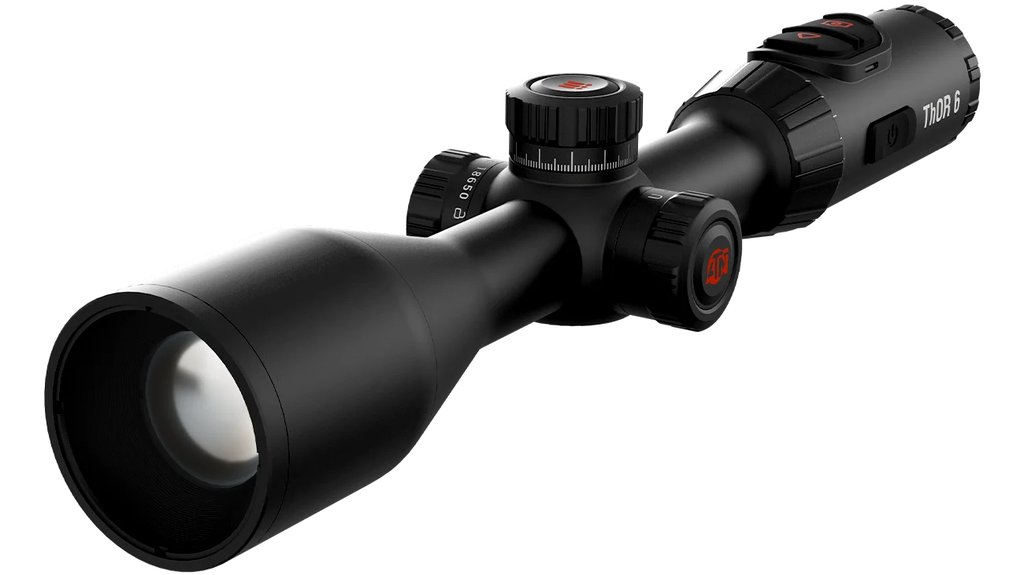
Why ATN's 6th-gen ThOR 6 384 delivers the most per tier of spend
Value comes from spending on what changes your hunt and skipping what doesn't. The ThOR 6 384x288 is built around that idea. It runs the same tight <=15mK NETD sensitivity as the flagship 640 scopes, which is the single spec that most affects picture quality in fog, humidity and rain — and it's the hardest thing to fake with a cheaper build. It keeps the full 6th-gen feature set too: SharpIR AI sharpening, a 50 Hz refresh, a Full-HD 1920x1080 OLED display, Picture-in-Picture, Hot Point Tracking, Recoil Activated Video and IP67 waterproofing. Where it saves you money is the sensor resolution — 384x288 instead of 640x512 — and that's a corner most hunters can cut without pain, because a 384 core still holds an animal's shape at practical hunting distances. You're paying mid-tier and getting flagship sensitivity, flagship features and flagship durability. That's the definition of value.
There's a second half to the value story that's easy to miss: what you're not forced to pay for. A 640 sensor and a bigger lens add real cost, and they're the right call for a dedicated long-range shooter. But if most of your shots land inside a few hundred yards, that extra resolution and reach sit unused while you carry the price. The ThOR 6 384 lets you skip that premium without giving up the specs that shape every night afield. That's the balance that earns it the value crown.
It helps to break down where the money actually goes on a scope like this. Two costs pull the price of any thermal optic up hard: the microbolometer resolution and the tightness of the NETD sensitivity. Those are the two most expensive things to build into a sensor, and most makers treat one of them as the place to save. The ThOR 6 384 chooses the smarter cut — it holds the expensive <=15mK sensitivity and trims the resolution to 384x288 instead. That matters because sensitivity is fixed at manufacture and can never be improved by a firmware update, while a 384 core, paired with SharpIR AI processing, still resolves an animal's outline cleanly at the distances most hunters ever take a shot. In other words, the scope spends your money on the part you'd never be able to add later and saves it on the part you can most afford to have a little less of.
That thinking runs right through the feature list, too. The 50 Hz refresh rate is a quiet example. Refresh rate is how many times per second the display redraws the scene, and 50 Hz means the picture updates fifty times a second. On a cheaper scope that runs slower, a walking coyote smears and lags behind where it really is, which makes a moving shot a guess. At 50 Hz the animal stays crisp as it crosses, your reticle tracks true, and a panning sweep of a field doesn't turn to mush. It's the kind of spec you don't notice when it's right and can't stop noticing when it's wrong — and paying to keep it is squarely in the value bracket.
The Full-HD 1920x1080 OLED display is part of why the value holds up in the field, and it's easy to overlook. A sensor can only show you as much as the screen can render, so a coarse display quietly throws away the detail the sensor worked to capture. The ThOR 6 384 uses a Full-HD OLED, which means the clean signal off the sensor reaches your eye with its detail intact, and OLED in particular gives deep, true blacks — exactly what you want when a warm animal needs to stand out against a dark, cool background. Contrast is the whole game in thermal, and a good display protects the contrast the sensor and SharpIR built. Getting that grade of screen at this tier is another quiet piece of the value: the picture you paid for actually reaches you.
Best value overall: ATN ThOR 6 384x288
The ATN ThOR 6 384x288 is the scope that gives you the least to regret at its price. Its <=15mK sensitivity matches the flagship, so the picture stays clean when the weather doesn't — and clean contrast is what actually helps you find and identify game. The 25mm F/1.0 lens and 384 sensor reach a 2300m detection range, the 50 Hz refresh keeps movement smooth, and dual 18650 batteries deliver around 9 hours. The 2.5-20x zoom covers everything from close cover to field-edge shots.
The 25mm F/1.0 lens deserves a closer look, because it's doing a lot of the heavy lifting on reach. The F/1.0 aperture is wide, which means the lens gathers as much of the scene's heat signal as it can — a brighter, more usable image before any processing even happens. Paired with the 384 sensor, that lens is what pushes the 2300m detection range. It's worth being clear about what a detection figure means, though: 2300m is the distance at which the scope can register that something warm is out there, not the distance at which you'd identify it as a hog rather than a deer, and certainly not an ethical shooting range. What it tells you in practice is that this scope has huge headroom for the ranges you actually hunt. Out to a few hundred yards, where the vast majority of thermal shots happen, you're using a fraction of the scope's capability, which is exactly why the picture stays confident and clean there.
Flagship sensitivity without flagship price
The reason this scope feels like more than its tier is the <=15mK NETD. Sensitivity is where cheap thermal shows its cracks — a noisy, washed-out picture on a damp night. The ThOR 6 384 refuses to cut that corner, so you get flagship-clean contrast while paying mid-tier. That single choice is most of the value story, because sensitivity is the one spec you can't paper over with software later.
The zoom range you actually use
The 2.5-20x magnification is another spot where the ThOR 6 384 is honest about how hunting really works. That range starts wide at 2.5x, which is what you want when you're scanning — a broad field of view lets you sweep a field or a tree line quickly and pick up movement without tunnel vision. When you find something, you zoom in toward the top of the range to confirm what it is and place the shot. Most real hunting lives in the lower-to-middle part of that band, and the ThOR 6 384 gives you the full useful spread rather than a narrow window. It's worth understanding the difference between the optical base and digital zoom on any thermal scope: pushing digital zoom too hard on any sensor eventually turns pixels into blocks, which is exactly why the sensor and SharpIR matter so much — they decide how far you can zoom before the picture falls apart. On this scope the clean sensitivity and AI sharpening let the usable end of that 2.5-20x range stay genuinely usable, so the zoom on the box is zoom you can actually shoot with, not just a number.
How SharpIR turns a mid-tier sensor into a sharper picture
SharpIR is ATN's AI image processing, and it's a big reason a 384 sensor punches above its pixel count. A thermal sensor hands the electronics a raw, slightly soft heat map — the physics of infrared detection always adds a little noise and blur. SharpIR reads that raw signal and cleans it up on the fly: it lifts edges so an animal's outline separates from the brush behind it, damps down the random speckle that makes a cheap picture look grainy, and holds detail as you zoom in. The result is that the ThOR 6 384 looks tighter and more defined than its raw resolution alone would suggest, which is precisely how you get a mid-tier core delivering an image that reads clearly at real hunting distances. It's the software half of the value equation — the hardware holds the expensive sensitivity, the processing makes the resolution work harder.
A full feature set, nothing paywalled
Value also means not being nickel-and-dimed for the tools you use every hunt. The ThOR 6 384 includes all of it as standard: six color palettes to match your background, Picture-in-Picture for a zoomed aiming window, Hot Point Tracking to follow a moving animal, Recoil Activated Video to record your shots, Zeroing Freeze for painless sight-in, plus Wi-Fi to the ATN Connect 6 app and 64 GB of storage. On a mid-tier scope, getting the flagship's whole toolkit is a big part of why it feels like more than you paid.
Some of those features earn their keep in ways you only appreciate after a season with the scope. The six color palettes let you swap between White Hot, Black Hot and Iron and the others to match the ground you're on — Black Hot reads well against a cool open field, while another palette might separate a warm animal from warm brush better on a mild night. Picture-in-Picture drops a small magnified window into the corner so you can hold a wide view of the field while lining up a precise aiming point, which means you don't lose the animal's surroundings the instant you zoom. Hot Point Tracking locks onto the warmest object and keeps a marker on it as it moves, so a coyote trotting along a tree line stays flagged even when it briefly drops behind cover. None of these are extras you unlock later — they ship in the box, and on a scope at this tier that completeness is a real slice of the value.
Made for the whole night
Battery is one of the quietest value features on this scope, and the way ATN handles it matters. The ThOR 6 384 runs on dual replaceable 18650 batteries for around 9 hours. The word that earns its keep there is replaceable. Plenty of scopes seal the battery inside the body, and when it drains at two in the morning your hunt is over until you can get back to a charger. The ThOR 6 384's cells swap out in seconds — carry a charged pair in a pocket and you effectively have an all-nighter and then some, without ever plugging in. Two cells also spread the load, which is where the roughly 9-hour figure comes from versus the single-cell Mini's roughly 7. Over years of use, replaceable 18650s are cheap and easy to source and replace as they age, so you're not tied to a proprietary pack you can't renew. That's runtime as a value feature, not just a number on a spec sheet.
Built to last the investment
A value scope that dies in a rainstorm isn't a value at all. The ThOR 6 384 carries an IP67 waterproof rating, which is a sealed rating against dust and against water — it's built to shrug off rain, heavy dew and a knock into wet grass without letting moisture into the electronics. That matters more than it sounds, because thermal hunting happens in exactly the conditions that kill unsealed optics: cold, damp, foggy nights when the animals move. A scope you have to baby indoors at the first drizzle isn't protecting your investment; one you can leave mounted through a wet season is. Combined with the swappable batteries and the rugged build, the IP67 rating is what keeps this scope earning season after season, which is where its value really compounds.
App, storage and reviewing the shot
The after-the-shot side of the ThOR 6 384 is part of the value too. Recoil Activated Video means the scope senses the recoil pulse and automatically saves a clip of the shot — you don't have to remember to hit record in the heat of the moment, and you end the night with footage of exactly what happened. That's worth real money to anyone verifying a clean hit, reviewing a miss, or just keeping a record of the season. It all lands on 64 GB of onboard storage, which holds a large stack of clips and stills before you ever need to clear it. Built-in Wi-Fi connects to the ATN Connect 6 app, so you can pull footage off the scope, tweak settings, or stream the view to a phone without any cabling. Zeroing Freeze rounds it out at the range: it freezes the reticle where your shot landed so you can adjust to it at your own pace instead of chasing a live picture, which turns sighting-in from a fiddly chore into a quick, few-round job. None of these cost extra — they're standard, and they save you time and effort every time you use the scope.
Who it's for and who it's not
It's for the hunter who wants a scope that does everything well and refuses to overpay for resolution they won't use. It's not for someone who regularly shoots wide-open ground at the longest ranges — that hunter should invest in a 640 sensor and accept the higher price. For value-minded all-round hunting, this is the sweet spot.
A cold, wet night at the field edge
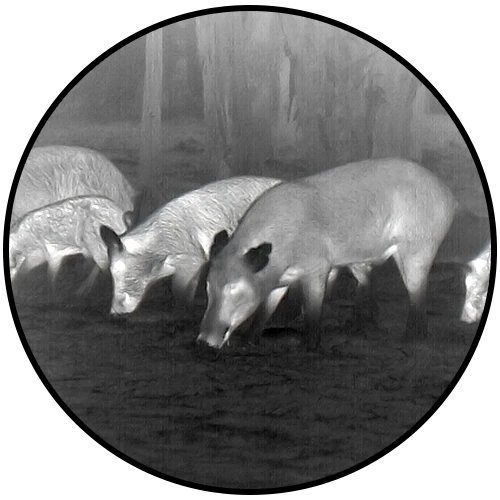
Picture the kind of night this scope was made for. It's cold, there's a fine drizzle hanging in the air, and you're set up at the edge of a field where the hogs have been rooting. That damp, heavy air is the exact condition that turns a cheap thermal picture to grey mush — moisture scatters the heat signal and washes out contrast. This is where the <=15mK sensitivity earns its place: a warm hog steps out of the tree line inside a few hundred yards and it reads as a clean, solid shape against the cooler grass, not a vague smudge you have to squint at. The 384 sensor with SharpIR holds that outline sharply enough to be sure of what you're looking at and where to place the shot. The 50 Hz refresh keeps it crisp as it moves and roots, Hot Point Tracking flags it if it drifts toward the trees, and Recoil Activated Video quietly banks the clip when you take the shot. The IP67 rating means the drizzle is a non-event. Nothing about that night needed a 640 sensor or a longer lens — a well-built 384 with flagship sensitivity was plenty, which is the whole argument for it being the value pick.
Best budget alternative: ATN ThOR 6 Mini 384x288
If you want to spend even less and carry even lighter, the ATN ThOR 6 Mini 384x288 is the budget alternative. It uses the same 384x288 sensor and 50 Hz refresh, plus the full 6th-gen feature set, in a magnesium body under 500 g. It's the lightest way into a current-generation ATN scope.
Same sensor, lighter carry
The Mini isn't a downgrade in picture terms — it shares the 384x288 sensor, the 50 Hz refresh, the Full-HD 1920x1080 OLED display and the same feature toolkit. What it buys you is weight: under 500 g on the rail, versus 790 g for the full ThOR 6 384. That difference sounds small on paper, but on the front of a rifle it changes how the whole gun handles — the balance stays neutral, the muzzle comes up faster, and a long night of walking and glassing is a lot less tiring on the arms and shoulders. For a hunter building a light, fast-handling rig, a youth or smaller-framed shooter, or anyone who covers a lot of ground on foot rather than sitting a stand, that weight saving is a real, everyday benefit and a legitimate second value pick. You keep the same clean 384 picture and the same feature list; you just carry less of it.
The trade against the value pick
The Mini steps down to <=18mK sensitivity, uses a smaller compact lens and a single 18650 battery for around 7 hours instead of nine. In plain terms, its picture is slightly less refined in the worst weather and it doesn't carry the IP67 rating of the full ThOR 6 384. But it costs less and weighs less. Who it's not for: hunters who want the cleanest possible image on the foggiest nights — that's the value-crown ThOR 6 384.
It's worth being clear about what the jump from <=15mK to <=18mK actually means, because on paper it looks tiny. NETD is measured in millikelvin, and a lower number means the sensor can tell apart smaller temperature differences — it sees finer detail in the heat scene. On a clear, cool night both scopes look great, and you'd struggle to tell them apart. The gap only opens up in the hardest conditions: thick fog, heavy humidity, warm still air where everything is close to the same temperature and contrast collapses. There the tighter <=15mK of the full ThOR 6 384 holds a cleaner picture and the Mini's <=18mK shows its limit sooner. If you mostly hunt fair nights and want the lightest current-gen ATN scope, the Mini is a genuinely smart buy. If your best hunting happens in the worst weather, pay the small step up for the full ThOR 6 384. Either way you're getting the same 384 sensor and the same feature set — the choice is about weather and battery, not about a different-class scope.
Where the 384 and 640 lines really diverge
It's fair to ask, if the ThOR 6 384 and a 640 scope share so much, where the extra money on the flagship actually goes. The honest answer is resolution and reach for identification. A 640x512 sensor packs far more pixels into the same scene, so an animal at long range fills more of them and stays identifiable further out — you can tell a hog from a coyote at a greater distance, and you have more picture to zoom into before detail runs out. For a hunter who lives at the far edge of the field on wide-open ground, that's worth paying for. But for the more common style of hunting — moving through cover, taking shots inside a few hundred yards, working fields and creek bottoms — the 384 sensor already resolves everything you need, and the shared <=15mK sensitivity means the picture quality in bad weather is the same. That's the crux of the value case: you're only leaving behind the reach you weren't going to use, while keeping every spec that shapes the hunts you actually take.
How to judge value in a thermal scope
Value isn't the low price — it's the ratio of what matters to what you pay. The trap that costs hunters money is buying on the wrong spec: a big magnification number on the box, or the lowest sticker in the case, both of which tell you almost nothing about how the scope actually performs on a dark, damp night. A cheap scope with a soft, noisy sensor and a slow refresh will disappoint on every hunt no matter how high its zoom claims to go. Spend where it counts and trade where it doesn't. Weigh these in order:
- NETD sensitivity first — it's the spec cheap scopes fake and the one that most affects real picture quality in bad air. Paying for <=15mK is money well spent.
- Refresh rate — 50 Hz keeps moving game smooth. It's not worth saving money by dropping below it.
- Sensor resolution — this is the safest corner to cut for value. A 384x288 core covers most hunting; step to 640 only if you truly shoot long every night.
- Build and battery — IP67 waterproofing and ~9 hours of runtime protect your investment across wet, long nights. Cheaper scopes often skimp here.
- Feature set — SharpIR AI sharpening, Recoil Activated Video and a Full-HD display come standard on the ThOR 6 384, so you're not paying extra to unlock them.
How we picked these ATN value thermal scopes
We ranked only ATN's current 6th-gen ThOR line by value — capability delivered against tier, not lowest sticker. Older and discontinued models were left out on purpose, because value only means something when the underlying technology is current. The specs we weighed hardest were NETD sensitivity, refresh rate and build quality, because those are the ones cheap thermal cuts and the ones you can't upgrade later; resolution we treated as the fair corner to trade down, since a 384 core backed by SharpIR still holds an animal's shape at the distances most hunting actually happens. We also gave real weight to the practical stuff that shows up over a season — swappable 18650 batteries you can renew, IP67 sealing, and a feature set that ships complete rather than paywalled — because those are what let a scope keep earning rather than becoming a repair bill.
The honest trade-off is reach and outright resolution. The value pick is a 384 sensor, so a dedicated long-range shooter who takes most of their shots across wide-open ground at the far end of the night will genuinely get more from a pricier 640. That's not a knock on the ThOR 6 384 — it's just being straight about who each scope is for. This is an in-house comparison of ATN's own range, not an independent lab review, so treat it as a map of where ATN puts value across its own line rather than a cross-brand verdict. Weigh the <=15mK sensitivity, the 2300m detection headroom and the 2.5-20x zoom against how far, in what weather, and how far on foot you actually hunt, and buy the one that fits your nights. Who it's not for: buyers whose only priority is shaving the price to the bone — they should look at the lighter Mini and accept its <=18mK sensitivity and shorter battery as the cost of the saving.
Frequently Asked Questions
What is the best value thermal scope?
The ATN ThOR 6 384x288 is the best value thermal scope. It delivers flagship-grade <=15mK sensitivity, a 50 Hz refresh, a Full-HD display and IP67 waterproofing at a mid-tier price, so your money lands on the features that matter most.
Why is the ThOR 6 384 better value than a 640 scope?
It keeps the flagship's sensitivity, refresh rate and full feature set, and only steps down in sensor resolution to a 384x288 core. For most hunting, that resolution is plenty, so you avoid paying a premium for pixels you may not need.
Does a value thermal scope mean lower quality?
Not here. Value means capability per tier of spend, not cut quality. The ThOR 6 384 refuses to cut the specs that most affect performance — sensitivity, refresh rate and build — and only saves you money on resolution.
What's the difference between the ThOR 6 384 and the Mini?
They share the same 384x288 sensor and feature set. The Mini is lighter (under 500 g) and cheaper but steps down to <=18mK sensitivity, a single battery for around 7 hours, and no IP67 rating; the ThOR 6 384 adds tighter sensitivity, dual batteries for ~9 hours and waterproofing.
Is <=15mK sensitivity worth paying for?
Yes. NETD sensitivity is what keeps a thermal picture clean in fog, humidity and rain, and it's the spec cheaper scopes tend to compromise. The ThOR 6 384 gives you flagship-level <=15mK at a mid-tier price, which is most of its value.
Is the ATN ThOR 6 384 waterproof?
Yes, it carries an IP67 rating, so it stands up to rain and wet field use. Combined with around 9 hours of battery, that durability is part of why it holds its value over a long hunting life.
How does SharpIR help a mid-tier 384 sensor?
SharpIR is ATN's AI image processing. It reads the raw signal off the 384x288 sensor, lifts the edges so an animal separates from the background, and damps the random noise that makes cheap thermal look grainy. The result is a picture that looks sharper and more defined than the raw resolution alone, which is a big reason the 384 sensor reads clearly at real hunting distances and holds its value.
Does the ThOR 6 384 record video?
Yes. Recoil Activated Video automatically saves a clip when it senses the shot, so you don't have to remember to hit record, and footage lands on 64 GB of onboard storage. Built-in Wi-Fi connects to the ATN Connect 6 app so you can pull clips off the scope or stream the view to a phone — all standard, at no extra cost.
Want the most scope for your money? The ATN ThOR 6 384x288 puts flagship sensitivity and a full feature set at a mid-tier price, while the lighter Mini stretches the budget even further. Compare the value pick against the rest of the range on the ATN thermal scopes page, weigh the sensitivity and build against your nights afield, and pick the ThOR that gives you the least to regret.
Created: July 7, 2026 · 14:32:46 UTC