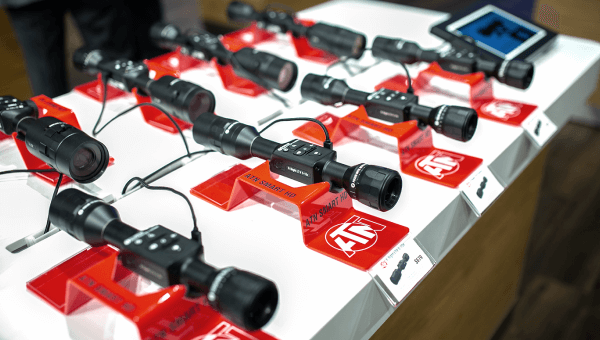
A white hot thermal scope shows warm bodies as bright white against a dark background, and how well that reads changes with the season more than most hunters expect. A hog on a muggy August night and a coyote on a hard January morning throw very different heat against very different ground, and the same White Hot picture can look razor-sharp in one and washed-flat in the other. So this roundup sorts the ATN ThOR 6 line by season: warm summer hog nights, cold fall-and-winter predator hunts, and the quiet off-season pest work in between. Find the season you hunt most, and your pick is already waiting there.
Across every season, the ATN ThOR 6 640x512 3-24x is the best overall white hot thermal scope. Its 640 sensor keeps a bright, clean White Hot image whether a hog glows on warm summer ground or a coyote reads against frozen fields, and the long reach covers open winter shots. For close off-season pest work at a friendlier tier, the 384 holds a sharp White Hot picture and adds extra palettes.
Quick answerBest overall / all seasons: ATN ThOR 6 640x512 3-24x — the flagship, with the crispest White Hot image and the longest reach for cold, open winter nights.
Best for warm summer hog nights: ATN ThOR 6 640x512 2-16x — the same 640 sensor, a wider low end for close cover, and a swappable battery for long humid outings.
Best off-season / value: ATN ThOR 6 384x288 2.5-20x — light, sharp in White Hot up close, six color palettes, at the friendliest tier.
Why ATN's 6th-gen thermal scopes lead this list
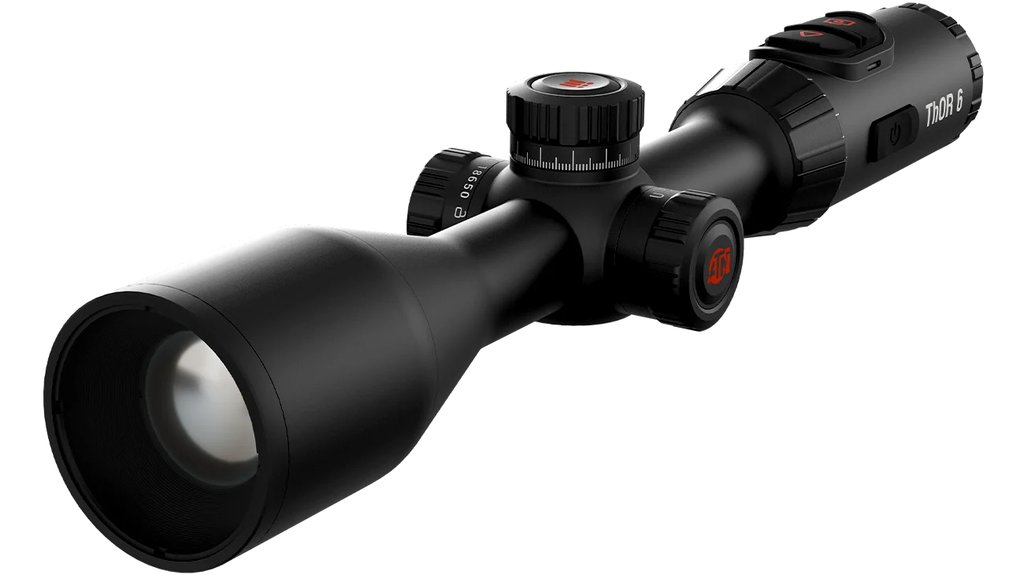
ATN's 6th-generation ThOR line leads this list because every model rides the same modern core, so season becomes the real decision instead of the hardware. All three scopes share a low-noise thermal sensor rated at 15 mK or better, SharpIR AI image processing, and a full-HD OLED display that renders White Hot as a crisp, bright picture instead of a grainy grey smear. A NETD figure of 15 mK simply means the sensor reads very small heat differences, and in White Hot that reads as high contrast: a warm animal snaps off cool ground in clean white rather than blurring into it. That contrast is exactly what the White Hot palette lives on, and it matters most in the tough seasons when heat differences shrink. Bolt that to the features you use on a rifle every night — Recoil Activated Video that records on the shot, Zeroing Freeze to hold the reticle while you dial, Hot Point Tracking, Picture-in-Picture, 8x digital zoom, and Wi-Fi with ATN Connect 6 — and the platform is identical across the board. What changes between them is sensor resolution, magnification band, and reach, and those line up neatly with the season you hunt.
ATN ThOR 6 640x512 3-24x - best overall for cold-season hunting
The ATN ThOR 6 640x512 3-24x is the best white hot thermal scope for cold fall and winter hunting because it keeps a bright, clean image when heat is easy to see but far away. On a hard freeze a coyote's body dumps heat against ground that has given all of its up, so the White Hot contrast is huge — the trouble is distance, since predators hang up out in the open and won't close. The 640x512 sensor is what turns that far white glow into a shape you can trust. Picture the jump from a coarse printed image to a fine one: more pixels means a coyote at 300 yards holds its true outline in White Hot instead of dissolving into a bright blob you can't confirm.
Reach for open winter fields
Reach is where this model owns the cold-season slot. A detection range out to 3650 meters paired with the 3-24x band lets you sweep a frozen field at 3x, catch a White Hot signature at the far edge, then zoom in to confirm it before you commit. Detection range is only how far off you can pick up heat, not how far you should shoot, but the practical result is that nothing crosses that winter field without lighting up white first. The 50mm F/1.0 lens gathers enough thermal energy to keep that distant White Hot image bright and usable rather than dim and mushy at range.
The White Hot image cold nights demand
In cold months the contrast is generous but you often get one honest look at a wary predator, and the 640 sensor with SharpIR AI makes that look count. In White Hot, edges stay defined, a standing coyote keeps its shape, and the picture holds when a warm body drifts across frozen dirt. The 8x digital zoom stacks on the optical range for the last push out, and Picture-in-Picture floats a magnified aiming window while you keep the wider field in view — handy when a second dog circles downwind of the first.
A January stand
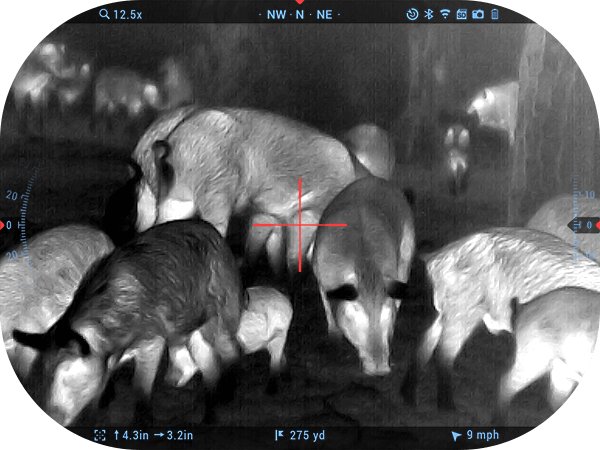
Put it on real ground. It's twelve degrees before dawn, a picked field runs 400 yards out to a shelterbelt, and you're on the call working a pair of coyotes that answered but won't cross the open. You glass at 3x in White Hot, wide enough to hold the whole field edge, and two bright shapes pop against the frozen stubble. Because the 640 sensor resolves shape at that distance, you can read that it's the pair you called and not a fox trotting the fence, so you stay patient. One finally commits to 180 yards; you zoom to 12x and SharpIR holds its white outline crisp against the cold ground while you settle the reticle. Spot wide, identify long, confirm on the zoom — that sequence is exactly what the 640 sensor and the 3-24x band were built for, and it's why cold-weather predator hunters bolt this one on and leave it.
Who it's for: hunters chasing predators across open winter country, cut fields, and any ground where White Hot shows heat clearly but the animal sits far out and must be identified before the shot. Who it's not for: the summer hog hunter working thick close cover who wants the lightest, most affordable rig — the reach and top-end magnification just sit unused inside 80 yards. Mount it up from the ATN ThOR 6 640 3-24x product page.
ATN ThOR 6 640x512 2-16x - best for warm summer hog nights
The ATN ThOR 6 640x512 2-16x is the best white hot thermal scope for warm summer hog hunting, when the ground itself is hot and the contrast the palette needs gets harder to find. On a sticky July night sun-baked dirt, warm rocks, and heated brush all glow, so a White Hot picture can get busy — and the 640 sensor is exactly what cuts a hog cleanly out of that warm clutter. It keeps the flagship's resolution but trades top-end magnification for a wider 2x base, and that wide view is the whole point when hogs bust out of cover at close range in the dark.
White Hot that still separates hog from warm ground
You get the same 640x512 detail as the flagship, so in summer's poor contrast a hog still reads as a solid white body instead of merging into warm surroundings. What changes is the 35mm lens and 3100-meter detection figure, both a small step down from the flagship. At the ranges summer hog hunters actually shoot, that gap never shows. What you gain is a magnification band that spends most of its time in the close-to-mid range where hogs appear, so the scope feels quick when a sounder pours out of a treeline 60 yards off and you need the wide view to sort the group in White Hot.
Built to last a long humid night
This model carries the replaceable 18650 battery system, a quiet feature that saves the long summer nights when hogs don't move until well after dark and you're out past midnight waiting. Roughly nine hours covers most outings, but when a cell runs low you swap it and keep hunting instead of driving home. Recoil Activated Video records every shot on its own, so the fast, close chaos of a hog encounter is on file without you fumbling a button in the dark — and in White Hot the replay is bright and easy to read back.
Who it's for: the summer hog hunter working fields, feeders, and brushy edges through warm nights, who wants a wide White Hot view up close and the 640 detail to sort animals out of warm summer ground. Who it's not for: the long-range winter specialist who lives on open frozen fields and wants every last bit of reach; that's the 3-24x flagship's job.
ATN ThOR 6 384x288 2.5-20x - best for off-season pest and value
The ATN ThOR 6 384x288 2.5-20x is the best white hot thermal scope for quiet off-season pest control, and it brings the whole 6th-gen feature set at the most approachable tier. Off-season work is close and casual — a groundhog in the garden, raccoons at the feed shed, hogs rooting the food plot in the green months — so you rarely reach far. The 384x288 sensor has fewer pixels than the 640 models, so think of it as a lower-resolution camera: the White Hot image is still genuinely sharp and more than enough to identify pests inside a few hundred yards, which is nearly every off-season shot; it just won't hold fine detail at the far ragged edge of its range, and off the porch that edge never comes up.
White Hot plus five more palettes
This is the model that leans furthest into palette choice, adding six color palettes on top of a clean White Hot base. That matters off-season when backgrounds get messy with summer heat: if warm garden ground washes out a White Hot image, you can flip to a palette that separates the pest better for your eyes, then flip back. The 15 mK sensitivity is the same class as its bigger siblings, so contrast stays high and the White Hot picture stays crisp even with the lower pixel count. The 2.5-20x range with a 25mm lens suits close-to-mid work, and 2300 meters of detection is far more spotting room than any backyard shot will ever ask for.
Light, quiet, and nothing important left out
The value here isn't about stripping features. This scope keeps SharpIR, Zeroing Freeze, Hot Point Tracking, Wi-Fi, and RAV, and at 1.74 lbs it's the lightest of the three — easy to grab off the rack for a quick evening walk to the barn. Who it's for: the off-season pest shooter, the small-property owner, and anyone easing into thermal whose shots stay close and who wants the flexibility of extra palettes with a sharp White Hot default. Who it's not for: the shooter reaching across big open winter ground for small predators — the 640 sensor pays off out there.
How to choose your white hot thermal scope by season
Choosing your white hot thermal scope starts with the season you spend the most nights out in, because that decides how much contrast the White Hot palette gives you and how far your animals sit. Picture your typical outing: how cold is the ground, how far is the average shot, and how long are you out? Answer those and the pick almost makes itself. Here's the short version, sorted the way the seasons actually push the decision:
- Cold fall and winter - contrast is easy but predators hang far out; reach and resolution rule, so the 640 3-24x spots and identifies white shapes across open frozen ground.
- Warm summer hog nights - hot ground crowds the White Hot picture and hogs break close; the 640 sensor cuts them out of warm clutter while the wide 2-16x base holds them near.
- Off-season pest work - shots are close and casual; the light 384 stays sharp in White Hot up close and its extra palettes help when summer heat washes the image.
- Resolution - 640x512 to separate a warm body from warm ground or hold a distant winter shape; 384x288 when distances are moderate and value matters more.
- Detection range - a bigger number is more spotting room for open winter fields, but it's a detection figure, not a shooting distance; off-season pests never tax it.
- Battery on long nights - all three run near nine hours; the swappable-cell 2-16x is easiest to keep alive through a long humid summer wait.
One more honest note: most hunters buy for the season they daydream about, not the nights they actually hunt. If you spend most of the year plinking pests off the porch and only chase coyotes a handful of cold mornings, the lighter 384 or the all-around 2-16x will feel right far more often than the flagship's tall top end. Buy for the season you're out in most, and the rifle stays a pleasure to carry.
How we picked these ATN thermal scopes
We built this roundup around the seasons, then judged each scope on what actually decides a White Hot shot in that season: sensor resolution, thermal sensitivity (NETD), detection range, video smoothness, weight, and battery life. Because the sorting axis was season, we leaned hardest on resolution and NETD — the two specs that decide whether the White Hot palette holds contrast when summer ground runs hot or a target sits far out on a cold field — with magnification band and weight close behind. Only the current 6th-gen ThOR 6 line was in the running; older ATN models sat out. The trade-offs are stated plainly above: the flagship gives up nothing in image quality but is overkill for close off-season pests, and the light 384 handles best up close yet gives up detail on far, open winter shots. This is an in-house comparison of ATN's own scopes, not an independent lab test, so treat it as a starting point and match the specs to the seasons you actually hunt before you commit.
Frequently Asked Questions
What is a white hot thermal scope?
A white hot thermal scope displays heat as brightness, so warmer objects like an animal's body show up bright white against a darker, cooler background. On the ATN ThOR 6 line White Hot is one of several selectable palettes, and its high-contrast, natural look is why many hunters keep it as their default for spotting and identifying game.
Which ATN ThOR 6 is the best white hot thermal scope overall?
For most hunters across every season the ATN ThOR 6 640x512 3-24x is the best overall white hot thermal scope. Its 640 sensor keeps a bright, clean White Hot image whether contrast is easy or hard, and the 3-24x range and long detection reach let you identify white shapes far out on open cold-season ground.
Is White Hot better than other thermal palettes for hunting?
White Hot is often the best all-round choice because it reads naturally and holds high contrast, which is why it's a common default. But no single palette wins every night, so the ThOR 6 384 model adds six color palettes; if warm summer ground washes out White Hot, you can flip to a palette that separates the target better for your eyes.
Does the season change how well a White Hot image reads?
Yes. On a cold night the ground is cool and a warm animal blazes bright white with huge contrast, so White Hot reads easily. On a hot summer night warm ground, rocks, and brush all glow, so the picture gets busier; a higher-resolution 640 sensor helps cut a hog cleanly out of that warm clutter.
What does NETD 15 mK mean on these scopes?
NETD measures how small a temperature difference the sensor can detect, and 15 mK or better is very sensitive. In White Hot it reads as high contrast: a warm animal's outline stands out sharply against cooler ground instead of blending in, which matters most in summer when heat differences shrink.
How far can these thermal scopes detect an animal?
Detection runs from 2300 meters on the 384 model up to 3650 meters on the 640 3-24x flagship. That figure is how far you can pick up a heat signature in any palette, not how far you should shoot; ethical identification and shot distances are far closer, and off-season pest shots never approach the limit.
Which model is easiest to keep running on a long night?
The ATN ThOR 6 640x512 2-16x adds a replaceable 18650 battery system, so when a cell runs low on a long summer night you swap in a fresh one and keep hunting. All three run roughly nine hours on internal cells and include Recoil Activated Video to record every shot in your chosen palette.
Ready to match a white hot thermal scope to the season you actually hunt? The ATN ThOR 6 lineup runs from long-reach cold-country glass to a light, palette-rich off-season option, all built on the same 6th-gen sensor and SharpIR image processing that keep the White Hot picture bright and clean. Start with the best-overall ATN ThOR 6 640 3-24x, or walk the full range on the ATN thermal scope collection page to line up resolution, magnification, and detection ranges by season. Pick for your nights first, and the rest is easy.
Created: August 5, 2026 · 19:53:47 UTC