ATN's GIVEAWAY

Binox 6 Dual 256 6-48x

SIGN UP TO OUR EMAIL LIST AND WIN!!!

* FOR US RESIDENTS ONLY

Thermal vs Night Vision Scope for Hog Hunting

ImageHogs are smart, fast, and largely nocturnal. If you are serious about managing a hog problem or running dedicated hog hunts in 2026, you already know that your biggest obstacle is not finding them during the day. It is dealing with what happens after dark.

The question most hunters face when building their low-light setup comes down to one fundamental choice: thermal or night vision scope for hog hunting. Both technologies have evolved significantly. Both have real strengths. And both have real limitations that matter when you are out in a field at 2 a.m. with hogs moving through the brush.

This guide breaks it all down so you can make a clear, confident decision based on your terrain, budget, hunting style, and what you actually need from a scope.

Quick Answer: Thermal or Night Vision for Hog Hunting?

If you want the short version before we go deeper:

Choose thermal if your priority is detecting hogs quickly, hunting in complete darkness, working through fog or brush, or covering large areas of ground efficiently. Thermal does not need any ambient light. It reads heat, not reflected light, which means hogs cannot hide in shadows, heavy cover, or dark treelines the way they can from a night vision scope.

Choose night vision if you want a more familiar visual experience, need a scope that works effectively in both daylight and low-light conditions, or are working within a tighter budget. Night vision produces a more detailed, natural-looking image when conditions allow, and modern digital night vision options like the X-Sight 5 offer day and night capability in a single optic.

The right choice depends heavily on where and how you hunt. Let's break both down properly.

What Is a Thermal Scope?

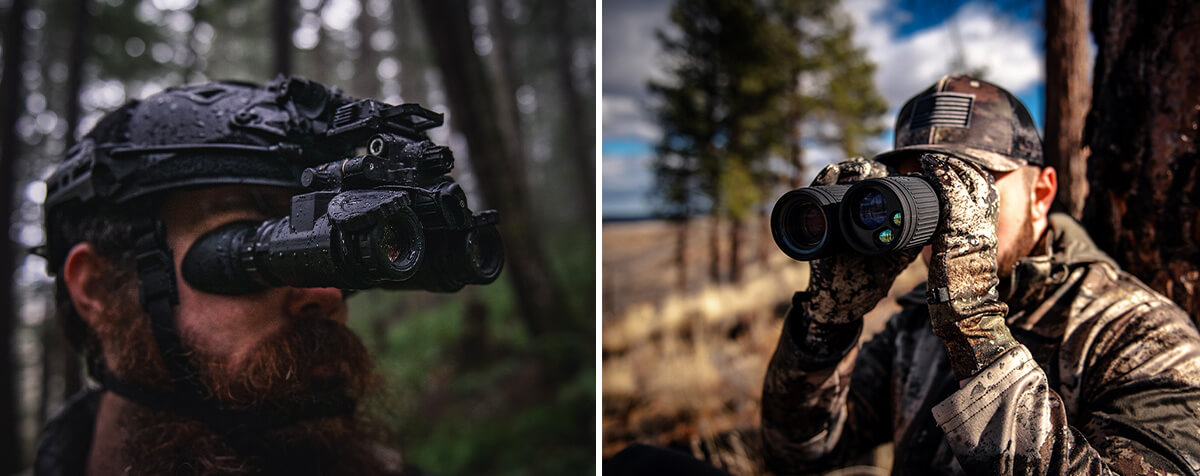
A thermal scope does not amplify light. It detects infrared radiation, meaning it reads the heat emitted by objects and living animals and converts that data into a visible image. Every warm-blooded animal has a heat signature, and thermal sensors can detect those signatures regardless of the ambient light level.

For thermal scope hog hunting, this translates into a few key advantages. A hog standing in the middle of a dark field, tucked behind a stand of brush, or rooting near a tree line glows against the cooler background. You do not need a moon. You do not need a headlamp. You do not need any infrared illuminator. The scope sees the heat, and you see the hog.

Thermal scopes in 2026 have advanced well beyond what was available just a few years ago. Modern platforms like the ATN ThOR 6 and ATN ThOR 6 Mini are built on sixth-generation thermal engines with ultra-sensitive NETD sensors that detect even subtle heat differences in difficult environments. The ThOR 6, for example, offers resolution options of 384x288 or 640x512 with ≤15mK NETD sensors on a 12μm pixel pitch, which represents a meaningful leap in detection sensitivity and image clarity for hunters. The ThOR 6 Mini offers configurations from 256x192 through 640x512, giving hunters the ability to match resolution and budget to their hunting needs.

Thermal imaging hunting also opens up capabilities that night vision simply cannot match, such as detecting a heat signature through light fog, identifying movement in dense grass, or scanning a wide field quickly without losing animals in shadow.

What Is a Night Vision Scope?

Night vision works differently. Rather than detecting heat, a digital night vision scope amplifies available light, including infrared light projected by an onboard illuminator. Modern digital night vision scopes like the ATN X-Sight 5 use high-resolution sensors and powerful processors to capture and enhance the scene in front of you, producing a detailed, full-color or high-contrast image depending on conditions.

The X-Sight 5 uses a 4K+ resolution sensor with ATN's Gen V Quad Core processor, offering a visual experience that is noticeably more detailed than what older night vision technology produced. In low-light conditions with the onboard infrared illuminator active, you get a clear, identifiable image of your target and surroundings. It also functions as a full day scope, making it one of the most versatile optics available for hunters who want one scope that handles both day and night situations.

Where night vision falls short compared to thermal is in conditions with no ambient light at all, in dense brush that blocks line-of-sight, and in fog or precipitation that scatters the infrared illuminator's beam. A hog that steps into a dark shadow behind a brush pile may disappear from a night vision image. The same hog is clearly visible on a thermal display.

That said, night vision vs thermal hunting is not a simple thermal-wins-every-time comparison. Night vision provides more contextual detail in the image, which some hunters find helpful for identifying terrain, distinguishing hogs from other animals, and placing ethical shots accurately. The choice depends on what matters most in your specific hunting setup.

Thermal vs Night Vision for Hog Hunting: Side-by-Side Comparison

Detection

Thermal wins this category outright. Heat signatures are visible regardless of light level, shadow, or camouflage. You can scan a large open field or a dark tree line and pick up a hog's body heat immediately. Night vision depends on the animal being in enough light, or within range of your IR illuminator, to be visible.

Identification

Night vision has an edge here. Because it produces a more natural-looking image with visible detail, identifying what you are looking at is generally easier. With thermal, you are identifying shapes and heat patterns rather than visible features. Experienced hunters learn to identify hogs by their heat profile quickly, but the learning curve is real.

Image Clarity

Both technologies have improved significantly. High-end thermal options like the ThOR 6 with SharpIR© AI-enhanced imaging produce remarkably crisp thermal images with strong edge definition. The X-Sight 5's 4K+ sensor produces excellent visual clarity in night vision mode. At this level of technology, neither has a dramatic advantage, though they are presenting fundamentally different types of images.

Performance in Total Darkness

Thermal is the clear winner. Night vision needs some form of light, either ambient or from an IR illuminator, to function. In complete blackout conditions, a thermal scope continues to work exactly as normal because it is reading heat, not light.

Performance in Brush and Cover

Thermal has a meaningful advantage. When a hog is partially obscured by tall grass or light brush, its heat signature often bleeds through enough to still be visible. Night vision relies on a direct line of sight and will lose the animal behind any solid cover.

Range

Both technologies scale with sensor resolution and optics quality. The ThOR 6's highest-spec 640x512 model lists a detection range of up to 3,650 meters under ideal conditions. The X-Sight 5 with its 4K+ sensor and a 5–25x magnification range provides strong reach for a digital night vision optic. For most practical hog hunting scenarios, both platforms offer more range than the average hunter needs.

Battery Life

The X-Sight 5 offers up to 14 hours on a single charge. The ThOR 6 runs approximately 9 hours using its dual 18650 battery system, while the ThOR 6 Mini delivers around 7–8 hours depending on the configuration. All three feature replaceable battery systems, which is important for extended hunts.

Ease of Use

Both ATN platforms share intuitive controls. The ThOR 6 and ThOR 6 Mini use a streamlined 3-button interface designed to be usable with gloves in the dark. The X-Sight 5 uses a similar approach with ATN's Gen V Quad Core interface. Features like Zeroing Freeze, Recoil Activated Video (RAV), and built-in ballistic calculators on select LRF models appear across both product lines.

Price and Value

Night vision is generally more affordable at entry level. A capable digital night vision scope like the X-Sight 5 typically costs less than a comparable thermal scope. Thermal sensors are more expensive to manufacture, and the price difference remains meaningful in 2026. Budget is a legitimate deciding factor for many hunters.

Ethical Shot Placement

Both technologies support ethical hunting when used correctly. Thermal's ability to identify body heat zones can help with shot placement at distance. Night vision's more detailed image can make confirmation and shot selection clearer at close to medium range. Neither technology replaces sound shot discipline and knowledge of hog anatomy.

Best Use Cases

Thermal is best for large open fields, dense brush, complete darkness, fog, fast scanning across terrain, and situations where detection speed matters most.

Night vision is best for mixed-use day and night setups, hunters on a budget, situations where image detail and context matter, and feeder setups with some ambient light.

Image

Pros and Cons of Thermal Scopes for Hog Hunting

A thermal scope hog hunting setup offers real advantages but comes with trade-offs that every buyer should understand before committing.

Pros

  • Detects heat regardless of light level, including total darkness
  • Effective through fog, light rain, and in dusty or smoky conditions
  • Picks up heat signatures through light grass and cover
  • Faster detection across large areas
  • Does not require an IR illuminator
  • Hogs cannot use darkness or shadows to hide from the sensor
  • Modern platforms like the ThOR 6 include advanced features: SharpIR© AI imaging, Hot Point Tracking, RAV, PIP mode, and built-in Wi-Fi

Cons

  • Higher cost at entry and performance levels compared to night vision
  • Image is based on heat, not visible detail, which requires a learning curve for identification
  • Cannot see through glass, water, or solid surfaces
  • Some hunters find the thermal image less intuitive initially
  • Heavy brush or thick vegetation can still block detection in some cases

Pros and Cons of Night Vision Scopes for Hog Hunting

Night vision remains a valid choice for hog hunting in 2026, particularly for hunters who want versatility or are working within a budget.

Pros

  • More affordable entry price compared to thermal
  • Produces a natural-looking, detail-rich image that is easier to interpret
  • Functions as a full-spectrum day scope, as with the X-Sight 5
  • 4K+ resolution provides excellent image quality in good conditions
  • Strong feature set including ballistic calculator, RAV, built-in LRF on select models, and 4K video recording
  • Up to 14 hours of battery life on the X-Sight 5

Cons

  • Requires some ambient light or an active IR illuminator to function effectively
  • Performance degrades in total darkness without sufficient IR output
  • Fog, rain, and dust can scatter the IR illuminator and reduce image quality
  • Hogs in deep shadow or behind cover may not be visible
  • IR illuminators have a limited range, which caps effective detection distance in darkness

Which One Is Better for Different Hunting Scenarios?

Open Fields

Thermal is highly effective here. You can scan a large pasture or food plot quickly and pick up heat signatures at distance without needing a beam of infrared light to reach the target. Night vision also works well in open fields when there is moonlight or some ambient glow, but thermal remains the more reliable choice for pure detection performance.

Thick Brush

Thermal has a clear edge. Hogs moving through cedar, mesquite, or thick coastal brush will often still register a heat signature even when they are partially hidden. Night vision will lose the animal the moment it steps behind solid cover.

Feeder Setups

This is one area where night vision competes well. At a feeder with a known, fixed distance and some ambient light from the feeder or surrounding area, a quality digital night vision scope delivers a clear, detailed image that makes shot selection straightforward. The X-Sight 5's 4K+ sensor performs well in this environment.

Spot-and-Stalk Hunting

Thermal is the stronger tool for active spot-and-stalk work. You are moving through unfamiliar terrain in the dark, scanning as you go, and needing to detect animals before they detect you. Thermal's ability to pick up heat signatures quickly and at range gives you a significant advantage in this style of hunting.

Group Hunting

Thermal is better for coordinating group hunts where guides or spotters need to locate, count, and direct hunters onto multiple hogs quickly. The ability to track heat signatures across a field without any illuminator makes group coordination faster and quieter.

Budget-Conscious Hunters

Night vision is the realistic choice if budget is the primary constraint. A solid digital night vision setup delivers real capability for hog hunting at a lower entry price than thermal. The X-Sight 5 in particular offers a strong feature set and day and night versatility that makes it a practical long-term optic.

Longer-Distance Shooting

Both technologies scale to longer distances with higher-resolution sensors and appropriate magnification. For shots beyond 200 yards, the ThOR 6's detection range and clarity at distance make it well-suited to precise long-range engagement. The X-Sight 5's 5–25x configuration supports longer-range shooting from a night vision platform.

Beginner Hog Hunters

Beginners may find night vision's more intuitive, detail-rich image easier to work with initially. Thermal takes some time to learn: reading heat profiles, understanding how the image changes with ambient temperature, and identifying species rather than just heat blobs. That said, many beginners adapt to thermal quickly because the detection advantage is so immediately apparent.

Product Fit: Matching the Right Scope to Your Setup

ATN ThOR 6

The ThOR 6 is built for hunters who want full-scale thermal performance and a comprehensive feature set. It is available in 384x288 and 640x512 sensor configurations with ≤15mK NETD sensitivity, paired with a 0.49-inch 1920x1080 OLED display. Detection ranges extend to 3,650 meters on the top-spec 640x512 model. Select LRF models include a built-in laser rangefinder and ballistic calculator, making it a capable all-in-one platform for hunters who take longer shots or need precise distance data.

It runs on a dual 18650 battery system for approximately 9 hours of runtime, includes Recoil Activated Video, Hot Point Tracking, SharpIR© AI imaging, and connects to the ATN Connect 6 app via built-in Wi-Fi. If you want the most capable thermal option in the ATN lineup for serious hog and predator hunting, the ThOR 6 is where that conversation starts.

ATN ThOR 6 Mini

The ThOR 6 Mini offers the same sixth-generation thermal engine in a significantly more compact and lightweight package. At under 500 grams for the entry configurations, it adds minimal weight to any rifle setup. It is available in three sensor configurations: 256x192, 384x288, and 640x512, all on a 12μm pixel pitch.

It is a strong choice for hunters who cover a lot of ground on foot, run a leaner kit, or want thermal capability without the bulk of a full-size scope. The ThOR 6 Mini shares most of the core features of the ThOR 6, including SharpIR© AI imaging, RAV, PIP mode, Hot Point Tracking, and built-in Wi-Fi. Battery life runs approximately 7–8 hours depending on configuration.

ATN X-Sight 5

The X-Sight 5 is a digital smart scope, not a thermal device. It uses a 4K+ resolution sensor with ATN's Gen V Quad Core processor to deliver a detailed, natural-looking image in both day and night conditions. It is available in 3–15x and 5–25x magnification configurations, including LRF versions with a built-in laser rangefinder.

For hunters who want one optic for all seasons and all light conditions, the X-Sight 5 makes sense. It records 4K video, includes Recoil Activated Video, a ballistic calculator, a custom reticle editor, and dual-stream video with live streaming capability. Battery life is rated at up to 14 hours. It is the right tool when versatility, image detail, and value matter, and when thermal is either out of budget or not required for the hunting environment.

Buyer's Guide: How to Choose the Best Scope for Hog Hunting in 2026

Finding the best scope for hog hunting in 2026 means matching the optic to your actual hunting conditions, not just buying the most impressive spec sheet.

Sensor Resolution is one of the most important specifications for thermal scopes. Higher resolution means more detail, sharper edges, and better target discrimination at range. A 640x512 sensor provides substantially more detail than a 256x192 at longer distances.

Magnification determines how effectively you can identify and engage targets at range. For most hog hunting situations, 2–16x or 3–24x optical magnification covers the majority of scenarios. Digital zoom adds additional range but typically at some cost to image quality.

Detection Range listed by manufacturers is typically measured under favorable contrast conditions. Real-world detection will vary with ambient temperature, vegetation, and weather. Use detection range specs as a comparative guide, not an absolute guarantee.

Refresh Rate matters for tracking fast-moving animals. A 50 Hz refresh rate, as specified on both the ThOR 6 and ThOR 6 Mini, provides smooth, responsive motion that reduces lag when panning or following moving hogs.

Battery Life is a practical field concern. Multi-hour hunts, overnight setups, or guides running consecutive nights need scopes with strong battery endurance and, ideally, replaceable battery systems.

Weight affects how long you can hold the rifle steady and how comfortably you can carry your setup. The ThOR 6 Mini at under 500 grams is significantly lighter than the full-size ThOR 6 at approximately 790–855 grams depending on configuration. The X-Sight 5 weighs 1.87 lbs / 0.85 kg.

Mounting System should match your rifle setup. The ThOR 6 uses 30mm rings, which are not included. The ThOR 6 Mini mounts via Picatinny rail. The X-Sight 5 includes 30mm standard rings.

Recording Features like Recoil Activated Video (RAV) are increasingly standard on quality hunting optics. RAV automatically captures the 10 seconds before and after each shot without requiring any manual input.

Zeroing Features such as Zeroing Freeze, which pauses the image at impact for precise reticle adjustment, simplify setup and reduce wasted ammunition.

Weather Resistance is non-negotiable for a hunting optic. Both the ThOR 6 and ThOR 6 Mini carry an IP67 rating, meaning they are fully dust-tight and can handle submersion to one meter. The X-Sight 5 is rated weather resistant.

Budget is a real factor. Thermal costs more than night vision at comparable quality levels. Define what you can realistically spend before evaluating specific models, and be honest about whether the hunting conditions you face actually require thermal performance.

Final Verdict: Thermal or Night Vision for Hog Hunting?

If your primary goal is finding hogs fast, hunting in complete darkness, working through brush, fog, or difficult terrain, and maximizing detection at range, thermal is the stronger choice for hog hunting in 2026. The ability to detect heat regardless of ambient light is a genuine capability advantage that night vision cannot replicate.

The ATN ThOR 6 represents the high end of that choice: full-resolution thermal sensors, AI-enhanced imaging, long detection range, and a complete feature set for hunters who want the most capable platform available. The ATN ThOR 6 Mini brings the same generation of thermal technology in a lighter, more compact form for hunters who prioritize mobility without sacrificing core thermal performance.

If budget is a constraint, you hunt mixed day and night conditions, you value image detail and contextual information, or you want a single versatile optic for multiple seasons, night vision remains a legitimate and practical choice. The ATN X-Sight 5 is one of the most capable digital day and night scopes on the market in 2026, offering 4K+ clarity, strong smart features, and real value for hunters who do not need or cannot justify a thermal investment.

For serious, dedicated hog hunting, especially in varied terrain, total darkness, or heavy cover, thermal is the practical answer most experienced hunters eventually reach. But the best scope for hog hunting is the one that fits your conditions, your budget, and the way you actually hunt.

Frequently Asked Questions

Is thermal better than night vision for hog hunting?

For most hog hunting scenarios, yes. Thermal detects heat signatures regardless of available light, works in total darkness without an IR illuminator, and picks up animals that night vision would miss in brush or shadow. The trade-off is cost: quality thermal scopes typically cost more than comparable night vision options.

Can you use night vision for hog hunting in total darkness?

You can, but night vision scopes require either ambient light or an active infrared illuminator to function. Without those, the image degrades significantly or becomes unusable. In true blackout conditions, thermal is the more reliable technology.

Is a thermal scope worth it for hog hunting?

For hunters dealing with regular or high-volume hog activity, or hunting large properties in varied terrain, a thermal scope is generally worth the investment. The detection advantage over night vision is significant, and modern platforms like the ThOR 6 and ThOR 6 Mini include smart features that add real value beyond the sensor itself.

What is the best scope for hog hunting in 2026?

There is no single answer because the best scope depends on your hunting conditions, budget, and how you hunt. For pure thermal performance, the ATN ThOR 6 or ThOR 6 Mini are strong choices. For hunters who want a versatile day and night optic with strong smart features, the ATN X-Sight 5 is worth serious consideration.

Can thermal see through brush?

Not through solid vegetation, but thermal can often detect heat signatures through light brush, tall grass, or sparse cover where the animal's body heat bleeds through gaps in the vegetation. In heavy brush, no optic can see through solid material.

Is the ThOR 6 good for hog hunting?

The ThOR 6 is well-suited to hog and predator hunting. Its sixth-generation thermal sensor, SharpIR© AI-enhanced imaging, Hot Point Tracking, and detection range make it a capable platform for detecting and engaging hogs in the field. Select LRF models also include a built-in rangefinder and ballistic calculator for hunters who take longer shots.

Is the X-Sight 5 good for night hunting?

The X-Sight 5 performs well for night hunting in conditions where ambient or infrared light is available, such as feeder setups, semi-open terrain, or hunts with some moonlight. Its 4K+ sensor and Gen V Quad Core processor deliver strong image quality in night mode. For total darkness or heavy cover, thermal remains more capable, but the X-Sight 5 is a highly versatile option for hunters who want one scope that handles multiple conditions.

ATN STORES
Dallas Store

3000 Grapevine Mills PWKY
Space #133 Grapevine, TX 76051

Houston Store

5015 Westheimer Road
Suite A1192, Houston TX 77056

Atlanta Store

5900 Sugarloaf Pkwy
Suite 513, Lawrenceville GA 30043

Chicago Store

GAT Guns Store 970 Dundee Ave
East Dundee, IL 60118

SCOPE COMPARISON CHART
ATN Thor 4 ATN Thor LT ATN X-Sight 4k ATN X-Sight ltv