A thermal scope with rangefinder capability answers the one question that decides a shot in the dark: how far away is that heat signature? Knowing the distance lets you hold correctly the first time instead of guessing and burning a round. The ATN ThOR 6 line builds smart ranging and ballistic tools right into the optic, so distance, hold, and heat detection all live on the same reticle. This roundup ranks three ThOR 6 options by how they serve a hunter who needs range data before pulling the trigger.
Best balance: ATN ThOR 6 640x512 2-16x — full 640 clarity and ranging tools with a wider field of view.
Best value: ATN ThOR 6 384x288 2.5-20x — the same ranging and ballistic suite at the budget tier.
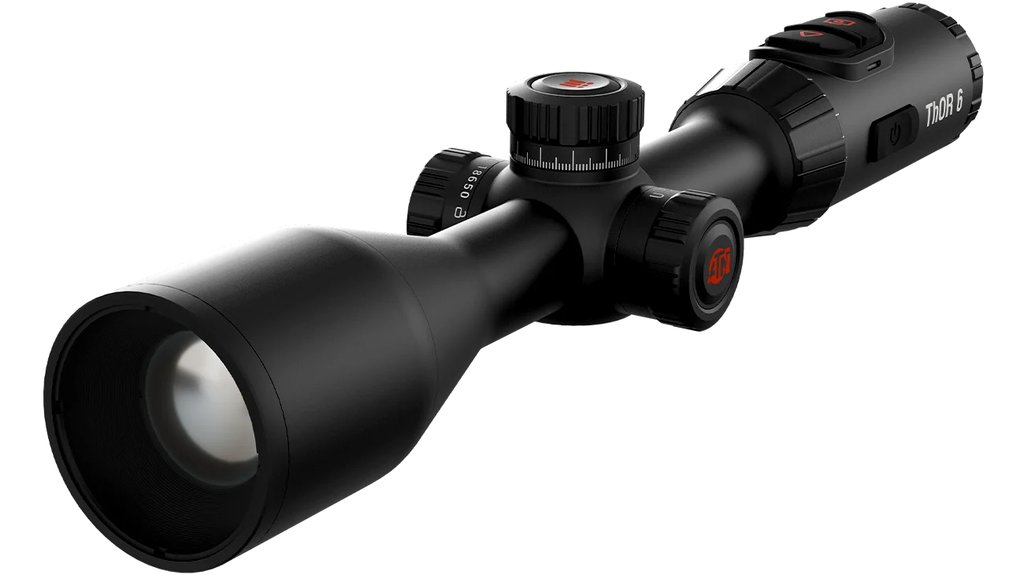
Why ATN's 6th-gen ThOR 6 handles ranging so well
ATN's 6th-generation ThOR 6 line matters here because the ranging tools are built into the software of every model, not sold as a bolt-on. The Smart Rangefinder lets you measure distance to a target through the optic, and the onboard Ballistic Calculator then moves the point of impact for that range so your hold is correct. Pair that with a sensor rated at 15 mK — NETD in millikelvin describes the smallest temperature difference the sensor can see, and lower is a cleaner image — and you can both find the animal and know exactly how far it sits. The tools are identical across the line; what changes is how far out you have targets worth ranging.
ATN ThOR 6 640x512 3-24x — best overall for ranging distant targets
Range it, then hold correctly
The ATN ThOR 6 640x512 3-24x is the pick when the animals you range are far away. Its 640x512 sensor carries four times the pixels of a 384 detector — think of the jump from standard definition to HD — so a target you range at distance still shows enough detail to confirm what it is. With a 50 mm lens and detection out to 3650 m, there is always something worth ranging in the frame, and the Ballistic Calculator adjusts your aim point for that measured distance.
Who it's for and who it's not
It's for the long-range hunter who ranges targets across open ground and wants detail at the far end. It is not the value choice — it's the flagship tier, so if your shots stay inside moderate range you are paying for reach you may not use.
ATN ThOR 6 640x512 2-16x — the balanced ranging build
Wide field, full 640 detail
The ThOR 6 640x512 2-16x keeps the 640 sensor and the full ranging and ballistic suite but starts at 2x, giving a wider field of view that makes it easier to scan and settle the rangefinder on a moving animal. Detection reaches 3100 m, and the replaceable 18650 battery system lets you swap a fresh cell mid-hunt. You trade some top-end zoom for a faster, wider picture.
Who it's for and who it's not
It's for the hunter who ranges targets at short-to-medium distance and wants a wide view to work with. It's not the choice if you need maximum magnification to range and confirm targets at the far end of a big field.
ATN ThOR 6 384x288 2.5-20x — value with the same ranging tools
Full ballistic suite, budget tier
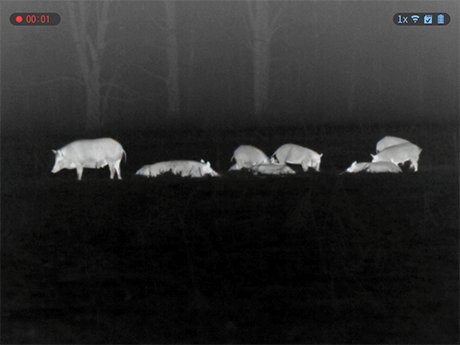
The ATN ThOR 6 384x288 2.5-20x proves you do not have to pay flagship money to get ranging built in. It runs the same Smart Rangefinder and Ballistic Calculator, plus SharpIR, Recoil Activated Video, and Hot Point Tracking, on a 384 sensor and 25 mm lens. Detection reaches 2300 m — far beyond the range at which most hunters range and shoot game — so for typical distances the ranging tools do everything the pricier models do.
Who it's for and who it's not
It's for the value-minded hunter who wants distance-on-target tools at typical ranges. It's not for someone ranging and identifying small targets at extreme distance, where the 640 sensor's extra detail earns its price.
Why ranging matters more in the dark
Ranging changes a night hunt more than it changes a daytime one, because darkness strips away the depth cues your eyes normally use to guess distance. In daylight you unconsciously judge yardage from familiar landmarks, terrain, and the apparent size of the animal against its surroundings. Through a thermal optic at night, all of that context collapses into a warm shape on a dark background, and a coyote at 120 yards can look a lot like one at 220. Guess wrong and your holdover is wrong, which on a lean predator or a specific pig in a sounder is the difference between a clean shot and a wasted one. Putting a measured distance on the reticle removes the guess entirely.
That is why the ThOR 6's built-in Smart Rangefinder is more than a convenience. You lase the target through the same optic you are aiming with, the scope reads the distance, and the Ballistic Calculator translates that into a corrected point of impact using your load's data. There is no juggling a separate handheld unit in the dark, no looking away from the animal, and no mental math while a coyote decides whether to bolt. The whole sequence — find, range, hold, shoot — happens inside one field of view, which is exactly what you want when the window is short.
Getting accurate ranging results in the field
A rangefinder is only as good as the habits around it, so a few field practices make the ThOR 6's tools pay off. Range the animal itself when you can, not the brush in front of it, because a signature partly screened by cover can throw the reading. Take a moment to steady the reticle before you lase; a shaky hold on a distant target can catch the ground beyond it. And confirm your ballistic profile is loaded correctly for the rifle and load you are actually shooting, since the calculator's correction is only as accurate as the data you feed it. None of this is difficult, but doing it consistently is what turns a ranged number into a first-shot hit.
It also helps to range a few reference points when you first set up — the far fence line, a lone tree, the edge of the field — so you have a mental map of the distances around you before an animal ever appears. Then, when a hog steps out, you already have a rough sense of the range and the scope's reading simply confirms and refines it. This blend of preparation and instant on-reticle ranging is where a thermal scope with a rangefinder truly earns its place over a plain thermal optic.
How to choose a thermal scope with a rangefinder
Pick based on how far you range targets and how much detail you need at that distance, because the ranging tools themselves are the same across the ThOR 6 line.
- Ranging tools are standard — every ThOR 6 includes the Smart Rangefinder and Ballistic Calculator, so this is not a spec you shop for.
- Detection range sets the ceiling — you can only range what the sensor can detect; match the model's reach to your longest realistic shot.
- Resolution helps at distance — a 640 sensor confirms a ranged target far out; 384 is ample for normal hunting ranges.
- Refresh and weight — all three update the image quickly and sit near 1.8 lbs, so tracking a ranged, moving animal stays smooth on any of them.
How we picked these ATN thermal scopes
We judged these three by how well each serves a hunter who ranges before shooting, weighing detection range, sensor resolution, NETD sensitivity, refresh rate, weight, and battery life against real ranging distances. Only the current 6th-gen ThOR 6 line was considered. The honest trade-off is that the ranging and ballistic tools are identical across all three, so the value model does the job at normal distances and the extra spend on a 640 model only pays off when you range small targets far out. This is an in-house comparison of ATN's own range, not an independent lab review, so weigh the detection numbers against the distances you actually shoot.
Frequently Asked Questions
Does the ATN ThOR 6 have a built-in rangefinder?
Yes. Every ThOR 6 includes a Smart Rangefinder that measures distance to a target through the optic, along with a Ballistic Calculator that shifts your point of aim for that range. The tools are software-based and standard across the whole line.
How does the rangefinder work with the ballistic calculator?
You range the target through the scope, and the Ballistic Calculator uses that distance with your load data to move the reticle's point of impact. The result is a corrected hold, so you do not have to guess drop at unknown distances.
Which ThOR 6 is best for long-range ranging?
The ThOR 6 640x512 3-24x. Its 640 sensor and 3650 m detection range let you range and still confirm detail on distant targets, while its higher magnification helps you settle the rangefinder precisely far out.
Is the rangefinder as good on the budget model?
The ranging and ballistic tools on the value-tier ThOR 6 384x288 are the same software as on the flagship. The only difference is that the 384 sensor and shorter detection range set a lower ceiling on how far you can range.
Do I still need a separate handheld rangefinder?
For most hunting you do not, because the ranging function lives inside the scope and puts distance right on the reticle. A separate unit is only useful if you want to range targets outside the scope's field of view.
How far can the ThOR 6 range and detect targets?
Detection reaches about 2300 m on the 384 model and up to 3650 m on the 640 3-24x. You can only range what the sensor detects, so the higher-tier models give you more usable ranging distance.
If you are done guessing yardage in the dark, a ThOR 6 puts the rangefinder and the ballistic hold on the same reticle you are already looking through. Start with the value-tier 384 model if your shots stay at normal range, or step up to a 640 model when you range targets far across open ground. Compare all three, check the ranging specs, and see current pricing on the ATN thermal scope collection. Match the detection range to your longest realistic shot, and let the scope do the math on everything closer.
Created: August 10, 2026 · 10:05:21 UTC