The best thermal scope for hog hunting depends less on chasing the biggest spec and more on the terrain you hunt. Pigs move at night through everything from tight creek bottoms to wide-open ag fields, and the scope that shines in thick brush is not the one you want across a 400-yard bean field. This roundup ranks three ATN ThOR 6 options by terrain — close cover, mixed ground, and open country — so you can pick the one that matches where your hogs actually live.
Best for mixed ground: ATN ThOR 6 640x512 2-16x — 640 clarity with a wider view for shifting terrain.
Best for thick brush / value: ATN ThOR 6 384x288 2.5-20x — light, quick, and plenty of scope for close-cover hogs.
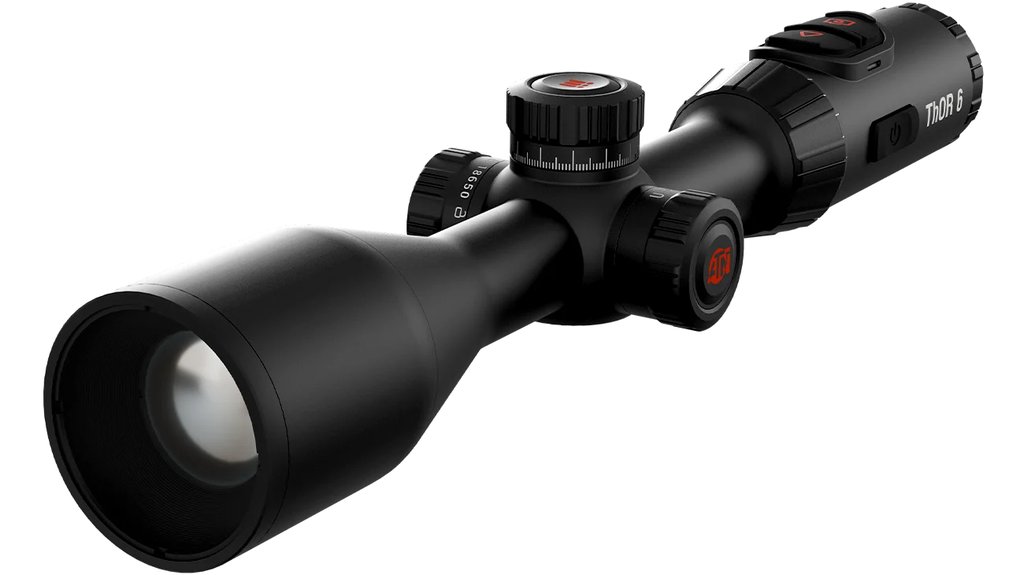
Why ATN's 6th-gen ThOR 6 is built for hogs
ATN's 6th-generation ThOR 6 line suits hog hunting because pigs run hot and move in groups, and this line is tuned to catch exactly that. A hog's body heat lights up hard against cool ground on a sensor rated at 15 mK — NETD in millikelvin is the smallest temperature difference the sensor can resolve, and lower means a cleaner, higher-contrast picture. Recoil Activated Video captures the shot automatically, Hot Point Tracking marks the hottest signature so you can pick a boar out of a milling sounder, and the fast refresh keeps pigs from smearing as they run. Which model you choose depends on how far away those pigs are.
ATN ThOR 6 640x512 3-24x — best for open-country hogs
Reach across the field
The ATN ThOR 6 640x512 3-24x is the pick when hogs feed in wide fields and you need to reach out. Its 640x512 sensor holds four times the pixels of a 384 detector — like moving from standard definition to HD — so a sounder 300 yards out still resolves into individual pigs instead of warm blobs. The 50 mm lens and 3-24x zoom push detection to 3650 m, and Hot Point Tracking helps you settle on the biggest boar in the group.
Who it's for and who it's not
It's for the hunter working open ag ground and long field edges. It is not the pick for tight, close-range brush hunting, where its higher magnification narrows the field more than you need and you are paying for reach you will not use.
ATN ThOR 6 640x512 2-16x — best for mixed ground
Clarity with a wider window
The ThOR 6 640x512 2-16x keeps the 640 sensor but starts at 2x, opening a wider field of view that suits ground that shifts between cover and clearing. You keep the crisp 640 detail and get to 3100 m of detection, while the replaceable 18650 battery lets you swap a cell during an all-night stand. It is the do-it-all hog scope when your terrain will not sit still.
Who it's for and who it's not
It's for the hunter who bounces between brush and field in one night. It's not the best if nearly all your shots are long — the 3-24x pulls ahead there — or if you want the lightest, cheapest setup for close work.
ATN ThOR 6 384x288 2.5-20x — best for thick-brush hogs
Light, quick, and close
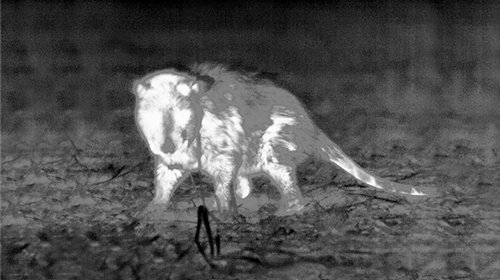
The ATN ThOR 6 384x288 2.5-20x is the value pick and the right tool for close-cover pigs. Hogs in a creek bottom or thick brush are usually inside 150 yards, and at those distances a 384 sensor puts a sharp, high-contrast pig on the reticle with room to spare — detection reaches 2300 m. It's the lightest model in the line and keeps the full feature set, so it swings fast when a sounder busts out of cover.
Who it's for and who it's not
It's for the brush hunter who wants a light, affordable scope for close, fast shots. It's not for identifying pigs way out across an open field, where the 640 models resolve detail the 384 cannot.
How hogs behave after dark, and why it shapes your scope choice
Hogs are a night animal that moves in groups, roots up ground fast, and scatters at the first sign of danger — and every one of those traits should push a decision about which thermal scope you carry. Because pigs travel as a sounder, you rarely face a single clean target; you face a milling knot of warm bodies where a big boar and a dozen sows and shoats overlap. That is where Hot Point Tracking earns its keep, flagging the hottest signature so you can pick a specific animal out of the crowd instead of guessing. It is also why a sharp image helps: on a 640 sensor a group at distance resolves into distinct pigs, while a coarser picture leaves you looking at one warm blob.
Hogs also bust fast once the first shot goes, and a good night on a sounder often means taking more than one pig in the seconds before they clear the field. That rewards a fast refresh rate, which keeps running animals crisp rather than smeared, and Recoil Activated Video, which records the whole sequence automatically so you can review exactly what happened after the chaos settles. A scope that lags or blurs on movement will cost you follow-up pigs; the ThOR 6's fast refresh is built precisely for this kind of rapid, moving-target work.
Matching magnification and field of view to hog country
The right magnification for hogs depends on whether your pigs live in tight cover or open ground, and getting it wrong makes the hunt harder than it needs to be. In thick creek bottoms and brush, pigs appear close and without warning, so a scope that starts at a low power gives you the wide field of view you need to catch them and swing on them fast. Crank up too much magnification in close country and you are looking through a soda straw, sweeping past pigs that are right in front of you. That is why the lighter, value-tier model with its handy zoom range suits brush hunting so well.
Out in open ag fields the calculus flips. Pigs feed at distance, you have time to set up, and the ability to zoom in and confirm a boar across 300 yards matters more than a wide close-in view. There the flagship's higher magnification and longer reach come into their own. The honest takeaway is that no single magnification is best for all hog hunting — you match it to your terrain, and the ThOR 6 line gives you a model tuned for each end of that spectrum.
How to choose a thermal scope for hog hunting
Let your terrain and typical shot distance make the call, not the biggest detection number on the box. Hogs are big and hot, so contrast is rarely the problem — reach and field of view are.
- Match reach to terrain — open fields reward the 3-24x, brush rewards a lighter, wider 384.
- 640 for far pigs, 384 for close — resolution matters most when you identify a sounder at distance.
- Use Hot Point Tracking — it flags the hottest signature so you can single out a boar from a moving group.
- Refresh keeps runners sharp — all three update fast, so bolting hogs stay clear instead of smearing across the frame.
How we picked these ATN thermal scopes
We ranked these three by how well each handles the way hogs actually move — in groups, at night, across changing terrain — weighing sensor resolution, NETD sensitivity, detection range, refresh rate, weight, and battery against short-, mid-, and long-range hog scenarios. Only the current 6th-gen line was considered. The trade-off is straightforward: the open-country pick is heavier on reach and lighter on brush handling, while the value model is the reverse. None of these is the right buy for a hunter who never leaves tight cover but insists on maximum magnification. This is an in-house comparison of ATN's own range, not an independent lab test, so match the specs to your terrain.
Frequently Asked Questions
What is the best ATN thermal scope for hog hunting?
It depends on terrain. For open fields, the ThOR 6 640x512 3-24x gives the reach and detail to work pigs at distance. For thick brush and close shots, the value-tier 384x288 is lighter and plenty capable.
Do I need a 640 sensor for hogs?
Not for close and mid-range hunting. A 384 sensor easily spots and confirms hogs inside a couple hundred yards. Step to 640 when you regularly identify sounders across open fields, where the extra pixels sharpen distant detail.
How does thermal help me tell a boar from the sows?
Hot Point Tracking marks the hottest signature in the frame, which helps you pick a target out of a milling group. Combined with the sharp 640 image at distance, it makes singling out a specific pig much easier.
Will a thermal scope pick up a hog in thick cover?
Yes, as long as heat can reach the sensor. Pigs run hot and light up strongly at 15 mK sensitivity, though very dense brush directly between you and the animal can block the signature until it steps into a gap.
Is the value-tier ThOR 6 good enough for hogs?
For most hog hunting, yes. The 384x288 model detects heat far past normal shot distance and keeps the full feature set, so it handles close- and mid-range pigs well. It only falls short on long-range identification.
Does Recoil Activated Video help on hogs?
It does. RAV starts recording automatically when the rifle fires, so you capture the shot on a sounder without fumbling for a button, which is useful when pigs scatter fast after the first round.
Pigs do not read spec sheets, so pick the ThOR 6 that matches your ground. Open fields call for the 640 3-24x, mixed terrain the 640 2-16x, and tight brush the light, value-tier 384. See all three side by side, read the full specs, and check current pricing on the ATN thermal scope collection. Nail the terrain match first and the rest of your hog hunting gets a lot simpler after dark.
Created: August 10, 2026 · 10:05:21 UTC