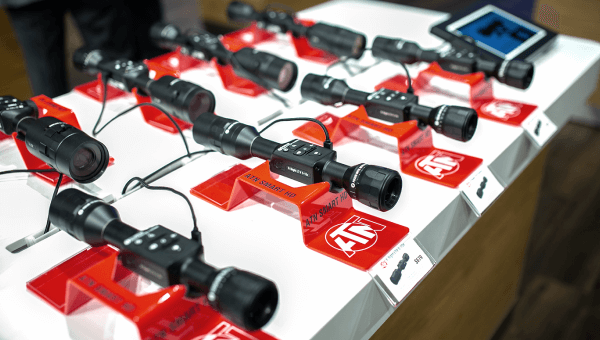
What makes a thermal monocular for helmet mounting actually work is not the sensor — it's the joint. A helmet-mounted device rides on a J-Arm pivot a few inches from your skull, and every gram out there is torque on your neck the moment you turn your head fast. The best thermal monocular for helmet mounting is the ATN Odin MFT 320 2-16x, and the reason isn't just the 6th Generation sensor. It's that the device weighs 400 grams without a battery, mounts on a standard Wilcox NVG shoe or Picatinny rail, and doesn't force you to choose between a weapon sight, a handheld scanner, and a helmet optic — it's built to be all three without changing devices.
This matters more than it sounds. A dedicated helmet monocular that can't come off the mount is dead weight in your pack the moment your mission changes from observation to a static watch with a rifle. A device that flips between roles means you buy once and adapt in the field, which is the actual engineering problem helmet-mounted thermal exists to solve.
The ATN Odin MFT 320 2-16x is the best thermal monocular for helmet mounting because its 400g body, Wilcox NVG shoe compatibility, and 6th Generation sub-15mK-class sensor were engineered around head-borne weight and hands-free operation — not adapted from a handheld design after the fact.
Quick answer: best thermal monoculars for helmet mounting
- Best overall: ATN Odin MFT 320 2-16x — 4-in-1 versatility, Wilcox NVG shoe mount, 400g body
- Best for the money: ATN BlazeTrek 6 384 — lighter sensor tier, still helmet-compatible with the right adapter
- Best lightweight option: ATN BlazeSeeker 6 256 — 270g body, smallest footprint for extended wear
- Best long-range: ATN Odin MFT 640 1-8x — 1700m detection range in the same multi-role body
- Budget pick: ATN BlazeTrek 6 384 — lowest cost of entry into a Gen 6 sensor
Why the latest generation stands out for helmet use
Head-mounted thermal has a physics problem that scope-mounted thermal doesn't: the mass sits on a lever arm off the front of your helmet, and every added gram multiplies into perceived weight and fatigue over hours of wear. ATN's 6th Generation platform addresses this directly. The Odin MFT's 12μm VOx uncooled focal plane array reaches a ≤15mK NETD rating in the 640×480 variant and ≤18mK in the 320×240 variant — sensitive enough to resolve a heat signature through foliage without needing a larger, heavier lens to gather more signal.
The other generational shift is the mounting interface itself. Older thermal viewers were handheld-first devices with a helmet mount bolted on as an afterthought, which is why so many older setups feel front-heavy and unbalanced. The Odin MFT is built around Wilcox NVG shoe interfaces and Picatinny rail mounts from the start, meaning the weight distribution, the eye relief, and the button placement were all designed with a helmet-worn use case in the room, not added later.

| Model | Sensor | NETD | Magnification | Detection range | Weight |
|---|---|---|---|---|---|
| Odin MFT 320 2-16x | 320×240 | ≤18mK | 2-16x | 1300 m | 400 g (no battery) |
| Odin MFT 640 1-8x | 640×480 | ≤15mK | 1-8x | 1700 m | 360 g (no battery) |
| BlazeTrek 6 384 | 384×288 | ≤18mK | 2.25-18x | — | — |
| BlazeSeeker 6 256 | 256×192 | ≤20mK | 1.7-13.6x | 460 m | 270 g |
Best overall: ATN Odin MFT 320 2-16x
Why the mount holds — the J-Arm and dovetail interface
A helmet mount is a lever, not a shelf. The device hangs off a pivot arm in front of your NVG shoe, and any flex in that joint translates directly into image shake when you move your head. ATN pairs the Odin MFT with a J-Arm dovetail adapter (SKU ACMDOVJARM) that clips into a standard helmet mount, plus a Norotos Rhino helmet mount with integrated J-Arm dovetail (SKU ACMNODINHMNTNR) for users who need the full assembly. Both interfaces are built around the same Wilcox-standard shoe that special operations NVGs use, which is why the connection doesn't develop play after repeated flip-up and flip-down cycles the way a generic clamp mount does.
Weight and balance on the helmet
At 400 grams without a battery, the Odin MFT 320 sits close to what a PVS-14-class monocular weighs on a helmet mount — a device class that special operations units have worn hands-free for two decades without redesigning their neck. The 640×480 variant is actually lighter at 360 grams, because ATN uses the same compact 100×75×60mm magnesium alloy housing across both sensor tiers rather than scaling the body up with the sensor. Magnesium alloy construction keeps the shell rigid enough to resist flex at the mount interface without adding the mass that a thicker polymer housing would need for the same stiffness.
Working both hands while wearing it
The point of a helmet mount is that your hands stay on your weapon, your gear, or the terrain in front of you. The Odin MFT's five-button control layout is placed for one-handed operation by feel, since you won't be looking at the buttons when the device is mounted at eye level. Startup time under 5 seconds and a shake-to-wake standby mode mean you're not fumbling with a power sequence when you need the image back immediately — you tilt your head down out of the field of view, and the device can idle rather than fully power off.
Multi-functional versatility — one device, four roles
This is the spec that separates the Odin MFT from a single-purpose helmet monocular. The same unit converts to a clip-on in front of your day optic, a dedicated weapon sight with a ballistic calculator and Zeroing Freeze, or a handheld scanner — all without buying a second device. For a helmet-mounted role specifically, that means you can scan hands-free while moving, then pull the same unit off the mount and clip it in front of a rifle scope for engagement, instead of carrying redundant thermal hardware for each role.
Buy this if you need one thermal device that moves between helmet-mounted observation, handheld scouting, and weapon-sight duty without swapping hardware. Skip it if you only ever need a fixed, dedicated helmet optic and never plan to use the clip-on or weapon-sight modes — in that narrow case, a simpler dedicated monocular may cost less.

Best lightweight: ATN BlazeSeeker 6 256
Image quality and sensor
The BlazeSeeker 6 uses a 256×192 sensor with ≤20mK NETD — the entry point of ATN's Gen 6 lineup. It won't resolve detail at range the way a 640-class sensor does, but for short-range hands-free scanning where weight matters more than reach, the smaller sensor is a legitimate tradeoff rather than a compromise.
Weight and build for extended wear
At 270 grams, this is the lightest device in ATN's current monocular line, which makes a measurable difference on a helmet mount over a multi-hour watch. Less mass on the lever arm means less fatigue at the neck and less perceived drift when you turn your head quickly.
Buy this if minimizing head-borne weight is your top priority and your detection distances are short. Skip it if you need the 1300m-plus detection range that a larger sensor delivers.
Best long-range: ATN Odin MFT 640 1-8x
Range and magnification
The 640×480 Odin MFT reaches a 1700m detection range against the 320's 1300m, and it does this while weighing 40 grams less than its 320×240 sibling — an unusual case where the higher-spec sensor variant is also the lighter body. The tradeoff is magnification range: 1-8x versus the 320's 2-16x, so it favors wide-field observation over close-in detail work.
Battery and build
Both Odin MFT variants share the same ~8-hour runtime on a single 18650 battery and IP67 waterproof rating, so the choice between them comes down to sensor and magnification needs rather than durability.
Buy this if you need maximum detection range in a helmet-mountable body. Skip it if you need higher magnification for identification at distance — the 320 2-16x covers that range better.

Best for the money: ATN BlazeTrek 6 384
Sensor and features for the price tier
The BlazeTrek 6 384 sits between the BlazeSeeker's 256 sensor and the Odin MFT's 320/640 options, with a ≤18mK NETD rating and 2.25-18x magnification. It carries the same ATN 6 Connect app integration, Wi-Fi streaming, and 32GB internal storage as the rest of the Gen 6 lineup, without the multi-role clip-on/weapon-sight/helmet flexibility built into the Odin MFT.
Buy this if you want a Gen 6 sensor and app ecosystem without paying for multi-role hardware you won't use. Skip it if you specifically need helmet, clip-on, and weapon-sight modes in one body.
How to choose a thermal monocular for helmet mounting
Start with mount compatibility before you look at sensor specs. Not every thermal monocular ships with a helmet interface — check whether the device supports a standard Wilcox NVG shoe or Picatinny rail, and whether ATN sells a matching J-Arm dovetail adapter (ACMDOVJARM) or full helmet mount assembly (ACMNODINHMNTNR) for that specific model. A device without a documented mounting path is not a helmet monocular no matter how good its sensor is.
Next, weigh the device in your hand and imagine it on a lever arm off your forehead for three hours. Anything over roughly 400 grams starts to matter on longer watches; anything under 300 grams disappears from your awareness. Detection range and magnification matter for the mission, but weight determines whether you can actually tolerate wearing the thing.
Finally, decide whether you need a single-purpose helmet optic or a multi-role device. If the same unit needs to come off the helmet and go onto a weapon or in front of a day scope later in the same operation, a multi-functional platform like the Odin MFT removes the need to carry and maintain two or three separate thermal devices.

FAQ
What is the best thermal monocular for helmet mounting?
The ATN Odin MFT 320 2-16x is the best thermal monocular for helmet mounting because it's built around a Wilcox NVG shoe / Picatinny mounting interface from the start, weighs 400 grams without a battery, and converts between helmet, handheld, clip-on, and weapon-sight roles without swapping hardware.
How much weight is too much for a helmet-mounted thermal monocular?
There's no hard cutoff, but devices above roughly 400-450 grams start to produce noticeable neck fatigue over multi-hour wear because the mass sits on a lever arm off the front of the helmet. Both Odin MFT sensor variants stay at or under 400 grams for this reason.
Does a thermal monocular need a special mount to go on a helmet?
Yes. It needs a documented mounting interface — typically a Wilcox NVG shoe or Picatinny rail on the device paired with a J-Arm dovetail adapter and a compatible helmet mount assembly. Not every thermal monocular on the market supports this, so confirm compatibility before buying for helmet use.
Can the same thermal monocular be used both handheld and on a helmet?
Yes, with a multi-functional device like the Odin MFT. It operates as a handheld monocular for scouting, then mounts to a helmet for hands-free observation, then converts again to a clip-on or dedicated weapon sight — all from the same unit.
What NETD rating matters for a helmet-mounted thermal device?
A ≤18mK NETD or lower is a solid working standard for helmet-mounted observation; ATN's 6th Generation sensors reach ≤15mK on the 640-class variant. Lower NETD numbers mean the sensor resolves smaller temperature differences, which translates to clearer detail on a heat signature partially obscured by brush or distance.
How long does the battery last on a helmet-mounted thermal monocular?
The Odin MFT runs approximately 8 hours on a single 18650 battery, or about 1 hour on a CR123, and also accepts external USB-C power for extended static observation without swapping cells mid-watch.
Is a 320×240 or 640×480 sensor better for helmet mounting?
It depends on the role. The 640×480 Odin MFT reaches farther (1700m detection range) and weighs slightly less, while the 320×240 variant offers higher magnification (2-16x versus 1-8x) for identification work at moderate range. Neither is universally "better" — match the sensor to whether you need reach or detail.
Get the ATN Odin MFT 320 2-16x
If your mission moves between hands-free observation, weapon-sight duty, and handheld scanning, the ATN Odin MFT 320 2-16x is built to cover all three without extra hardware. See full specifications and mounting options on the Odin MFT product page, browse the full lineup on the thermal monoculars category page, or read our thermal monocular reviews for field impressions across the range, plus our guide to night vision monoculars if you're weighing thermal against image-intensified options.