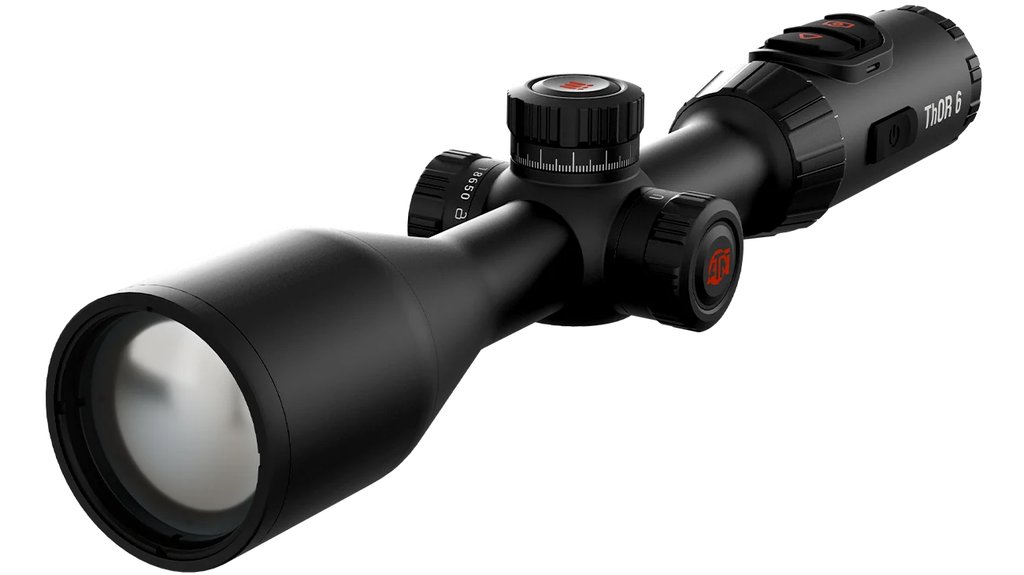
Ask ten hunters about night vision scope vs thermal and you will get ten strong opinions, most of them missing the one thing that actually decides it: night vision amplifies light, thermal reads heat. Those are two completely different ways of seeing in the dark, and each wins in a different situation. This is a straight technology comparison-no hype, no brand-bashing-ending with an honest recommendation. The thermal side of this piece is built around the ATN ThOR 6, because it is the current 6th-gen thermal scope we would put on our own rifle.
For most hunters after dark, thermal wins-and the ATN ThOR 6 640x512 3-24x is our pick. Thermal reads body heat, so it works in total darkness and spots hidden, camouflaged animals a night-vision scope would walk right past. Choose night vision instead only when you need natural, recognizable detail and you already have a little ambient light to work with.
Night vision vs thermal at a glance
Here is the short version before the details: night vision gives you a natural, detailed picture but needs some light, while thermal sees heat in pitch black but shows signatures instead of fine detail. The table below lays the two technologies side by side on the points that decide a night hunt, so you can see where each one earns its place.
How night vision works
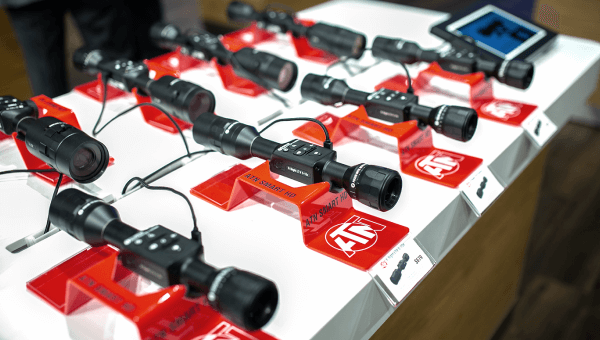
Night vision works by amplifying the small amount of light already in the scene-moonlight, starlight, or the beam from an IR illuminator-so you see a fairly natural, detailed picture. The image looks closer to what your eye would see in daylight: you can read a coat pattern, tell a doe from a buck, and pick out fine features on the animal. That recognizable detail is night vision's real strength. The catch is that it needs at least a little light to amplify; on a truly black, moonless night under heavy canopy, a light-amplifying scope struggles unless you add an IR illuminator. And because it works with reflected light, it cannot see body heat, so an animal tucked into thick brush or lying still can blend right into the background. ATN's own digital day/night line, the X-Sight, is the modern take on this approach-it works in daylight too and records what you see-but its whole job is detail from light, not heat.
How thermal works
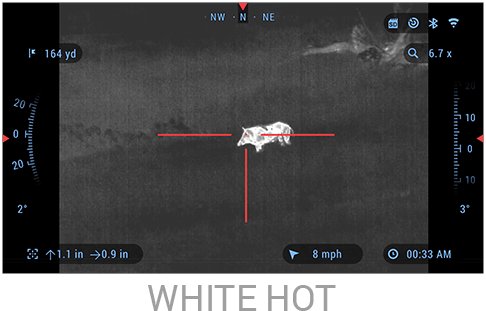
Thermal works by reading heat instead of light, so it needs no ambient light at all-it sees a warm animal in total darkness the same as it does at dusk. On the ATN ThOR 6, a 640x512 thermal sensor turns the temperature difference between a living body and the cooler ground into a bright, unmistakable shape. Because it reads heat, thermal cuts straight through the tricks that fool your eye: a coyote holding still in shadow, a hog bedded in tall grass, an animal partly screened by brush-if it is warmer than its surroundings, it glows. It even punches through light fog and smoke that would blind a light-amplifying scope. The honest trade-off is detail: thermal shows you a heat signature, not a crisp photo, so you get less fine coat and facial detail than night vision. But for finding game after dark, that heat picture is hard to beat, and the ThOR 6's SharpIR AI processing sharpens the edges so you can still tell what you are looking at.
What the numbers mean
Two specs on the ThOR 6 explain why the thermal picture reads so clearly. The 640x512 resolution is the pixel count that draws the animal-think of it like the step from standard definition to HD: more dots mean cleaner edges and a shape you can identify farther out. The NETD figure of 15 mK or lower is the smallest temperature gap the sensor can tell apart; the lower that number, the better it separates a warm body from ground that is nearly the same temperature. On a summer night, when a hog is barely warmer than sun-heated dirt, that low NETD is what turns a vague smudge into a solid target.
When to choose night vision
Choose night vision when you need natural, recognizable detail and you have at least a little light to work with. If you are watching a food plot on a moonlit night and it matters that you can clearly identify the animal-tell a legal buck from a young one, or make certain of your target before the shot-a light-amplifying picture gives you more of that fine detail than a heat signature does. Night vision also suits the hunter who wants one optic that does daytime duty too: a digital day/night scope like ATN's X-Sight line runs in daylight and after dark on the same rifle, and records the whole hunt. The trade-off you accept is that it needs some ambient light or an IR illuminator, and it will not reveal an animal hidden by cover, because it cannot see heat.
When to choose thermal
Choose thermal when the priority is finding and spotting game in real darkness, especially animals that do not want to be seen. Hogs and coyotes move on the blackest nights, hide in brush, and hold still to avoid detection-and that is exactly where thermal shines, because their body heat gives them away no matter how good their cover is. In total darkness, through light fog, across an open field where you need to scan fast for warm bodies, thermal finds the animal first every time. That is why our recommendation for a dedicated night hunter is a thermal scope. You give up some fine detail compared to night vision, but you gain the one thing that matters most after dark: you actually see the animal that a light-amplifying scope would miss.
Our recommendation
For most hunters weighing night vision scope vs thermal, our recommendation is thermal, and specifically the ATN ThOR 6 640x512 3-24x. It leads its class on the specs that decide a night hunt: a 640x512 sensor for a clean, identifiable picture, NETD of 15 mK or lower so warm bodies separate from cool ground, and detection out to 3650 m-far past any shot you would take, but proof of how early it flags heat. You get 3-24x magnification, a Full-HD OLED display, and features that earn their keep in the field: Zeroing Freeze and RAV to lock and re-check your zero, Hot Point Tracking to hold on a moving animal, Picture-in-Picture for a precise aim without losing the wide view, and about 9 hours on a pair of 18650 cells. If you want a shorter, lighter setup for tighter woods, the ATN ThOR 6 640x512 2-16x keeps the same 640 sensor with a 35 mm lens and 2-16x zoom. Want to spend less without leaving the current line? The ATN ThOR 6 384x288 2.5-20x drops to a 384 sensor and 2300 m detection-still plenty for most stands. Compare the whole current family on the ATN thermal scopes page and match the sensor to the distances you actually hunt.
A night in the field with thermal
Picture a black, moonless field edge at two in the morning-the kind of night where a light-amplifying scope goes dim and useless. Through the ThOR 6 the picture is anything but empty: a hog steps out of the tree line as a bright, warm shape long before your eyes could find it, and a second one bedded down in the grass glows where you would never have looked. Thermal turned an empty-looking field into a full one, because it read the heat those animals could not hide. That is the practical difference the spec sheet is trying to describe, and it is why a dedicated night hunter reaches for heat vision first.
How we compared them
We compared these two technologies the way a hunter actually lives with them after dark-judged on how each one sees (amplified light vs heat), how much ambient light it needs, whether it can spot game hidden by cover, the level of usable detail it gives you, and daylight versatility, all weighed against a real night hunt rather than a lab bench. On the thermal side we only considered the current 6th-gen ThOR 6 line, rated on sensor resolution, NETD sensitivity, detection range, refresh rate, weight and battery. The honest trade-offs are real: thermal wins for finding animals in darkness but shows heat signatures instead of fine coat and facial detail, while night vision gives a more natural, recognizable picture but needs some light and cannot see heat through cover. Neither is the pick for every job-if your whole priority is close-up identification under a bright moon, a light-amplifying or digital day/night scope may suit you better. This is an in-house comparison of ATN's own thermal range, not an independent lab review, so check the specs against your own terrain, distances and how dark your nights really get before you decide.
Frequently Asked Questions
What is the real difference between a night vision scope and thermal?
A night vision scope amplifies existing light-moonlight, starlight, or an IR beam-to show a natural, detailed picture. A thermal scope reads heat instead of light, so it works in total darkness and shows warm bodies as bright shapes. Night vision gives more fine detail; thermal finds animals faster and sees through cover.
Which is better for hog and coyote hunting, night vision or thermal?
For hogs and coyotes, thermal is usually the better choice. Both animals move on the darkest nights and hide in cover, and thermal reveals their body heat no matter how well they are hidden. The ATN ThOR 6 640x512 spots warm bodies fast across an open field, which is exactly what predator and hog hunting demand.
Can thermal see in complete darkness like night vision cannot?
Yes. Thermal needs no ambient light at all because it reads heat, so it sees a warm animal on a black, moonless night just as well as at dusk. A night vision scope needs at least a little light to amplify, or an IR illuminator, and struggles under heavy canopy on the darkest nights.
Does thermal show as much detail as a night vision scope?
No, and this is the honest trade-off. Thermal shows a heat signature rather than a crisp photo, so you get less fine coat and facial detail than a light-amplifying scope. The ATN ThOR 6 uses SharpIR AI processing and a 640x512 sensor to sharpen edges, but for pure close-up identification detail, night vision still leads.
Can you use a thermal scope in daylight?
Yes. The ATN ThOR 6 works day or night because heat is present around the clock. Night vision behaves differently-a traditional light-amplifying tube can be damaged by bright light, though modern digital day/night scopes like ATN's X-Sight line are built to run in daylight too.
Which ATN ThOR 6 should I pick for night hunting?
For most night hunters we recommend the ATN ThOR 6 640x512 3-24x for its high-resolution sensor, low NETD, and long detection range. Choose the ThOR 6 640x512 2-16x for a shorter, lighter setup in tighter woods, or the ThOR 6 384x288 2.5-20x to spend less while staying on the current 6th-gen line.
If you hunt in real darkness and want the technology that finds game a light-amplifying scope would miss, go thermal-and start with the ATN ThOR 6 640x512 3-24x. Its 640x512 sensor, low NETD and long detection range turn a black field into one full of bright, unmistakable shapes, while Zeroing Freeze, Hot Point Tracking and Picture-in-Picture keep you steady on the shot. Want a lighter build or a lower rung on the same line? Compare the current family on the ATN thermal scopes page and match the sensor to the distances and darkness you actually hunt. See the heat, and you will never go back to guessing.
Created: August 10, 2026 · 10:05:21 UTC