Ask how much is a thermal scope and the honest answer is: it depends on what the optic has to do after dark. Two scopes can look alike on a shelf and sit tiers apart in price because of what is inside — the sensor, its sensitivity, the glass out front, and the range it can actually reach. This guide walks through what pushes a thermal scope up or down the ladder, using ATN's current 6th-generation ThOR 6 thermal scope line as the worked example so you know what you are paying for before you buy. For the exact figure on any model, the product pages are the place to look — this guide is about the why, not the number.
What determines the price of a thermal scope?
The price of a thermal scope is set mostly by the hardware that decides how well it sees, not by badges or extras. The single biggest lever is the thermal sensor: how many pixels it has and how sensitive each one is. After that come the germanium lens out front, the detection range that hardware delivers, and the refresh rate that keeps a moving animal smooth. ATN's ThOR 6 line is built on one shared platform — the same SharpIR AI, the same app, the same recording — so as you move from the value tier to the flagship tier you are paying for more sensor, more glass and more reach, not for a different set of gadgets. That makes the ladder easy to read: pick the seeing you need and the tier follows.
How the pieces add up
- Sensor resolution comes first. A 640x512 detector puts far more pixels on the target than a 384x288 one, so it holds detail as you zoom and identifies at greater distance. More pixels is the clearest reason one ThOR 6 sits above another in price.
- Thermal sensitivity (NETD) sets image quality. The whole ThOR 6 line reads down to <=15mK, meaning it picks up tiny temperature differences for a clean, high-contrast picture even in damp or foggy air. A lower mK number is a more capable sensor.
- Lens size and detection range track together. A larger germanium objective gathers more of the scene's heat, which is why the 50mm flagship reaches a 3650m detection range while the smaller-lens models reach less. More glass, more reach, higher tier.
- Refresh rate keeps motion honest. A 50 Hz refresh renders a running animal smoothly instead of smearing it, which matters most at the longer ranges the pricier models are built for.
- Shared electronics keep features flat. SharpIR AI, Recoil Activated Video, Hot Point Tracking, Wi-Fi and ATN Connect 6 ride on every ThOR 6, so features are not what separate the tiers — the seeing hardware is.
What can you use a thermal scope for?
- Predator calling — spotting and confirming coyotes across open ground at night, where reach and clarity earn their keep.
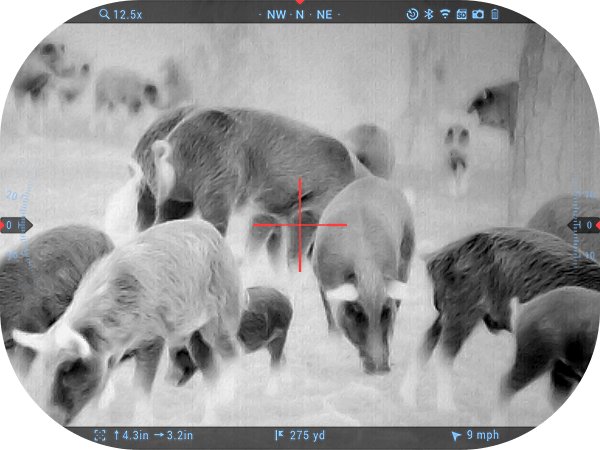
- Hog control — reading a whole sounder in the dark before you pick a target, often for hours at a stretch.
- Property and pest management — checking fence lines and fields after dark without throwing light that spooks game.
- Observation and scouting — learning what moves on your ground at night so you hunt smarter by day.
- Recording the hunt — capturing footage with Recoil Activated Video to review shots and share the night afterward.
Key features that affect value
- Sensor resolution (384 vs 640) — think of it like standard definition versus high definition: a 640x512 sensor carries more detail to the edge of the frame, which is the main thing that lifts a scope into a higher tier.
- NETD (thermal sensitivity) — at <=15mK the ThOR 6 reads faint heat, so contrast holds up in fog, drizzle and heat-soaked ground rather than washing out.
- Detection range — tied to lens size; the flagship's 50mm glass reaches a 3650m detection range, the smaller-lens models less, and you pay for the extra reach.
- Refresh rate — 50 Hz keeps fast movement smooth, which is where cheaper thermal optics usually fall down.
- SharpIR AI — on-board enhancement that cleans edges in real time so an animal reads as itself, not a blur, without adding cost across the line.
- Battery and recording — roughly 9 hours from a 2x 18650 pack, plus Recoil Activated Video and the ATN Connect 6 app, standard on every ThOR 6.
What to look for before buying
- Start from your real range. Log the distance you actually identify and shoot at, then buy the sensor and lens that cover it — do not pay for a 3650m reach you will never use.
- Weigh sensor over magnification. Resolution is what lets you identify at distance; digital zoom only makes a blur bigger, so put your money in the sensor first.
- Check NETD, not just pixels. A sensitive <=15mK sensor keeps the picture usable in bad air, which decides more nights than an extra ounce of zoom.
- Confirm the platform is current. The 6th-gen ThOR 6 line shares the newest AI, app and recording — an older generation may look cheaper but gives up capability.
- Match the power system to your sits. All-night stands reward the swappable 18650 build so a spare set keeps you running.
Common mistakes when judging a thermal scope's price
- Chasing magnification instead of sensor. A big zoom number on a small sensor still hands you a blur at distance; resolution is what you are really paying for.
- Ignoring NETD. Two scopes with the same pixel count can perform worlds apart in fog if one has a far more sensitive sensor.
- Overbuying reach. Paying flagship money for a 3650m detection range when your shots fall inside a couple hundred yards wastes the premium.
- Underbuying the sensor. Saving on resolution to hit a lower tier can leave you unable to identify at the range you actually hunt.
- Judging on the sticker alone. A current-generation platform with better sensitivity and AI can be the smarter buy even when it sits a tier up.
Example: the ATN ThOR 6 640x512 3-24x
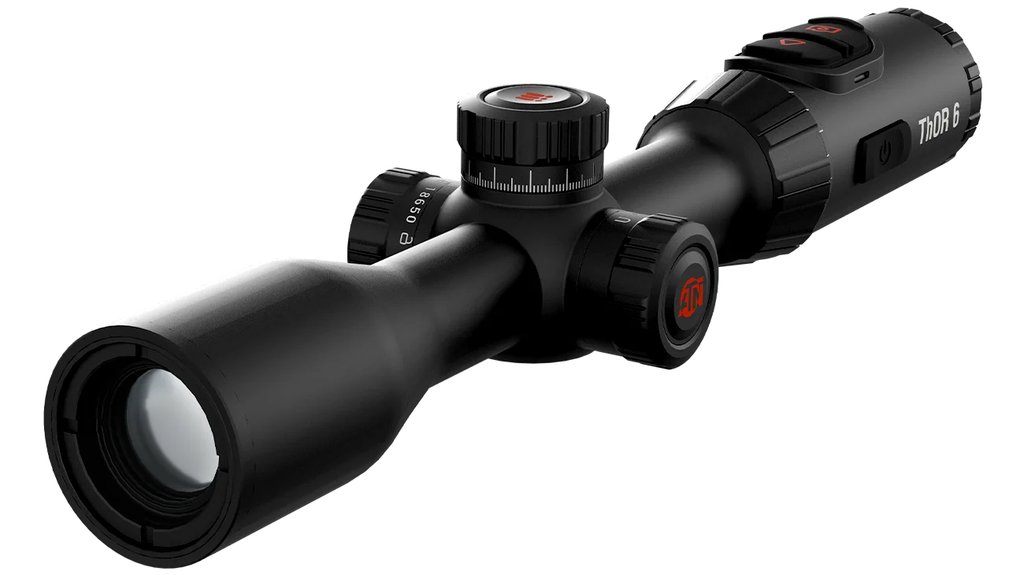
To make the ladder concrete, take the ATN ThOR 6 640x512 3-24x, the flagship of the line. It sits at the top tier because it stacks the expensive ingredients: a full 640x512 sensor, a 50mm germanium objective, a 3650m detection range and a 3-24x zoom band, all on the <=15mK, 50 Hz platform. Step down to the 640x512 2-16x and you keep the sensor but trade lens and reach for a lower tier; step down again to the 384x288 2.5-20x and you drop the sensor for the value tier. Same AI, same app, same recording throughout — what changes with price is purely how far and how clearly the optic sees. For the current figure on each, check the model's page rather than any number quoted here.
Is a thermal scope worth it?
For anyone who hunts predators or manages hogs after dark, a thermal scope pays for itself in nights that would otherwise be a write-off — you see, identify and act in true darkness with no light to spook game. Whether the value tier or the flagship is worth it to you comes down to the range you hunt and how sensitive an image you need in bad weather. The value-tier 384 model handles honest mid-range work, while the flagship 640 earns its outlay on open ground where early identification is everything. Buy for the range you actually shoot, keep to the current 6th-gen platform, and a ThOR 6 is a season-long tool rather than a gadget.
How this guide was put together
This is an in-house explainer from ATN about our own 6th-generation ThOR 6 line, not an independent lab review, so treat it as a starting point and check the specs against how you actually hunt. To answer what drives a thermal scope's price we looked at the levers that genuinely move it — sensor resolution and thermal sensitivity (NETD), detection range, lens size, refresh rate, weight and battery life — and judged each against real field use rather than a spec sheet. Only current ThOR 6 models were considered. The honest trade-off: more sensor, glass and reach cost more, and no amount of digital zoom substitutes for a bigger sensor. Who this guide is not for: anyone shopping purely on the lowest sticker with no regard to the range they hunt, since the cheapest option can cost you the shot that matters.
Frequently Asked Questions
What makes one thermal scope cost more than another?
Mostly the seeing hardware: sensor resolution, thermal sensitivity (NETD), lens size and the detection range that hardware delivers. Across the ATN ThOR 6 line the features are shared, so moving up a tier buys more sensor and more reach, not different gadgets.
Does a bigger sensor really change the price that much?
Yes. A 640x512 sensor carries far more detail than a 384x288 one and lets you identify at greater distance, and that jump is the clearest single reason one ThOR 6 sits a tier above another.
Is a cheaper thermal scope good enough for hunting?
It can be, if your ranges are honest. The value-tier ThOR 6 384x288 2.5-20x handles mid-range hog and predator work well; the extra cost of the 640 models buys reach and clarity you only need on open ground.
Do features like recording and Wi-Fi add to the price?
Not really. SharpIR AI, Recoil Activated Video, Hot Point Tracking, Wi-Fi and the ATN Connect 6 app ride on every ThOR 6 regardless of tier, so they are not what separates a value model from the flagship.
Where can I see the exact price of an ATN thermal scope?
On each model's product page in the ATN thermal scope range. This guide sticks to why prices differ; the current figure for any ThOR 6 variant is listed on its own page.
Should I spend more on magnification or on the sensor?
The sensor. Resolution is what lets you identify at distance, while digital zoom past the optical range only enlarges a blur. Put your money into a better sensor before a higher zoom number.
Sensor: 640x512 thermal.
NETD: <=15mK for a clean image in fog and drizzle.
Magnification: 3-24x (up to 8x digital zoom).
Detection range: 3650m from the 50mm germanium lens.
Refresh: 50 Hz for smooth motion.
Battery: ~9 hours from a 2x 18650 pack.
Weight: 830 g / 1.83 lbs. Plus SharpIR AI, Recoil Activated Video, Hot Point Tracking and ATN Connect 6.
Now that you know what drives the number, put a real figure to it: open the ATN ThOR 6 640x512 3-24x page for the flagship, or browse the full range of ATN thermal scopes to compare sensors, lenses and reach across the value and flagship tiers side by side. Match the sensor and detection range to the way you actually hunt, and you will pay for the seeing you need instead of the one on the box. Every ThOR 6 runs SharpIR AI and the Connect 6 app, so whichever tier you land on, you are ready to hunt from night one.
Created: August 10, 2026 · 10:05:21 UTC