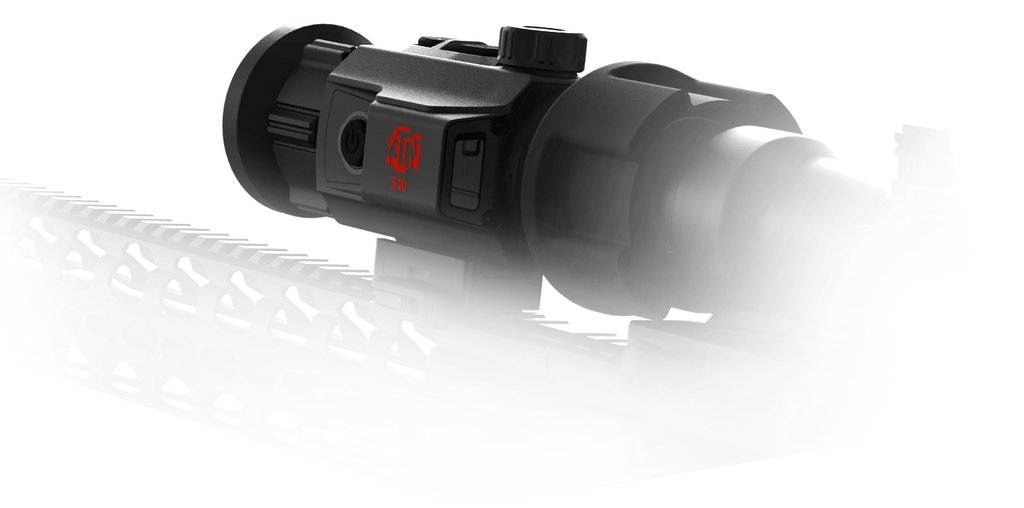
A clip on thermal scope attachment is the answer when you like your rifle exactly the way it is. Instead of swapping optics, the ATN TICO 6 clamps onto the front of the day scope you already run, sits in the light path, and turns that scope into a thermal setup for the night. You keep the glass you trust, you keep your zero, and when you pull the clip-on off it drops into your hand as a thermal monocular for scanning. This roundup sorts ATN's 6th-generation thermal clip-ons by how they mount and get used, and every pick is a TICO 6.
Short answer: for a clip on thermal scope attachment, the ATN TICO 6 384x288 1-12x is our top pick. It clamps in front of your existing day scope with the included Quick Detach Mount, keeps that scope's zero, and pops off in seconds to work as a handheld thermal monocular for scanning.
Quick answer: top ATN picksBest overall clip-on setup: ATN TICO 6 384x288 1-12x — clamps to the day scope you already run, keeps your zero, and doubles as a monocular.
Best for the longest reach: ATN TICO 6 640x512 1-15x — the high-resolution 640 sensor and 50mm lens push detection farthest for far-country rigs.
Best dual-role handheld: ATN TICO 6 384x288 1-12x again — lighter in the hand when you drop the eyepiece on and scan on foot.
Why ATN's 6th-gen clip-on attachments fit the rifle you already run
A clip-on attachment earns its place because it changes nothing you have already dialed in. You do not re-zero, you do not learn a new reticle, and you do not give up the day scope you shoot well. The TICO 6 mounts on a rail in front of that scope, drops its thermal image into the same line of sight you already use, and lets you keep hunting with the exact hold you trust. Both attachments here share the same 6th-gen fundamentals — an NETD of 18 mK or lower (NETD is the smallest temperature difference the sensor can see, and a lower number means a cleaner picture in damp or cold air), a 50 Hz refresh so motion stays smooth, SharpIR AI sharpening the image, a removable eyepiece that turns the unit into a monocular, and the included Quick Detach Mount so it comes on and off without touching your zero. The difference between them is how much sensor and lens you want out front, which comes down to how far your setup needs to reach.
One note on magnification before the table misleads anyone: a clip-on's own optics are essentially 1x. It does not add zoom of its own. The magnification you see comes from the day scope behind it, so a scope set to 4x gives you a 4x thermal picture, and a scope wound to 10x gives you 10x. The TICO 6 384 is a natural match for day scopes up through the 1-12x range and the TICO 6 640 for scopes up to about 1-15x, which is why those ranges appear in their names — they describe the host scope the attachment is built to feed, not zoom in the clip-on itself.
Best overall clip-on setup: ATN TICO 6 384x288 1-12x
The ATN TICO 6 384x288 1-12x is our top clip on thermal scope attachment because it does the core job cleanly and adds a second life as a monocular. It clamps in front of your day scope with the included Quick Detach Mount, feeds a 384x288 thermal image into your existing glass, and holds your zero when it comes on and off. At 524 g / 1.15 lbs it is the lighter of the two, which matters both up front on a carbine and in the hand when you switch to scanning.
Keeps your zero, keeps your rifle
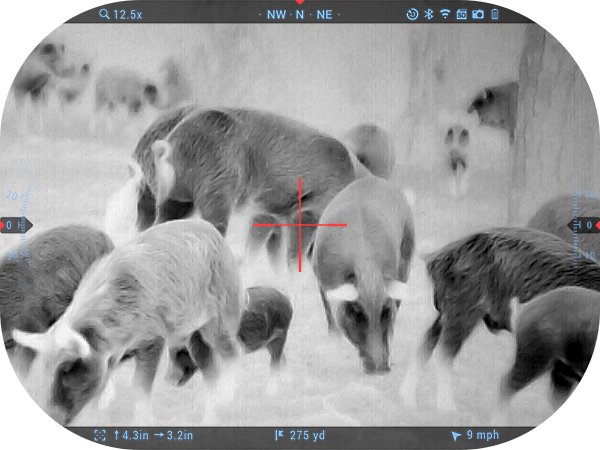
The whole point of this setup is that your rifle stays your rifle. The Quick Detach Mount returns the attachment to the same position each time, so the day scope you sighted in stays sighted in — you are not re-zeroing every night. The 384x288 sensor (resolution is the pixel count of the picture, so more pixels means more detail to work with) and an NETD of 18 mK or lower give you a clean image to hold on, and detection out to 2710 m means you spot heat long before it is in range. SharpIR AI tidies the edges so a warm shape reads as an animal rather than a smudge.
Drops off into a handheld monocular
Pull the removable eyepiece on and the same unit becomes a thermal monocular you can carry in a jacket pocket. That is the dual-role trick: scan a field on foot with it in your hand, spot heat, then clamp it back in front of your day scope and take the shot with the rifle you already know. Recoil Activated Video (RAV) rolls when the shot breaks, Hot Point Tracking flags the warmest object in frame, and the included wireless remote lets you drive it without breaking your hold. Who it is for: a hunter who wants to add thermal to a rifle and optic they already trust, and who values one tool that both scans and mounts. Who it is not for: someone chasing the absolute longest reach in wide-open country — for that, step up to the 640.
Best for the longest reach: ATN TICO 6 640x512 1-15x
The ATN TICO 6 640x512 1-15x is the clip-on for a setup that needs to see far. It keeps everything that makes the attachment work — the Quick Detach Mount, the zero-hold, the removable eyepiece for monocular mode — but puts a higher-resolution 640x512 sensor and a larger 50mm lens out front. That combination stretches detection to 3500 m, the longest in the line, so on open ground you pick up heat well beyond what the 384 reaches.
More sensor, more detail at distance
Going from 384x288 to 640x512 is like moving from a standard picture to a high-definition one — the extra pixels give you more detail on a distant shape, so you can tell what you are looking at farther out. The 50mm lens gathers more of the scene's heat than the 384's 35mm, and the same 18 mK or lower NETD keeps a lukewarm animal separated from a cooling background on a damp night. Feeding that image into a day scope wound up toward its top end lets you read a far target the 384 would leave as a faint blob. It is the pick when your lanes are long and your day scope reaches out to about 1-15x.
Where the extra reach is worth it
This is the far-country attachment. Who it is for: a hunter shooting open fields, cut ground and long draws who wants the most detail the clip-on line can put in front of their scope. Who it is not for: someone working timbered edges and tight cover where shots stay close — the 640's extra lens and sensor add a little weight (564 g / 1.24 lbs) and runtime drops to about 7 hours on a single 18650, so if you never stretch past a couple hundred yards the 384 is the smarter, lighter match. Both attachments share the same clip-on and monocular behaviour; the 640 simply buys you reach where you actually have the lanes to use it.
How a clip-on keeps your zero
The feature that makes a clip on thermal scope attachment worth trusting is that it does not touch your point of impact. A clip-on sits in front of the day scope, in the light path, and simply projects a thermal image the scope then magnifies and aims through. Because your day scope is doing the aiming — the same reticle, the same zero you sighted in during daylight — the attachment adds thermal vision without moving where the bullet goes. The one thing that has to be repeatable is the mount, and that is what the included Quick Detach Mount handles: it clamps to the rail at the same spot every time, so the TICO 6 returns to the same position on the rifle whether it went on tonight or last week. Torque the mount to the rail once, confirm at the range that your daylight zero still holds with the clip-on fitted, and from then on the attachment comes on and off without a re-zero. That is the freedom the setup buys you — one rifle, one zero, thermal added only when you want it.
The monocular-mode trick, and why it changes a hunt
The removable eyepiece is the quiet reason a lot of hunters choose a clip-on over a dedicated thermal scope. With the eyepiece fitted, either TICO 6 becomes a handheld thermal monocular — light enough to carry loose, quick to bring up, and ideal for glassing a field before you ever shoulder the rifle. You walk in, scan the ground in your hand, find the heat, decide whether it is worth a stalk, and only then clamp the unit back in front of your day scope to take the shot. That saves you from carrying a separate scanner and a separate scope, and it keeps the rifle in a natural low-ready carry instead of up at your eye the whole time. The 384 is the lighter of the two in the hand at 524 g / 1.15 lbs, which is why it is our dual-role pick, but both units make the switch in seconds. Around 8 hours of runtime on the 384 (about 7 on the 640) from a single 18650 covers a full night of scanning-then-shooting, and you can carry a spare cell to swap when it runs low.
Pairing the attachment with your day scope
A clip-on only works as well as the day scope in front of it, so a little thought on the pairing pays off. Match the sensor to the magnification you actually use: the 384 feeds a day scope through roughly the 1-12x band cleanly, while the higher-resolution 640 has the detail to hold up when a scope is wound toward 1-15x, where a smaller sensor would start to look soft.
- Mount ahead of the scope — the clip-on needs enough rail in front of the day scope to sit in the light path; check you have the length before you buy.
- Match the sensor to your zoom — push a day scope to high magnification and a 640 sensor holds detail where a 384 begins to soften, so pick the sensor for how far up you dial.
- Keep the optical axis in line — the attachment and the day scope should sit true to the bore so the thermal image lands centred in your field of view.
- Confirm the zero with it fitted — shoot a group with the clip-on mounted after the first install so you know your daylight zero holds through the attachment.
- Use monocular mode to scan first — drop the eyepiece on, glass the ground in hand, then clamp the unit back on the rifle only when you have something to shoot at.
A real night with the clip-on
Picture a still field an hour after dark. You leave the rifle slung and carry the TICO 6 384 in your hand with the eyepiece on, sweeping the treeline as a monocular. A warm shape drifts out along a fence — a hog, working the edge two hundred yards off. You watch it in the handheld for a moment, read the direction it is moving, and decide it is worth a shot. You clip the unit back onto the rail in front of your day scope, and because the Quick Detach Mount returns it to the same spot, your daylight zero is exactly where you left it. You bring the rifle up, the day scope's own reticle sits on the hog through the thermal image, and the 18 mK NETD keeps its body separated from the cooling ground. The 50 Hz refresh keeps it smooth as it steps, you settle your familiar hold, and RAV rolls the moment the shot breaks. No new scope to learn, no re-zero — just thermal added to the rifle you already shoot well.
Mounting and care
Getting the most from a clip-on comes down to a clean mount and simple upkeep. Seat the Quick Detach Mount on a solid section of rail, torque the clamp to spec, and mark its position so a shift shows before it costs you a shot. Keep the front and rear lens surfaces clean — a smear of dew or dust in the light path dulls the image the day scope then magnifies, so a lens cloth in your pocket is worth the space. Run a charged 18650 and carry a spare, since the cell is the only thing between you and a dead attachment mid-hunt; the 384 gives about 8 hours and the 640 about 7. When you switch to monocular mode, fit the eyepiece firmly so it does not work loose in your hand, and store the unit in a padded case so the mount interface stays true. Treat the mount and the glass with the same care you give the rest of the rifle and the attachment will keep returning to zero for years.
How to choose a clip on thermal scope attachment
Choosing between the two TICO 6 attachments comes down to how far you shoot, how much you carry, and how your day scope is set up. Both keep your zero, both drop off into a monocular, and both share the same 6th-gen sensor sensitivity and refresh rate. Work through these points against your own setup:
- Mounting — both use the included Quick Detach Mount; confirm you have rail length in front of your day scope for the clip-on to sit in the light path.
- Keeping your zero — the attachment aims through your day scope, so your existing zero is preserved; the mount is what makes it repeatable, so install it once and confirm with a group.
- Day-scope compatibility — match the sensor to the magnification you use: the 384 for scopes through ~1-12x, the higher-resolution 640 for scopes up to ~1-15x where a bigger sensor holds detail.
- Monocular mode — both remove the eyepiece to scan in the hand; the lighter 384 (524 g / 1.15 lbs) is the more comfortable handheld for long walks.
- Reach — if your lanes are long and open, the 640's 3500 m detection and 50mm lens earn their keep; in close cover the 384's 2710 m is plenty and it runs a little longer per charge.
- Runtime — both use a single 18650; the 384 gives about 8 hours, the 640 about 7, and a spare cell covers a full night either way.
How we picked these ATN thermal clip-ons
This is an in-house comparison of ATN's own thermal clip-on attachments, not an independent lab test, so treat it as a guide to matching an attachment to your rifle and confirm the specs against how you actually hunt. We judged the two TICO 6 units on what matters for a clip-on setup: how repeatably the mount returns to zero, sensor resolution and NETD for image quality, detection range for how far the attachment reaches, lens size, weight both up front and in the hand, and runtime on a single 18650. We weighed those against the real job of a clip-on — adding thermal to a day scope you already trust and scanning in monocular mode — rather than against a standalone scope. Only the current 6th-generation TICO 6 line was considered. The honest trade-off: the 640 sees farther and holds more detail at high magnification, but it is heavier and runs a little shorter per charge than the 384. Who this is not for: a hunter who would rather run a single dedicated thermal scope than clamp an attachment in front of existing glass — a clip-on's strength is keeping the rifle and optic you already shoot, and if you do not care about that, a standalone scope may suit you better.
Frequently Asked Questions
What is a clip on thermal scope attachment?
It is a thermal unit like the ATN TICO 6 that clamps onto the rail in front of your existing day scope and projects a thermal image into that scope's line of sight. You aim through your day scope as normal, so you get thermal vision without swapping optics or re-zeroing. The TICO 6 also removes its eyepiece to work as a handheld thermal monocular.
Does a clip-on attachment change my rifle's zero?
No. The clip-on sits in front of the day scope and aims through it, so your existing zero and reticle do the work. The only thing that has to be repeatable is the mount, which is why the TICO 6 includes a Quick Detach Mount that returns to the same position each time. Confirm the zero with a group after the first install and you are set.
Which ATN TICO 6 attachment should I choose?
For most setups the TICO 6 384x288 1-12x is the pick: lighter, longer runtime, and a natural match for day scopes through about 1-12x. Step up to the 640x512 1-15x if you shoot open country and want the higher-resolution sensor and 50mm lens for detection out to 3500 m and more detail at high magnification.
How does a clip-on's magnification work?
The clip-on itself is essentially 1x and adds no zoom of its own. All the magnification comes from the day scope behind it, so a scope set to 6x gives you a 6x thermal picture. That is why you match the sensor to your scope's zoom range rather than looking for magnification in the attachment.
Can the TICO 6 be used as a handheld thermal monocular?
Yes. Both TICO 6 attachments have a removable eyepiece that turns the unit into a handheld thermal monocular for scanning. You can glass a field in your hand, find the heat, then clamp the unit back in front of your day scope to take the shot with the rifle you already know.
How long does a clip-on attachment run on a charge?
The TICO 6 384 runs about 8 hours and the 640 about 7 hours on a single 18650 cell. Because the battery is swappable, carrying a spare cell lets you cover a full night of scanning and shooting without recharging.
What does the NETD rating on the TICO 6 mean?
NETD is the smallest temperature difference the sensor can detect, measured in millikelvin (mK). Both TICO 6 attachments are rated at 18 mK or lower, and a lower number means a cleaner, more detailed image in tough conditions like damp or cold air where heat signatures are faint.
Want to add thermal to the rifle you already trust? Start with the ATN TICO 6 384x288 1-12x — it clamps in front of your day scope, keeps your zero, and drops off into a monocular for scanning. If your lanes run long and you want the most reach and detail, look at the 640x512 build instead. Either way, compare the full range of ATN thermal clip-on attachments to match the sensor, lens and reach to the day scope you already shoot. Keep the optic you know, and let the TICO 6 handle the dark.
Created: August 10, 2026 · 10:05:21 UTC