Best Thermal Scopes Under $1,000 for Coyote Hunting in 2026: Top Value Picks
 For most of its history, thermal imaging was genuinely out of reach for the average coyote hunter. That has changed in 2026. The technology has matured, competition has increased, and the performance available at accessible price points is substantially better than what hunters had to work with even a few years ago.
The under-$1,000 category is now one of the most important segments in the thermal optics market, and for good reason. It is where the largest number of hunters are making buying decisions, and where the variance between good and poor choices is widest. Finding the best thermal scope under $1000 for coyote hunting requires understanding what this price range actually delivers, what realistic expectations look like, and which options are worth the investment.
The goal is not to find the cheapest thermal scope. It is to find a scope that delivers real predator-hunting performance — usable detection, reliable zero, practical battery life, and enough image clarity to make confident shot decisions — at a price that makes financial sense for your hunting frequency and terrain.
Can You Really Get a Good Thermal Scope Under $1,000 in 2026?
Yes — with realistic expectations. A thermal scope 1000 dollars or less in 2026 can deliver genuine night hunting capability if the hunter understands what they are buying and matches the scope to the terrain and distances they actually hunt.
Several things have changed in the sub-$1,000 thermal market in 2026. Entry-level thermal sensors have improved meaningfully in sensitivity, reducing the gap between budget and mid-range performance. Compact thermal scopes have become more widely available, giving hunters lightweight options that fit mobile predator setups without the weight of full-size alternatives. AI-enhanced image processing, once exclusive to premium models, has filtered down into mid-range products from established manufacturers.
What hunters should expect at this price point: solid close to mid-range detection capability, functional image quality for typical coyote hunting distances, reliable construction from reputable manufacturers, and practical battery life for evening or overnight sessions.
What hunters should not expect: premium-tier identification detail at long range, the widest field of view, or the deepest feature sets found in higher-cost configurations. For hunters whose typical setup involves calling coyotes inside 150 to 200 yards on moderate terrain, sub-$1,000 thermal is fully adequate in 2026. For hunters working large open fields at extended distances, the investment case for a step-up option becomes clearer.
One thing to avoid is trusting detection range claims that far exceed what the sensor resolution and sensitivity can realistically support. An entry-level 256x192 sensor with a modest NETD rating cannot deliver the same real-world detection range as a 640x512 sensor with a 15mK rating regardless of what the marketing states. Evaluate detection claims relative to the sensor specification.
Ranked List: Best Thermal Scopes Under $1,000 for Coyote Hunting in 2026
Here is a practical ranked overview by use case. Check current 2026 pricing and available configurations directly with the manufacturer before purchasing, as specific model pricing can vary.
- Best Overall Under-$1,000 Thermal Pick: ATN ThOR 6 Mini (384x288 model) — Delivers 6th generation thermal performance in a compact, lightweight housing. Full 0.49-inch OLED display at 1920x1080, SharpIR AI image enhancement, Hot Point Tracking, 50 Hz refresh rate, Zeroing Freeze, RAV, 64 GB internal storage, Wi-Fi, and a replaceable 18650 battery with approximately seven hours of runtime. Strong feature depth at a competitive price. Check current 2026 pricing at atncorp.com.
- Best Compact Sub-$1K Thermal Scope: ATN ThOR 6 Mini (256x192 model) — Entry point into the ThOR 6 Mini lineup. Compact housing at 180mm length, around 500 grams, Picatinny rail mount included, and up to eight hours of battery life. Most accessible configuration in the series for hunters on a tighter budget.
- Best for Beginner Coyote Hunters: ATN ThOR 6 Mini (256x192 model) — Simple 3-button controls, Zeroing Freeze for straightforward setup, and real thermal detection for close to mid-range calling setups. A practical entry into thermal without an overwhelming feature set or cost.
- Best for Mobile Calling Setups: ATN ThOR 6 Mini — Compact form factor and sub-540-gram weight keep the rifle balanced and easy to carry between stands. Picatinny rail mount fits most bolt guns and ARs directly without additional hardware.
- Best for AR-15 Predator Builds: ATN ThOR 6 Mini — Compact housing, light weight, Picatinny rail mount, and a 6,000-joule recoil rating make it a natural fit for AR-platform predator setups where rifle balance and handling speed are priorities.
- Best Value for Occasional Night Hunters: ATN ThOR 6 Mini (256x192 model) — Hunters who go out a handful of nights per season get genuine thermal capability and a full smart feature set without committing to a full-size or premium-priced optic.
- Best Step-Up Choice Before Premium Thermal: ATN ThOR 6 (384x288 model) — For hunters at the top of the under-$1,000 range or willing to stretch slightly, the full-size ThOR 6 at the 384x288 level offers 15mK NETD sensor sensitivity, a larger OLED display, approximately nine hours of battery life, and a more complete feature set. Check current 2026 pricing and configuration availability at atncorp.com.
Buyer's Guide: What Matters Most Under $1,000
Choosing a sub-1000 thermal riflescope requires prioritizing the features that actually determine field performance at this price range. Here is what to evaluate before committing to a purchase in 2026.
Sensor Resolution and Thermal Sensitivity
These two factors together determine how well the scope detects and defines heat sources. A 384x288 sensor with an 18mK or better NETD rating delivers meaningfully more detection capability and image detail than a 256x192 sensor with a 20mK rating. At the sub-$1,000 level, resolution and sensitivity directly determine whether the scope can identify a coyote clearly at your typical hunting distance.
Detection Range vs. Identification Confidence
Detection tells you something is there. Identification tells you it is a coyote and not a deer, a dog, or another animal. These are different capabilities and different distances. At lower resolutions, the identification window closes faster. Know which one matters more for your specific hunting setup.
Refresh Rate
A 50 Hz refresh rate produces fluid motion tracking on moving coyotes. This matters when an animal is trotting, circling, or running. Lower refresh rates create choppy images on fast-moving targets that make shot timing and follow-up accuracy harder.
Display Quality
OLED displays offer better contrast, deeper blacks, and faster response times than older screen technology. Both the ATN ThOR 6 and ThOR 6 Mini use OLED displays. The 384x288 and higher configurations in both lines use a 0.49-inch 1920x1080 OLED display. The 256x192 Mini uses a smaller 0.32-inch 800x600 OLED display — functional for close setups but less suited to extended scanning sessions.
Battery Life and Replaceability
A replaceable battery system using standard 18650 cells is strongly preferred at any price point. Carrying a spare cell and swapping it in the field eliminates battery anxiety on longer hunts at negligible cost and weight. Both the ThOR 6 and ThOR 6 Mini use replaceable 18650 systems.
Weight and Rifle Balance
Heavier thermal scopes shift rifle balance toward the muzzle. For hunters running mobile setups or lightweight rifles, compact options in the 500 to 580 gram range cause significantly less disruption to handling than full-size alternatives weighing 800 grams or more.
Mounting Compatibility
Confirm whether the scope includes a mount or requires separate hardware. The ThOR 6 Mini uses an integrated Picatinny rail mount that fits most rifles directly. The ThOR 6 uses 30mm rings that are not included and must be purchased separately. Factor mount cost into the total budget.
Zeroing Process
Zeroing Freeze pauses the image at the moment of recoil impact, allowing precise reticle adjustments without rushing before the image resets. This feature is available on both the ThOR 6 and ThOR 6 Mini and makes the zeroing process significantly faster and less frustrating for hunters of all experience levels.
Menu Simplicity
Thermal scope controls must work reliably in the dark with cold hands or gloves. A 3-button interface with logical, intuitive navigation is practically more valuable than a complex menu system with more options but higher cognitive load under time pressure. Both the ThOR 6 and ThOR 6 Mini use streamlined 3-button control layouts.
Weather Resistance
IP67 waterproofing and cold-temperature ratings matter for coyote hunting across a full winter season. Both the ThOR 6 and ThOR 6 Mini carry IP67 ratings and are rated to minus 30 degrees Celsius, covering the temperature range of most North American predator hunting environments.
Warranty and Support
A scope from a manufacturer with documented warranty support and a real service infrastructure is a stronger long-term investment than a similarly priced import with no meaningful support. Factor total ownership value, not just purchase price.

ATN ThOR 6: A Strong Value Option to Consider
The ATN ThOR 6 is built around a 6th generation thermal core with sensor options at 384x288 and 640x512, both featuring ultra-sensitive NETD sensors rated at 15mK or better on a 12-micrometer pixel pitch. That sensor sensitivity is a meaningful differentiator from lower-tier alternatives — it means the scope can detect temperature differences that would escape a less sensitive sensor, which matters in low-contrast conditions like warm autumn nights, early-morning fog, or hunting terrain where temperature differentials are narrow.
SharpIR AI-enhanced imaging processes the thermal image in real time, automatically improving edge definition and target contrast without manual input. For hunters who are still learning to read thermal images, this automatic processing reduces the gap between what the sensor captures and what the shooter can act on with confidence. Hot Point Tracking highlights the hottest object in the field of view immediately, accelerating the detection-to-engagement sequence on active calling setups.
The full feature set includes Zeroing Freeze, Recoil Activated Video, Picture-in-Picture, onboard video and audio recording with 64 GB internal storage, built-in Wi-Fi hotspot via the ATN Connect 6 app, six color palettes, and approximately nine hours of battery life from a dual replaceable 18650 system. Select LRF models add a built-in laser rangefinder and ballistic calculator rated to 1,000 meters.
The ThOR 6 fits hunters who call coyotes with regularity, want a more complete feature set, and are comparing long-term value rather than only upfront cost. At 1.74 to 1.89 pounds depending on configuration, it is heavier than compact alternatives — a relevant consideration for hunters who prioritize rifle balance or carry their rifle for extended distances. Check current 2026 pricing and configuration availability at atncorp.com.
ATN ThOR 6 Mini: Compact Thermal Performance for Practical Hunters
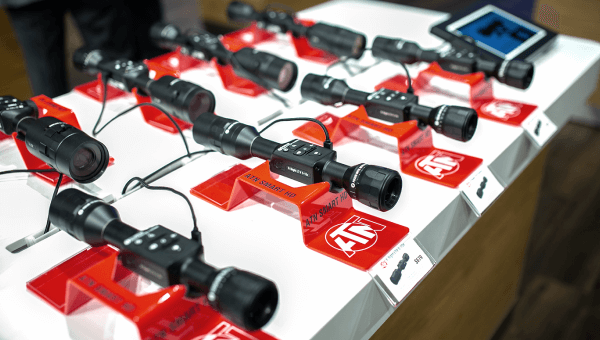
The ATN ThOR 6 Mini is an affordable thermal hunting scope that delivers the same 6th generation thermal platform as the full-size ThOR 6 in a significantly smaller and lighter form factor. At 500 to 580 grams depending on configuration, it represents a meaningful weight reduction that translates directly into better rifle balance, reduced fatigue during extended sessions, and easier carrying between stands.
It is available in three sensor configurations: 256x192 with a 20mK NETD sensor, and 384x288 and 640x512 with 18mK NETD high-sensitivity sensors — all on the same 12-micrometer pixel pitch thermal core. The 256x192 model uses a 0.32-inch OLED display at 800x600 with up to eight hours of battery life. The 384x288 and 640x512 configurations include the larger 0.49-inch 1920x1080 OLED display with approximately seven hours of runtime.
All ThOR 6 Mini configurations include SharpIR AI image enhancement, Hot Point Tracking, Picture-in-Picture, Reticle Transparency Control, Zeroing Freeze, multiple weapon profiles (up to five), Recoil Activated Video, built-in Wi-Fi hotspot, 64 GB internal storage, and a replaceable 18650 battery system. The housing is magnesium alloy, IP67 rated, and rated for 6,000 joules of recoil. Dimensions range from 180 to 200mm in length depending on configuration, fitting cleanly on most bolt guns and AR-15 platforms without charging handle clearance issues on standard configurations.
The multiple weapon profiles feature is practically valuable for hunters who run the same scope across multiple rifles or calibers. Zeroing Freeze simplifies the sighting-in process, especially when working in low-light conditions at the range before a season opener. The Picatinny rail mount included with the ThOR 6 Mini fits most modern rifle top rails directly without additional hardware.
Best fit: hunters who prioritize compact size, lighter overall system weight, and practical mobile field handling at a competitive price point — particularly those building lightweight AR-style predator rifles or running bolt guns where balance and carry comfort are priorities.
Comparison Table: Under-$1,000 Thermal Scope Options
| Scope / Option | Best For | Key Value Strength | Possible Trade-Off | Ideal Hunter Type |
|---|---|---|---|---|
| ATN ThOR 6 Mini (256x192) | Close setups, beginners, lightweight rifle builds, occasional hunters | Lowest cost entry to 6th gen platform; 500 g; Picatinny mount; 8-hour battery; full smart features | Smaller display; shorter detection range; identification distance narrows faster at range | Budget-focused beginner, occasional predator hunter, mobile setup, AR-15 build |
| ATN ThOR 6 Mini (384x288) | Mobile hunting, AR builds, mid-range calling setups, practical all-around use | 18mK NETD sensor; full 1920x1080 OLED; best feature-to-weight balance in the Mini line; detection to 2,300 m | Single battery vs. dual on full ThOR 6; ~7-hour runtime; higher cost than 256x192 entry | Mobile predator hunter who wants full smart features in a compact, lightweight package |
| ATN ThOR 6 (384x288) | Varied terrain, regular night hunting, open fields, field edges | 15mK NETD sensor; ~9-hour dual battery; larger OLED display; full feature set; detection to 2,300+ m | Heavier at 1.74 to 1.89 lbs; 30mm rings not included; higher investment than Mini | Frequent predator hunter who wants maximum feature depth and strong sensor performance |
| Generic sub-$1K thermal (no-name import) | Not recommended for serious use | Lowest upfront cost | Unreliable detection, zero, and build quality; no warranty support; inflated range claims common | Not recommended for hunters who expect consistent field performance |
What You Gain and Give Up Under $1,000
The under-$1,000 thermal category delivers genuine value in 2026. Being clear about both sides of that value equation helps hunters make decisions they will not regret after the first season.
What Hunters Can Gain
- Real thermal detection capability for close to mid-range coyote hunting without a premium-tier budget
- Compact and lightweight options that fit mobile setups and lightweight rifle builds
- Practical night hunting performance for the majority of common predator calling scenarios
- Easier justification for occasional or seasonal hunters who go out a limited number of nights per year
- Access to modern smart features including AI image processing, RAV, Wi-Fi, and internal storage at competitive pricing
- A manageable entry point for hunters new to thermal who want to learn the technology before committing to a higher-tier investment
What Hunters May Give Up
- Premium-tier image detail and identification distance, particularly at range in low-contrast conditions
- Wider field of view available on higher-tier configurations with larger objective lenses
- Longer battery life available on dual-battery full-size systems compared to single-cell compact options
- Maximum detection and identification range available on 640x512 sensors with the highest sensitivity ratings
- The construction ruggedness and materials quality found in top-tier premium optics
The key message: under-$1,000 thermal can work very well in 2026 if the hunter has realistic expectations, chooses a scope from a reputable manufacturer, and matches the optic's performance ceiling to the terrain and distances they actually hunt.
Detection Range vs. Identification Range
This distinction is one of the most important — and most commonly misunderstood — concepts for hunters evaluating thermal scopes in any price category.
Detection range is the distance at which the thermal sensor can register a heat source as something present. At this distance, you can see that something is there, but you may not be able to determine what it is. Identification range is the shorter distance at which the thermal image provides enough detail to confirm the target species with reasonable confidence — close enough to distinguish a coyote from a deer, a dog, or a fence post.
The gap between these two numbers is significant and widens as sensor resolution decreases. A 256x192 sensor may detect a heat source at 1,200 to 1,500 meters but may only provide confident identification out to 100 to 150 yards under real field conditions. A 384x288 sensor closes that gap meaningfully, and a 640x512 sensor closes it further.
For hunters evaluating thermal scopes under $1,000, the practical question is not what the maximum detection range is — it is whether the scope gives enough identification detail at the distances where they actually expect to take shots. If most shots happen inside 150 yards, a 256x192 sensor is fully adequate. If shots regularly extend to 200 yards or beyond, the 384x288 configuration is the more appropriate minimum investment.
Best Uses for Sub-$1K Thermal Scopes in 2026
As a practical coyote hunting optics budget guide, here are the scenarios where sub-$1,000 thermal scopes in 2026 deliver the most value and fit the hunting situation best.
- Bait sites — Close-range, fixed-position setups where coyotes approach to a known location. Any capable thermal scope with 256x192 resolution or better handles this scenario well.
- Smaller properties — Farms, woodlots, and mixed terrain under several hundred acres where shot distances are naturally limited and long-range detection is less critical.
- Calling setups inside realistic shooting distances — Most successful coyote calling sequences end with shots inside 150 yards. A 384x288 or even 256x192 sensor is fully adequate for this scenario.
- Wood lines and field edges — Thermal's ability to detect heat through light cover and total darkness makes it effective in these environments regardless of sensor resolution tier.
- Beginner predator hunters — Learning thermal hunting at accessible price points before committing to higher-tier investments is a rational approach for hunters building their predator hunting experience.
- Mobile night hunting — Lightweight compact options like the ThOR 6 Mini are specifically well-suited to walking setups where rifle weight and handling speed are priorities.
- AR-15 and lightweight rifle builds — Compact thermal options in the sub-$1,000 range add minimal weight to the rifle system and fit AR-platform setups without creating muzzle-heavy handling problems.
- Occasional winter coyote hunts — For hunters who go out a limited number of times per season, the sub-$1,000 price point is easier to justify on a per-hunt basis than a premium investment.
When You Should Spend More Than $1,000
The sub-$1,000 thermal category has real limits, and being honest about them helps hunters make decisions that serve their actual hunting situations rather than their wishful thinking about costs.
Consider spending more if you regularly hunt large open properties where coyotes may appear at 250 yards or beyond and you need the detection range and identification detail to act on those opportunities confidently. Consider spending more if you hunt multiple nights per week across a full season — at that frequency, the incremental performance of a better sensor, larger display, and more rugged construction pays for itself in outcomes and longevity.
Professional predator control operations that run year-round across varied terrain in all weather conditions benefit from the higher identification confidence, better image quality in difficult conditions, and stronger build durability of mid-to-premium tier options. If you need to deliver results consistently under adverse conditions, the performance margin of higher-tier optics is directly convertible to better outcomes.
Hunters who need maximum identification confidence before the shot — particularly when hunting near populated areas, farmsteads, or in any situation where target confirmation is critical — benefit from the clearer identification distance of higher-resolution sensors even if detection range is not the primary concern.
Common Mistakes Hunters Make When Buying Thermal Scopes Under $1,000
Buying Only by Lowest Price
The lowest-priced option is rarely the best value. A thermal scope that cannot reliably detect or identify coyotes at the distances you hunt has no useful value regardless of its purchase price.
Trusting Exaggerated Detection Claims
Detection range claims in thermal scope marketing are frequently optimistic. A detection claim that far exceeds what the resolution and NETD sensitivity can realistically support is a red flag. Cross-reference detection claims with sensor specifications before purchasing.
Ignoring Identification Range
Detection range is not identification range. Confirm that the scope gives enough image detail for confident target identification at the distances where you expect to take shots. This is a more relevant question than maximum theoretical detection distance.
Choosing Too Much Magnification
High magnification narrows field of view. For close calling setups where coyotes approach from multiple directions, a wider field of view at base magnification is more useful than maximum zoom capability. High-magnification configurations also typically cost more and may exceed what the terrain requires.
Forgetting Field of View
Field of view determines how much area you can monitor in a single sweep. Narrow field of view makes scanning less efficient and increases the chance of missing animals that approach from the edge of your coverage area during a call.
Overlooking Battery Life
A scope that runs low on battery before the hunt is over is a reliability failure. Confirm rated runtime and prioritize replaceable battery systems so that session length becomes a function of how many spare cells you carry rather than the scope's fixed capacity.
Ignoring Rifle Balance
Scope weight affects rifle handling significantly, particularly for hunters who hold shooting positions for extended periods or carry their rifle between multiple setups during a night hunt. Evaluate total system weight, not just optical performance.
Not Checking Mounting Compatibility
Verify the mounting system before purchasing. A scope that requires separate ring hardware adds unexpected cost to the total budget. A scope with an integrated Picatinny mount like the ThOR 6 Mini simplifies the installation process and avoids the need for additional hardware.
Skipping Zero Confirmation Before Hunting
A thermal scope requires a confirmed and stable zero before the first hunt. Do not assume the scope shipped with a usable zero or that zeroing after transport has not shifted the point of impact. Confirm zero before the season opens and after any significant transport or handling.
Assuming All Budget Thermal Optics Perform the Same
There is meaningful performance variation within the sub-$1,000 thermal tier in 2026. A compact scope from an established manufacturer with verified specifications, documented real-world use, and actual warranty support performs very differently from a similarly priced import with inflated claims and no service infrastructure.
Pros and Cons of Thermal Scopes Under $1,000
Pros
- Lower entry cost makes thermal hunting accessible to a broader range of hunters in 2026
- Real detection capability for close to mid-range coyote setups — the most common scenario for most predator hunters
- Compact and lightweight options available that keep rifle balance and carry weight manageable
- Practical for beginners and occasional hunters who want real thermal performance without premium investment
- Modern smart features including AI image processing, RAV, Wi-Fi, and internal storage now accessible at sub-$1,000 pricing from established manufacturers
- Strong value when expectations are calibrated realistically to terrain and hunting distances
Cons
- Image detail and identification distance fall short of premium optics, particularly at longer ranges
- Field of view and base magnification options may be narrower than higher-tier configurations
- Battery runtime on compact single-cell systems is shorter than dual-battery full-size alternatives
- Performance margin in difficult low-contrast conditions is smaller than at mid-to-premium tier
- Not the right tool for long-range open-country hunting where identification distance is regularly tested at 200 yards or beyond
Final Verdict: Best Thermal Scope Under $1,000 for Coyote Hunting in 2026
The thermal optics market in 2026 has made the under-$1,000 category genuinely competitive in ways it was not a few years ago. For hunters who approach this category with realistic expectations and choose carefully, finding the best thermal scope under $1000 for coyote hunting is an achievable goal — not a compromise.
The right choice depends on terrain, hunting distance, rifle setup, frequency of use, and how the hunter weighs weight against feature depth. For hunters who want a compact, lightweight thermal option with a full smart feature set and practical real-world performance, the ATN ThOR 6 Mini at the 256x192 or 384x288 level represents a strong value in 2026. It fits mobile setups, AR-15 builds, and hunters who want capable thermal without the bulk of a full-size scope.
For hunters who want a more complete feature set, stronger sensor sensitivity, and longer battery life — and who are willing to carry the additional weight — the ATN ThOR 6 at the 384x288 level is a step up worth evaluating. It covers a broader range of terrain and hunting distances while remaining focused on practical value rather than premium-tier pricing.
Compare the full ATN ThOR 6 and ATN ThOR 6 Mini lineups at atncorp.com to find the configuration that matches your 2026 hunting style, terrain, rifle setup, and budget.
Frequently Asked Questions
What is the best thermal scope under $1000 for coyote hunting in 2026?
The best thermal scope under $1000 for coyote hunting in 2026 depends on hunting style and terrain. For hunters who want a compact, lightweight option with a full smart feature set, the ATN ThOR 6 Mini at the 384x288 level is a strong choice. For hunters who want maximum feature depth and sensor sensitivity, the ATN ThOR 6 at the 384x288 level is worth evaluating. Check current 2026 pricing and configurations at atncorp.com.
Can a thermal scope under $1,000 really work for coyote hunting?
Yes — in 2026, thermal scope 1000 dollars or less options from established manufacturers deliver genuine night hunting capability for close to mid-range predator setups. The key is matching the scope's sensor resolution and detection capability to your actual hunting distances and terrain, not assuming every sub-$1,000 option delivers the same performance.
What should I expect from a sub-$1,000 thermal riflescope?
From a quality sub-1000 thermal riflescope in 2026, expect solid close to mid-range detection capability, functional OLED image quality, 50 Hz refresh rate on current-generation options, practical battery life with replaceable cell systems, IP67 weather resistance, and intuitive field controls. What you may not get is the widest field of view, the longest identification distance, or the deepest feature set available at higher price points.
Is ATN ThOR 6 good for coyote hunting?
Yes. The ATN ThOR 6 in 2026 delivers 6th generation thermal core performance with 15mK or better NETD sensor sensitivity, SharpIR AI image enhancement, Hot Point Tracking, 50 Hz refresh rate, and approximately nine hours of battery life. It is a capable and feature-complete option for predator hunters who call regularly and want strong performance across varied terrain and conditions.
Is ATN ThOR 6 Mini a good compact thermal option?
The ATN ThOR 6 Mini is one of the more practical affordable thermal hunting scope options available in 2026 for hunters who prioritize compact size and lighter rifle builds. At 500 to 580 grams depending on configuration, with a Picatinny rail mount included, and the full 6th generation thermal platform, it delivers the core performance of the ThOR 6 lineup in a housing that fits mobile setups and AR-style predator rifles well.
What is more important under $1,000: detection range or image clarity?
For most coyote hunters calling at realistic distances — inside 150 to 200 yards — image clarity and identification confidence matter more than maximum detection range. Detection range tells you something is there. Image clarity tells you what it is and whether to take the shot. At the sub-$1,000 level, prioritizing a scope with the best sensor sensitivity and OLED display quality at a given price point is generally the better decision than chasing the highest detection range claim.
Should beginners buy thermal under $1,000 or save for a higher-end scope?
For most beginners in 2026, starting in the sub-$1,000 category makes sense. The performance at this level is adequate for learning how coyotes respond to calls at night, building familiarity with thermal imaging, and developing the shooting skills that night predator hunting requires. If after a season or two the hunter identifies specific performance limitations that are costing them opportunities — longer identification distance, wider field of view, better performance in difficult conditions — that is the right time to evaluate a step-up investment rather than overspending before developing the experience to make the most of premium performance.