Ask what the best thermal scope on the market is and you're asking for the top of the top — the scope where nothing important is compromised. That's a specific question, and it deserves a specific answer rather than a hedge. A thermal scope is only as good as its weakest fundamental: a big lens on a low-resolution sensor still gives a soft picture, a sharp sensor behind a small lens still runs out of reach, and a great picture on a slow refresh still smears the moment an animal moves. The best on the market is the one that refuses to have a weak link. In ATN's current 6th-gen line, that flagship is the ATN ThOR 6 640x512 3-24x. It runs the highest-resolution sensor in the family, the tightest sensitivity, the longest reach and a full-featured processing suite, all in a waterproof body. This isn't a value pick or a budget compromise — it's the no-excuses choice for a hunter who wants the best picture and the longest reach the line offers, and who would rather pay once for the top than buy twice on the way up. Here's what puts it at the top, spec by spec, with the LRF version for hunters who want ranging built in.
Best with ranging built in: ATN ThOR 6 LRF 640x512 — flagship plus a laser rangefinder.
Longest reach: 3650m detection on the 50mm lens.
Sharpest picture at distance: the 640 sensor at <=15mK.
Why ATN's 6th-gen flagship sits at the top of the line
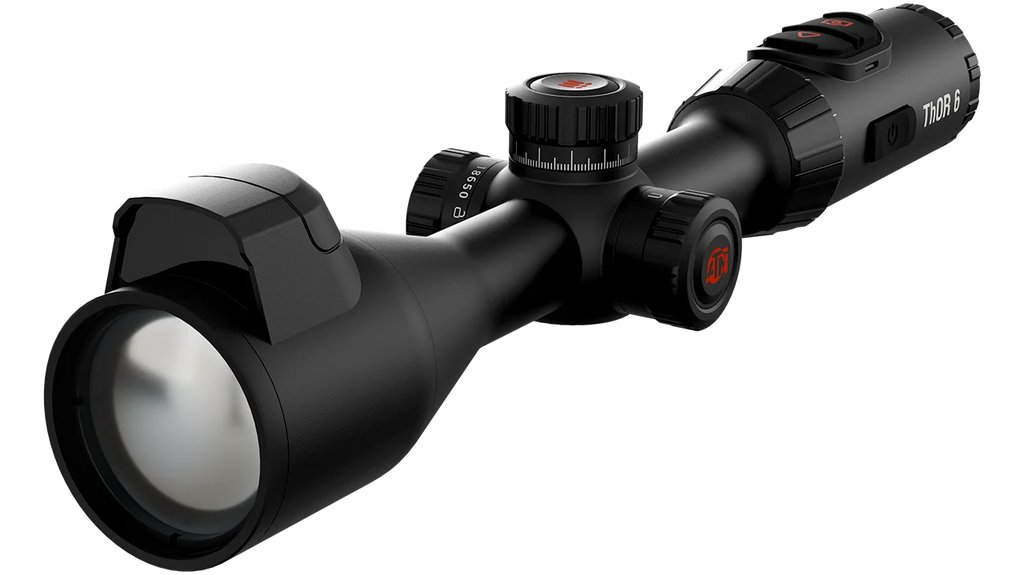
A flagship earns the title by refusing to compromise on the specs that decide picture quality and reach — and the ThOR 6 640x512 3-24x doesn't. It carries the highest-resolution sensor in the family at 640x512, roughly four times the pixels of a 384 core, so the image stays sharp and detailed all the way up its 3-24x optical zoom. Those extra pixels are not a spec-sheet brag; they are what let you read an animal instead of guessing at it. A 384 core stretched to high magnification thins its detail until a far shape becomes a warm smear, but the 640 keeps enough resolution on target that at distance you can still pick out legs, head and the direction it's facing — the difference between committing to a shot and holding fire. That sensor sits behind a large 50mm F/1.0 germanium objective, and the F/1.0 aperture is deliberate: the lower the f-number, the more infrared signal the glass gathers, so the sensor is fed a stronger, cleaner picture rather than a starved one. That light-gathering is what stretches detection to 3650m — the longest in the line — because reach is a partnership between a big sensor and a big, fast lens, not either one alone. Sensitivity is dialed to <=15mK, the tightest ATN offers; NETD measures the smallest temperature difference the sensor can resolve, and a lower number means it separates a faint heat signature from the background even when fog, dew or humidity flatten the scene and rob contrast. On top of that, SharpIR AI sharpening runs on the raw signal to clean up noise and firm up edges, so the extra detail the 640 captures reaches your eye instead of dissolving into grain. Then the rest of the suite comes standard: a 50 Hz refresh for smooth movement, a Full-HD 1920x1080 OLED display, Hot Point Tracking, Recoil Activated Video and IP67 waterproofing. Nothing that shapes real performance has been trimmed. That's what makes it the top pick rather than merely a good one.
Best on the market: ATN ThOR 6 640x512 3-24x
The ATN ThOR 6 640x512 3-24x is the flagship — the scope to buy when you want the best the line offers and nothing held back. Its 640 sensor and 50mm lens combine for the sharpest picture at the greatest distance, out to a 3650m detection range, and the 3-24x optical zoom brings far targets in close while the high pixel count keeps them detailed. The reason it sits at the top isn't any single headline number; it's that the numbers are matched to each other. A 640 sensor deserves a 50mm lens to feed it, a lens that reaches deserves a fast refresh so the far target doesn't smear, and all of it deserves tight sensitivity so weather can't wash it out. Those pieces reinforce one another here instead of one out-running the rest, which is exactly what you're paying for at the top of the line. The sections below take each strength in turn.
No-compromise reach and clarity
On open ground, this is where the flagship separates itself. The big lens gathers the signal, the 640 sensor renders the detail, and the <=15mK sensitivity keeps it all clean even when the weather works against you. Where lesser scopes turn distant heat into a shapeless blob, the flagship still shows you the animal — legs, head, direction of travel — so you can make an ethical call at distance. It's worth being clear about what that reach means. Detection range is the distance at which the scope can tell you something warm is out there; identification range — actually recognizing what the animal is and whether it's the one you want — is shorter, and it shrinks further in heavy weather or against a warm background. The flagship's advantage is that its resolution, lens and sensitivity push that identification distance out much further than a lesser scope manages, so the gap between spotting heat and confirming a target is smaller. That's the whole reason to buy the top of the line: not a bigger number on paper, but more confident calls at ranges where a compromise scope leaves you unsure.
Picture a real night to see how those specs stack up. You're set up on the edge of a picked field with open ground running out to the far treeline, and a coyote noses out well past where a smaller-core scope would have shown you only a wandering warm dot. On the flagship, the 50mm lens pulls in enough signal that the shape has substance, the 640 sensor holds its outline as you run the zoom up, and the <=15mK sensitivity keeps it separated from the cooling stubble around it — so you can watch it move, confirm it's a coyote and not livestock, and read that it's quartering rather than head-on. SharpIR firms the edges, the 50 Hz refresh keeps it from smearing as it trots, and you have the time and the picture to make a clean, ethical shot instead of a hopeful one. That's the flagship doing exactly what you paid for.
Smooth on fast game
Resolution is wasted if movement smears it, so the flagship pairs its sensor with a 50 Hz refresh. Refresh rate is how many times a second the display redraws the scene, and at 50 Hz the image updates fast enough that a moving animal renders as a clean, connected shape rather than a stuttering ghost. This matters most at the high magnification the 640 sensor invites: the more you zoom, the more any motion — the animal's or your own — is magnified, so a slow refresh that looked fine at low power turns to mush at 20x-plus. A coyote breaking across a field or a hog trotting a treeline stays crisp in the eyepiece instead of blurring, which keeps your reticle honest on a moving target and lets you track it smoothly to the shot. Fast refresh and high resolution work together — one without the other leaves performance on the table, and the flagship refuses to.
The complete toolkit
Being the flagship means nothing is held back on features either. It carries all six color palettes, Picture-in-Picture, Hot Point Tracking, Recoil Activated Video, Zeroing Freeze, Reticle Transparency Control, Wi-Fi to the ATN Connect 6 app and 64 GB of onboard storage, all shown on a Full-HD 1920x1080 OLED display. Each of those earns its place: the six palettes let you switch to whichever rendering — white hot, black hot or a colored profile — reads best against a given background; Picture-in-Picture floats a zoomed aiming window over a wider view so you don't lose the field while you hold on a target; Hot Point Tracking tags a heat source and keeps a marker on it as you pan; Zeroing Freeze locks the image while you dial your zero so a shifting picture can't throw the process off; and Reticle Transparency Control dims a crosshair that would otherwise wash out a dim, distant animal. Everything the line offers is here in one scope, with nothing paywalled to a higher tier.
Built for the long, wet night
A flagship that can't finish the night isn't a flagship, so the ThOR 6 640 is built to stay out. It's IP67 rated, meaning a hard rain, heavy dew or a river-bottom fog won't end your hunt — the sealed body keeps water out where a lesser build would fog or fail. It runs on dual 18650 batteries for around 9 hours of use, enough to cover a full night's sit and then some, and because 18650s are a standard, swappable cell you can carry a charged spare and be back up in seconds rather than tethered to a charger. That combination — waterproof body plus long, refillable runtime — is what lets you commit to the kind of long, weather-exposed nights where the flagship's reach actually pays off, instead of babying it home early.
Record and review every shot
The flagship also keeps a record of the hunt. Recoil Activated Video senses the shot and automatically saves the moments around it, so you capture the hit without fumbling for a record button in the dark — useful for confirming placement, reviewing a miss, or settling exactly what happened on a fast encounter. All of it lands on 64 GB of onboard storage, and Wi-Fi through the ATN Connect 6 app lets you stream the view to a phone or tablet, pull footage off the scope and share it without cables. For a hunter who wants to learn from every outing, that review loop turns each night into feedback rather than a memory that fades by morning.
Who it's for and who it's not
It's for the hunter who wants the best picture and the longest reach ATN builds and won't settle for a compromise. It's not for someone hunting only tight cover at close range or shopping on the tightest budget — they'd overpay for reach they won't use. If you want the top, though, this is it — or its LRF sibling below.
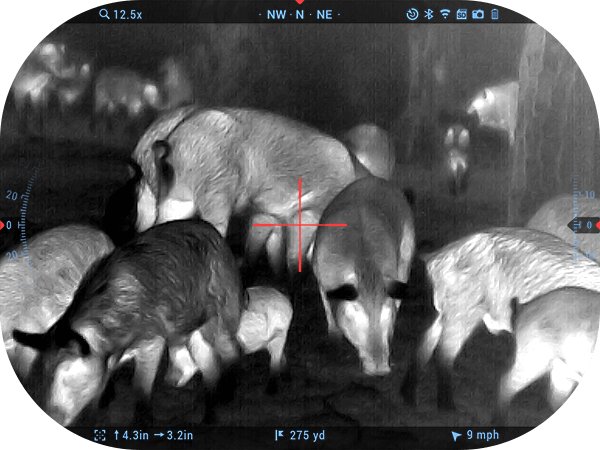
Best flagship with ranging: ATN ThOR 6 LRF 640x512
The ATN ThOR 6 LRF 640x512 takes the flagship and adds a built-in laser rangefinder — the one thing the standard 640 leaves out. It ranges to 1000m with +/-1m accuracy via an eye-safe 905nm Class 1 laser and feeds that into a ballistic calculator with up to 6 profiles, so a long shot becomes range, solution, send, all without lowering the rifle. It shares the standard flagship's 640x512 sensor, 50mm F/1.0 lens, <=15mK sensitivity and 3650m detection range verbatim — the picture and the reach are identical. What changes is that the LRF turns that reach into something you can act on precisely, because at the distances the sensor and lens can see, knowing the exact range stops being a nicety and becomes the deciding factor in the shot.
Why ranging completes the flagship
A flagship 640 scope reaches far enough that bullet drop becomes a real variable, and a wrong distance guess turns a good setup into a clean miss. Eyeballing range in the dark is a coin flip, and past a couple hundred meters a fifty-meter error can move your point of impact off the vitals entirely. The built-in rangefinder closes that gap. In practice the workflow is three quick beats: hit the laser to range the animal — the 905nm eye-safe Class 1 laser returns a distance out to 1000m with +/-1m accuracy — then let the ballistic calculator turn that number into a firing solution for your load, and send it, all without lowering the rifle or reaching for a separate device. Because everything happens inside the scope you're already looking through, you don't break your position or lose the animal while you do it. Storing up to 6 profiles means the calculator can hold the drop data for different loads or different rifles, so you pick the profile that matches what's on your shoulder tonight and the solution is right for that setup rather than an average. For the hunter who bought the top of the line to shoot at the top of its range, that integration is the finishing piece — the flagship's reach is only useful if you can put the round where the animal is at that distance, and the LRF is what makes the far shot repeatable instead of lucky.
The trade against the standard flagship
It adds a touch of weight — 855 g versus 830 g — and steps up in price for the ranging hardware. The sensor, lens, sensitivity and detection range are identical, so the only question is whether integrated ranging is worth it to you. For a long-range hunter it usually is: the 25-gram difference disappears on the rifle, and having the rangefinder built into the optic you're already aiming through is faster and steadier than fumbling for a handheld in the dark and then re-acquiring the animal. It also means one less device to carry, charge and lose. For a long-range hunter, that convenience compounds over a season into shots taken that would otherwise have been passed. Who it's not for: anyone who already runs a separate rangefinder they trust, or who shoots mostly at known, paced distances where a solution is already worked out — they can save the weight and the outlay by taking the standard flagship and lose nothing on picture or reach.
How to pick the best thermal scope on the market
At the top of the line, the choice isn't whether the scope is capable — it is — but which of its flagship strengths you'll actually use, and whether the ranging version is worth the step. Be honest about the distances you shoot and the weather you hunt in, because that's what tells you if you're buying capability you'll use or capability you'll carry. If most of your shots come inside a hundred meters in thick cover, the 3650m detection and the 640 sensor's long-zoom clarity are largely wasted on you, and you'd be paying for and hauling reach you'll never call on. But if you sit open fields, glass long draws, or take the shots that a lesser scope simply can't confirm, that same reach is the whole point — it's the difference between a night of near-misses and a night of clean, deliberate shots. The specs matter in a specific order, because the ones near the top of this list set the ceiling that the rest build on. Weigh them like this:
- Sensor resolution — a 640x512 core is the flagship's foundation; it keeps detail at long zoom where lower-res scopes go soft. This is non-negotiable for a top pick.
- Lens size — the 50mm objective is what turns a great sensor into 3650m of reach. Pair a big sensor with a big lens or you waste it.
- NETD sensitivity — <=15mK is the tightest ATN offers and keeps contrast clean in fog and humidity. It's part of what makes the picture flagship-grade.
- Refresh rate — 50 Hz keeps fast game smooth at high zoom, so the resolution isn't lost to motion blur.
- Ranging — decide whether you want a built-in laser rangefinder. The LRF bakes it in; the standard 640 keeps it lighter and less expensive.
How we picked the best ATN thermal scope on the market
We judged only ATN's current 6th-gen ThOR line and asked one question of each model: does it compromise on anything that shapes performance? The specs that decided it were sensor resolution, lens size, NETD sensitivity, refresh rate and detection range — the specs that actually determine whether you can see, identify and hit an animal at range — and the flagship leads or ties the line on every one. We deliberately did not let features like storage or app connectivity tip the call, because those are conveniences, not the things that make or break a shot; the ThOR 6 640 happens to carry the full feature set too, but it earned the top spot on the fundamentals. We also weighed each spec against the actual use-case behind the keyword: someone asking for the best on the market is asking for the ceiling, so we didn't discount a model for being expensive or heavy when the question was explicitly about which is best, not which is cheapest. That said, the honest trade-offs are real. The flagship is the priciest and among the heaviest in the family; a close-cover or budget hunter won't get their money's worth from its long reach, and the standard 640 versus the LRF comes down to whether integrated ranging is worth the extra weight to you. This is an in-house comparison of ATN's own scopes, not an independent lab review, so treat these as informed picks from within one brand's range rather than a verdict against the whole market — and weigh the 3650m detection and 640 resolution against the distances you truly shoot before you commit. Who it's not for: tight-budget buyers and close-range-only hunters, who are better served by a value or mini model that gives them most of the experience for less outlay and weight.
Frequently Asked Questions
What is the best thermal scope on the market from ATN?
The ATN ThOR 6 640x512 3-24x is the flagship and the best on the market in the line. It combines the highest 640x512 resolution, a 50mm lens, <=15mK sensitivity and a 3650m detection range with no meaningful compromises.
What makes a thermal scope the best on the market?
A top scope refuses to cut the specs that decide picture quality and reach — high sensor resolution, a large lens, tight NETD sensitivity and a fast refresh. The ThOR 6 640 3-24x leads or ties its line on all of them.
How far can the ATN ThOR 6 640 3-24x reach?
It has a 3650m detection range, the longest in the line, thanks to its 640 sensor and 50mm F/1.0 lens. Detection is spotting heat; your identification and shooting distance will be shorter and depend on conditions.
Should I get the standard flagship or the LRF version?
They share the same sensor, lens, sensitivity and reach. Choose the LRF if you want a built-in 1000m laser rangefinder and ballistic calculator; take the standard 640 if you already range separately or shoot at known distances and want to save weight and money.
Is the flagship worth it over a value scope?
If you regularly shoot open ground at long range, yes — the 640 sensor and 50mm lens hold detail where a 384 scope goes soft. If you hunt close cover or shop on a tight budget, a value or mini model gives you most of the experience for less.
Is the ATN ThOR 6 640 waterproof?
Yes, it carries an IP67 rating for rain and wet field use, and its dual 18650 batteries deliver around 9 hours of runtime. That build is part of what makes it a true flagship for hard, long nights.
What features come on the flagship ThOR 6 640?
It includes all six color palettes, Picture-in-Picture, Hot Point Tracking, Recoil Activated Video, Zeroing Freeze and Reticle Transparency Control, shown on a Full-HD OLED display. Wi-Fi to the ATN Connect 6 app and 64 GB of storage let you record and share footage. Nothing is paywalled to a higher tier.
What magnification range does the ThOR 6 640 3-24x cover?
It runs 3-24x optical magnification, so you can drop to 3x for a wide field when scanning close cover and zoom up toward 24x to bring a distant animal in for identification and the shot. Because it's a 640x512 sensor, the picture holds detail across that range instead of going soft at the top end, and the 50 Hz refresh keeps a moving target crisp even at high zoom.
Want the top of the line with nothing held back? The ATN ThOR 6 640x512 3-24x delivers the highest resolution, the longest reach and the cleanest picture ATN builds — and the LRF version adds a laser rangefinder for precision at distance. See both flagships alongside the rest of the family on the ATN thermal scopes page and pick the one that matches how far you push your shots.
Created: July 7, 2026 · 14:32:46 UTC