You've got a number in your head — $1,000 — and a rifle that needs glass on it before the next new moon. That's a real budget, not a starting point for negotiation, so the question isn't "what's the best thermal scope" in the abstract. It's what actually fits under that number, and what distances it realistically covers once it's mounted and zeroed. A snowy fence line at 120 yards is a different problem than a cut cornfield at 300, and a scope that handles one doesn't automatically handle the other. This guide draws the line at $1,000 and tells you straight what gets you there, what's just outside reach, and where that budget starts to run out of range.
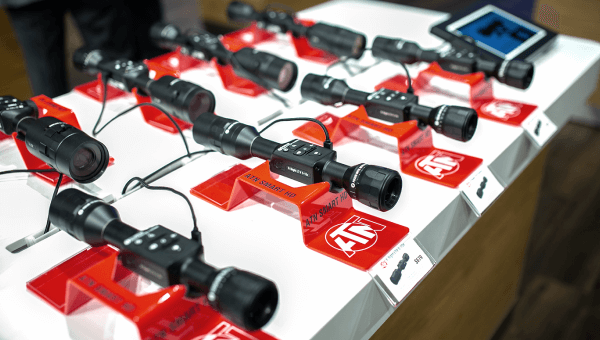
At a $1,000 ceiling, you're shopping the 256×192 sensor class — and one scope currently clears that bar outright. The ATN ThOR 6 Mini 256 2-16x lists at $985 with a real 12μm sensor, SharpIR processing, and a 1200 m detection range, enough to handle coyotes and hogs inside 150-200 yards without stretching your budget past its limit.
Quick answer: best thermal rifle scopes under $1,000
- Best overall under $1,000: ATN ThOR 6 Mini 256 2-16x (TIWST6M215) — $985, the only current ThOR 6 model that clears the line
- Best for the money: ATN ThOR 6 Mini 256 2-16x (TIWST6M215) — full smart-scope feature set at the lowest price point in the lineup
- Best lightweight pick: ATN ThOR 6 Mini 256 2-16x (TIWST6M215) — 500 g / 1.10 lbs
- Best long-range compromise close to the line: ATN ThOR 6 Mini 256 3.5-28x (TIWST6M225) — $1,205, just over budget but worth knowing about if you can stretch it
- Budget pick, full stop: ATN ThOR 6 Mini 256 2-16x (TIWST6M215) — $985
Why the latest generation stands out
A thousand-dollar ceiling used to mean settling for an older sensor generation with a slow refresh rate and a thin feature set. The current ThOR 6 Mini lineup changes that math. Even at the entry 256×192 resolution, the sensor is built on a 12μm thermal core with SharpIR AI-image enhancement, which sharpens contrast and edges in real time instead of leaving you to interpret a soft, low-detail blob. You still get a 50 Hz refresh rate, so a coyote breaking into a run doesn't smear across the screen. Smart features that used to live on scopes twice this price — Picture-in-Picture, Zeroing Freeze, Hot Point Tracking, Recoil Activated Video — are standard here too. Under $1,000 doesn't mean an old scope with a new sticker. It means the entry point into a current sensor generation, not a discontinued one.

What fits under $1,000, by the numbers
| Model | Sensor | NETD | Magnification | Detection range | Battery | Weight | Price |
|---|---|---|---|---|---|---|---|
| ThOR 6 Mini 256 2-16x | 256×192 | ≤20 mK | 2-16x | 1200 m | ~8 hrs | 500 g / 1.10 lbs | $985 — under $1,000 |
| ThOR 6 Mini 256 3.5-28x | 256×192 | ≤20 mK | 3.5-28x | 1500 m | ~8 hrs | 528 g / 1.16 lbs | $1,205 — over the line |
| ThOR 6 Mini 384 2.5-20x | 384×288 | ≤18 mK | 2.5-20x | 2300 m | ~7 hrs | Under 500 g | $1,975 — well over |
Best overall under $1,000: ATN ThOR 6 Mini 256 2-16x
What the distance actually looks like
Detection range on this scope is 1200 m, but detection isn't identification — it's the range at which a heat signature shows up on screen, not the range at which you can tell a coyote from a stump. Inside 150 yards, the 256×192 sensor at ≤20 mK NETD gives you a clean, confirmable silhouette, sharpened further by SharpIR processing. Between 150 and 200 yards, identification is still solid on a clear night; push past that and you're relying more on movement and shape than fine detail. If your terrain is a cut field where coyotes hang up at 250+ yards before committing, this is the edge of what $985 buys you. If you're working fence lines, feeder setups, or timber edges inside 150 yards, this scope has margin to spare.
Magnification and field of view
The 2-16x optical range with 8x digital zoom on top covers the scanning-to-shooting workflow most hunters actually use: wide field of view at low power to sweep a field, then dial in once you've got a target. The 15mm lens (F/1.0) keeps the field of view open, which is the right call for close-to-mid-range work rather than a narrow, long-reach setup.
Battery and build for a full night
A single 18650 rechargeable battery runs about 8 hours, and it swaps in seconds — carry one spare and you've covered a full night without hunting near an outlet. At 500 g and magnesium alloy construction, it's the lightest scope in the current lineup, rated IP67 and built to run from -30°C to +55°C. The 6000 Joule recoil rating covers standard hunting calibers without an upgrade.
What you get that you wouldn't expect under $1,000
Zeroing Freeze holds the image steady at impact so you can adjust the reticle without rushing. Hot Point Tracking flags the hottest object in frame, useful when you're scanning brush and don't want to miss a bedded hog. Recoil Activated Video captures 10 seconds before and after the shot automatically. Built-in Wi-Fi and 64 GB of internal storage are included, not upsells.
Buy this if your shots run inside 150-200 yards and you need to stay under a $1,000 ceiling without giving up smart-scope features. Skip it if you regularly need to identify game past 250 yards — that calls for either the next lens option or a step up in sensor resolution, both of which push past $1,000.

What's just outside the budget, and why it might be worth it
The ThOR 6 Mini 256 3.5-28x runs $1,205 — about $220 over the line — for the same 256×192 sensor with a longer 25mm lens, stretching detection range to 1500 m and magnification to 3.5-28x. If your hunting ground is open and your shots regularly sit past 200 yards, that $220 buys real range, not marketing. If you're working closer terrain, the extra reach goes unused and the narrower field of view at low power actually works against you when scanning. Stepping up to the 384×288 sensor line moves the price to nearly $2,000 — a different budget conversation entirely, not a marginal upgrade.
Scenarios: where $985 is enough, and where it isn't
- Coyotes on a called stand, 50-150 yards: $985 is enough. Detection and identification both hold up comfortably inside this range.
- Hogs at a feeder or bait site, under 100 yards: $985 is enough, with margin. Short range plays to the strengths of a 256 sensor.
- Fence-line scanning on a farm, 100-200 yards: $985 is enough for most nights; expect identification to get harder in the 180-200 yard range on marginal-contrast nights.
- Open pasture or cut cornfield, 250+ yards: $985 is not enough. You'll detect movement at range but struggle to confirm the target confidently. Budget for the 3.5-28x lens option or a higher-resolution sensor.
- Crossbow or PCP air rifle at short range: $985 is more than enough — the wide field of view and close focus work in your favor here.

How to choose under a hard budget
Start with the distance you actually shoot, not the distance you wish you shot. Most predator and hog hunting happens well inside 200 yards, and a 256×192 sensor at this price point covers that range without asking you to compromise on smart features or battery life. If your ground is genuinely long — open pasture, agricultural fields with no cover — be honest that $1,000 may not stretch far enough, and it's better to save toward the next lens or sensor tier than buy short and be disappointed in the field.
Rifle platform and weight matter under a hard budget too. A 500 g scope keeps a lighter rifle balanced, which matters if you're carrying a rifle on foot rather than sitting a stand all night. Check your mount height and rail length before you buy — a scope that's a perfect fit on paper is a headache if it doesn't clear your rifle's iron sights or magazine.
Don't let a low sticker price pull you below this tier without checking what's missing. A scope priced well under $985 with no stated sensor generation or NETD rating is very likely running older thermal technology — the savings come out of image quality you'll notice on your first cold night.

FAQ
What's the best thermal scope under $1,000?
The ATN ThOR 6 Mini 256 2-16x is currently the clearest option, priced at $985 with a 12μm sensor, SharpIR processing, and a 1200 m detection range. It's the only model in the current ThOR 6 lineup that fits under a $1,000 ceiling.
Is a thermal scope under $1,000 good enough for hunting?
Yes, for most predator and hog hunting inside 150-200 yards. A 256×192 sensor at this price point handles typical engagement distances well; it's long-range identification past 250 yards where the budget starts to show its limits.
What distance can I expect to identify game at with a $1,000 thermal scope?
Reliable identification generally holds inside 150-200 yards with a 256×192 sensor. The scope will detect heat signatures out to its full detection range, but confirming exactly what you're looking at gets harder as distance increases.
Why are some thermal scopes under $1,000 while similar-looking ones cost much more?
Sensor resolution and NETD sensitivity are the biggest price drivers. A 256×192 sensor scope can land under $1,000, while a 384×288 or 640×512 sensor with better low-contrast performance typically runs well over $2,000.
Should I wait and save for a more expensive thermal scope instead?
It depends on your typical shooting distance. If most of your shots are inside 200 yards, a scope under $1,000 does the job now. If you consistently hunt open ground past 250 yards, saving for a higher-resolution sensor is the better move.
Can a thermal scope under $1,000 handle cold weather hunting?
Yes — the ThOR 6 Mini 256 2-16x is rated for -30°C to +55°C operation and carries an IP67 waterproof rating, so cold and wet conditions aren't a limiting factor at this price point.
How long does the battery last on a budget thermal scope?
The ThOR 6 Mini 256 2-16x runs about 8 hours on a single 18650 battery, and the battery swaps in seconds. Carrying one spare covers a full night's hunt without needing to recharge in the field.
Bottom line
A $1,000 budget isn't a compromise if you match the scope to the distance you actually shoot. The ATN ThOR 6 Mini 256 2-16x fits under that ceiling at $985 and covers coyotes, hogs, and varmints inside 150-200 yards with a real sensor, real smart features, and a full night of battery life. If your ground runs longer, know that going in — don't buy short and hope. Check current pricing and specs on the ThOR 6 Mini 256 2-16x product page, or browse the full ATN thermal scope lineup if your budget or distance needs a different fit. For a broader look at what gets cut at every price tier, see our guide to the best cheap thermal scopes.