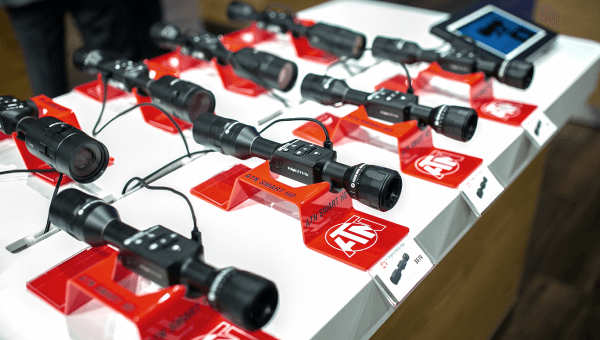
You already have a day scope zeroed to your rifle, and you do not want to give that up to hunt after dark. That is the exact problem a clip-on solves, and it is why the best clip on thermal scope for you is the one that matches the glass you already own: mount it in front of your existing optic and your reticle, your turrets and your zero all stay where they are. Below are the three ATN TICO 6 clip-ons, sorted by the day-scope magnification each one is built for.
Short answer: the ATN TICO 6 640 1-15x at $2,995 is the pick if your day scope runs past 12x — a 640×512 sensor at ≤18mK and 3,500 m of detection. For a 6-12x scope, the TICO 6 384 1-12x at $1,795. For an LPVO or anything up to 8x, the TICO 6 256 1-8x at $995, which is also the only one under $2,000 on both the store and list price.
Disclosure: ATN designs and manufactures all three clip-ons in this guide, and I run the company. That is a reason to read the cons as carefully as the pros, so each model below carries real limits rather than marketing ones, and every number comes from our own specification sheets with the date we checked them. We have not run a controlled head-to-head test of these three against each other, so there are no claims here about measured identification distances or zero shift.
Quick answer: the three picks
- Best overall — ATN TICO 6 640×512 | 1-15x ($2,995, list $4,285): 640×512 at ≤18mK, best with day scopes up to 15x.
- Best for the money — ATN TICO 6 384×288 | 1-12x ($1,795, list $2,415): 384×288 at ≤18mK, best with day scopes up to 12x.
- Best under $2,000 — ATN TICO 6 256×192 | 1-8x ($995, list $1,205): 256×192 at ≤20mK, best with an LPVO or any day scope up to 8x.

Why the latest generation stands out
Earlier clip-on designs asked you to trade image quality for convenience — you kept your day scope, but the thermal image through it was a step behind a dedicated scope. The TICO 6 line closes most of that gap with ATN's 6th Generation thermal engine: a 12µm VOx uncooled sensor running a 50 Hz refresh rate, paired with SharpIR© AI processing that sharpens edges and boosts contrast in real time.
The bigger shift is how the mounting works. The Quick Detach Mount attaches to a Picatinny rail in front of your scope and comes off in seconds without disturbing your zero — because the clip-on never touches your scope's internal adjustments, your day-scope zero holds. For hunters who have spent a season dialing in a rifle and do not want to redo that work, that is the entire value proposition in one sentence. All three models also record: 64 GB of internal storage, Recoil Activated Video, and Wi-Fi to the ATN Connect 6 app, with a wireless remote in the box.
Compare the TICO 6 lineup
| Best for | Model | Sensor / NETD | Day scope | Detection | Weight | Battery | Mount | Recording | Price |
|---|---|---|---|---|---|---|---|---|---|
| 4-15x bolt gun, open country | TICO 6 640 1-15x | 640×512, ≤18mK | up to 15x | 3,500 m / 3,828 yd | 564 g / 19.9 oz | ~7 hrs | QD Picatinny, or objective adapter | Yes | $2,995 (list $4,285) |
| 3-12x, all-round | TICO 6 384 1-12x | 384×288, ≤18mK | up to 12x | 2,710 m / 2,964 yd | 524 g / 18.5 oz | ~8 hrs | QD Picatinny, or objective adapter | Yes | $1,795 (list $2,415) |
| LPVO or 1-8x AR | TICO 6 256 1-8x | 256×192, ≤20mK | up to 8x | 1,500 m / 1,640 yd | 511 g / 18.0 oz | ~8 hrs | QD Picatinny, or objective adapter | Yes | $995 (list $1,205) |
Prices and specs: ATN product pages, checked 12 November 2026. The first price is the current store price, the second is list. Detection range is published in meters and converted to yards here; ounces are converted from the published grams. Detection is the distance at which the sensor registers a heat signature — not the distance at which you can identify an animal, and not a shooting distance. The Quick Detach Mount ships with every model; the Scope Mounting System that threads onto a day-scope objective is a $179 accessory, and the eyepiece adapter that turns the clip-on into a handheld monocular is $199.
Best overall: ATN TICO 6 640 1-15x
The TICO 6 640 1-15x is the one to buy if your day scope runs past 12x. A 640×512 sensor behind a 50 mm germanium lens is what keeps the image readable when your day optic is already magnifying it, and 3,500 m of detection is the longest in the line.
Pros
- Highest resolution here at 640×512, which is what survives being magnified again by a 15x day scope.
- Longest detection range of the three at 3,500 m (3,828 yd), behind a 50 mm F/1.0 germanium lens.
- 0.49-inch 1920×1080 OLED display, the same panel as the 384 and a step above the 256.
- Quick Detach Mount and wireless remote in the box; the eyepiece adapter turns it into a handheld monocular.
Cons
- $2,995 at the store and $4,285 at list — the most expensive clip-on in the line by a wide margin.
- About 7 hours on a single 18650, the shortest runtime of the three.
- 564 g / 19.9 oz hanging forward of your scope, which changes a rifle's balance more than a scope-mounted optic does.
- Overkill behind an 8x day scope: you pay for resolution your glass cannot pass through.
Key specs
640×512, 12µm VOx, 50 Hz, ≤18mK NETD; 50 mm F/1.0 germanium lens; 1× optical magnification, optimal day scope 1-15×; field of view 8.8° × 7.0°; detection 3,500 m (3,828 yd); 0.49-inch 1920×1080 OLED; one 18650 cell, about 7 hours; 564 g / 19.9 oz; 175×85×74 mm; magnesium alloy; IP67; −30°C to +55°C; 6,000 J recoil rating; 64 GB storage with Recoil Activated Video; SKU TICO6650A; $2,995.
Buy this if your day scope runs up to 15x and you want the sharpest image the TICO 6 line offers. Skip it if your day scope tops out around 8x — you would be paying for resolution your optic cannot fully use.

Best for the money: ATN TICO 6 384 1-12x
The TICO 6 384 1-12x keeps the ≤18mK sensitivity and the full-resolution display of the 640 on a smaller sensor and a 35 mm lens, for $1,200 less at the store price. For the 3-12x scopes most hunters actually run, this is the match.
Pros
- Same ≤18mK NETD and the same 0.49-inch 1920×1080 display as the 640, at $1,200 less in the store.
- About 8 hours on one cell — an hour longer than the 640.
- 40 g lighter than the 640, which you notice on a rifle that is already nose-heavy.
- 2,710 m (2,964 yd) of detection is more reach than most clip-on shooting ever uses.
Cons
- 384×288 is 110,592 pixels against 327,680 on the 640, so detail falls off sooner once a day scope magnifies the image.
- Rated for day scopes to 12x; past that the sensor is the limiting factor, not your glass.
- Stays under $2,000 at the store price but not at the $2,415 list price.
Key specs
384×288, 12µm VOx, 50 Hz, ≤18mK NETD; 35 mm F/1.0 germanium lens; 1× optical magnification, optimal day scope 1-12×; field of view 7.5° × 5.7°; detection 2,710 m (2,964 yd); 0.49-inch 1920×1080 OLED; one 18650 cell, about 8 hours; 524 g / 18.5 oz; 163×85×74 mm; magnesium alloy; IP67; −30°C to +55°C; 6,000 J recoil rating; 64 GB storage with Recoil Activated Video; SKU TICO6335A; $1,795.
Buy this if your day scope tops out at 12x or below and you want the full TICO 6 feature set at a lower price. Skip it if you are running a high-power day scope past 12x that would outresolve the sensor.
Best under $2,000: ATN TICO 6 256 1-8x
The TICO 6 256 1-8x at $995 is the only clip-on in the line that stays under $2,000 on both the store price and the $1,205 list price. It is built for an LPVO or any day scope up to 8x, which is most of what sits on an AR.
Pros
- Lowest price here at $995, and the only model under $2,000 on both numbers.
- Lightest of the three at 511 g / 18.0 oz in the shortest body, 159 mm long.
- Keeps the Quick Detach Mount, wireless remote, 64 GB storage, Recoil Activated Video and 6,000 J recoil rating of the rest of the line.
- The 25 mm lens and 1-8x pairing suits a short AR where rail space in front of the optic is tight.
Cons
- 1,500 m (1,640 yd) of detection against 2,710 m and 3,500 m on the larger models.
- ≤20mK NETD instead of ≤18mK — a real difference on humid nights, small but present.
- The display steps down to a 0.32-inch 800×600 OLED, and 256×192 is 49,152 pixels, about 15 percent of what the 640 carries.
- Not for a day scope past 8x: the sensor runs out before your glass does.
Key specs
256×192, 12µm VOx, 50 Hz, ≤20mK NETD; 25 mm F/1.0 germanium lens; 1× optical magnification, optimal day scope 1-8×; field of view 7.0° × 5.3°; detection 1,500 m (1,640 yd); 0.32-inch 800×600 OLED; one 18650 cell, about 8 hours; 511 g / 18.0 oz; 159×85×74 mm; magnesium alloy; IP67; −30°C to +55°C; 6,000 J recoil rating; 64 GB storage with Recoil Activated Video; SKU TICO6225A; $995.
Buy this if you run an LPVO or a day scope under 8x and want thermal on the same rifle without a second optic. Skip it if you hunt open country at distance — the 1,500 m detection and the smaller sensor are the wrong end of the line for that.

Clip-on vs. dedicated thermal scope
Buy a clip-on when the day scope on your rifle already works and you want one rifle for day and night. Buy a dedicated thermal scope when the rifle is a night rifle, when rail space in front of the optic is tight, or when you want more magnification and a purpose-built reticle for the money.
| Clip-on | Dedicated thermal scope | |
|---|---|---|
| Zero | Day-scope zero is untouched; nothing to re-zero | Needs its own zero, kept separately |
| Daylight use | Pull it off and the rifle is a day rifle again | Thermal all the time, no optical day channel |
| Weight and balance | 511–564 g forward of the scope, so the rifle goes nose-heavy | Weight sits over the receiver where the scope already was |
| Magnification | 1× optical; your day scope supplies the magnification | Built-in optical plus digital zoom in one unit |
| Reticle | Your day reticle and turrets, unchanged | Digital reticles, usually several styles |
| Rangefinder and ballistics | Not on the TICO 6 line | Available on LRF versions of the ThOR 6 |
If the answer is a dedicated scope rather than a clip-on, start with our guide to the best thermal scope for hunting. The engineering behind why a front-mounted unit holds your zero is unpacked in thermal clip-on vs dedicated scope.
How to choose a clip-on thermal scope
Match the clip-on's optimal day scope magnification to what you are actually running. A 640 sensor rated to 15x wastes its advantage on an 8x day scope, and an 8x-rated 256 sensor gets stretched thin behind a 16x day scope. Check your scope's top-end magnification first, then pick the clip-on rated for it.
Check your rifle's forward rail space. The QD mount needs a section of Picatinny rail in front of your scope; if you do not have one, the optional Scope Mounting System clamps around your day scope's objective bell instead. It comes in versions for 40 mm, 44 mm and 50 mm objectives, each with its own clamp diameter, so confirm your scope's objective before ordering.
Sensor resolution and NETD do different jobs, and on a clip-on both get judged twice — once by the thermal unit and again by the day scope magnifying its screen. Resolution decides how much detail survives that second pass: 640×512 is 327,680 pixels, 384×288 is 110,592 and 256×192 is 49,152. NETD decides whether there is usable contrast to begin with, and it runs ≤18mK on the 640 and 384 and ≤20mK on the 256. A lower NETD matters most on humid nights and over ground that has held the day's heat.
Plan for cold and for recoil. All three run a single replaceable 18650 cell for about 7 to 8 hours, and lithium cells lose capacity when it is cold, so carry a spare or a USB-C power bank for a long sit. On the durability side the whole line shares a 6,000 J recoil rating, IP67 sealing and a magnesium alloy housing rated from −30°C to +55°C, so the choice between models is about the sensor and the price rather than about which one survives the season.
Weight adds up in front of the balance point. A clip-on mounted forward of your scope shifts weight further from your shoulder than a scope-mounted optic does, so if you are already running a heavy rifle, the 256 model's lighter build at 511 g is worth considering even if you would otherwise choose a higher-resolution sensor.
Decide if you need the monocular function. All three TICO 6 models accept the eyepiece adapter that turns the clip-on into a handheld thermal monocular. If you also want to scout on foot before you are on the rifle, that dual-role capability is worth factoring into which model you buy, since it applies across the line. And check your state's rules on night hunting and thermal before you plan around any of it.

Frequently asked questions
Does a clip-on thermal scope require re-zeroing my rifle?
No. The clip-on mounts in front of your day scope and never touches its internal adjustments, so your existing zero holds and your reticle and turrets behave exactly as they did. You are adding a device in front of your optics, not replacing the optic itself.
Are clip-on thermals worth it?
They are worth it when you already own a day scope you do not want to replace and you want one rifle to work day and night. You keep the zero, the reticle and the daylight optic, and you add thermal for $995 to $2,995 instead of buying a second complete rifle setup.
What is the best thermal clip-on under $2,000?
The ATN TICO 6 256 1-8x at $995, list price $1,205 — the only TICO 6 under $2,000 on both numbers. It pairs a 256×192 sensor at ≤20mK with a 25 mm lens and 1,500 m of detection, and it is the lightest of the three at 511 g. The 384 model also stays under $2,000 at the store price, though not at list.
What is the best clip-on thermal for the money?
The ATN TICO 6 384 1-12x at $1,795, list $2,415. It carries the same ≤18mK sensitivity and the same 0.49-inch 1920×1080 display as the $2,995 flagship, and 2,710 m of detection, on a smaller sensor and $1,200 less at the store. For the 3-12x day scopes most hunters run, the extra resolution of the 640 is not reaching your eye anyway.
What magnification day scope works best with a clip-on?
It depends on the clip-on's sensor resolution. The TICO 6 640 is rated for day scopes up to 15x, the 384 model up to 12x, and the 256 model up to 8x. Match the clip-on to your scope's top-end magnification rather than buying the highest resolution regardless of fit.
Can you use a clip-on thermal with an LPVO or on an AR-15?
Yes, and the TICO 6 256 1-8x is built for exactly that: its 1-8x rating covers the magnification range of a typical LPVO, and its 159 mm body is the shortest in the line, which matters when rail space ahead of the optic is tight. A flat-top AR usually has the forward rail the Quick Detach Mount needs.
Can I use a clip-on thermal scope as a handheld monocular?
Yes, with the eyepiece adapter. All three TICO 6 models support it: attach the eyepiece and the clip-on works as a standalone thermal monocular for scouting off the rifle. The adapter is a $199 accessory rather than part of the standard box.
How does a clip-on mount to my rifle?
The included Quick Detach Mount clamps to a section of Picatinny rail in front of your scope. If your rifle has no forward rail space, the optional Scope Mounting System clamps around your day scope's objective bell, in versions for 40 mm, 44 mm and 50 mm objectives.
How far can you see with a clip-on thermal?
Published detection runs from 1,500 m on the TICO 6 256 to 3,500 m on the 640. Those are the distances at which the sensor registers a heat signature, not where you can tell what the animal is — identification happens at a fraction of them, and through a clip-on it also depends on the day scope in front of your eye.
Do clip-on thermals work in daylight?
Yes. Thermal reads emitted heat rather than visible light, so daylight does not damage the sensor and the unit works through the middle of the day. Contrast drops once the ground has absorbed the sun's heat, which is why dawn, dusk and shaded cover read best.
Does NETD matter on a clip-on?
Yes, and arguably more than on a dedicated scope, because a day scope magnifies whatever contrast the thermal unit produced. NETD is the faintest temperature difference the sensor can separate from the background: ≤18mK on the TICO 6 640 and 384, ≤20mK on the 256. Lower is better, and the gap shows up on warm, humid nights.
Are clip-on thermals legal for hunting?
It depends entirely on where you are and what you are hunting. Many states permit thermal on non-game species such as hogs and coyotes, often with conditions on licenses, seasons or landowner permission, and rules for game animals are usually stricter. Confirm the current rules with your state wildlife agency before the hunt.
How much does a clip-on thermal scope weigh compared to a dedicated thermal scope?
The TICO 6 line runs from 511 g to 564 g depending on sensor size. For comparison, a full-size ATN ThOR 6 thermal scope is 830 g and a ThOR 6 Mini is 500 to 528 g, so a clip-on sits between them — but its weight hangs forward of your existing day scope rather than over the receiver, which changes a rifle's balance more than a scope-mounted optic would.
What is the difference between the 640, 384 and 256 TICO 6 models?
Sensor resolution, detection range and the day-scope magnification each is built for. The 640 is 640×512 with 3,500 m of detection for scopes to 15x; the 384 is 384×288 with 2,710 m for scopes to 12x; the 256 is 256×192 with 1,500 m for scopes to 8x, and it is the lightest and cheapest.
Is a clip-on thermal scope better than a dedicated thermal rifle scope?
Neither is universally better. A clip-on preserves your existing day scope and zero and lets one rifle work day and night; a dedicated thermal scope is purpose-built as a single unit with its own magnification, reticles and, on LRF versions, a rangefinder. If you already own a day scope you do not want to replace, the clip-on gets you there without starting over.
Bottom line
Pick by the glass already on your rifle. If your day scope goes above 12x, the TICO 6 640 1-15x at $2,995 is the only one of the three that will not be the limiting factor. If it tops out at 12x or below, which covers most hunting rifles, the 384 1-12x at $1,795 gives you the same sensitivity and the same display for $1,200 less at the store price. And if you are running an LPVO or anything up to 8x on an AR, the 256 1-8x at $995 is the match, and the only one under $2,000 either way. All three keep your zero, come off the rail in seconds and take the eyepiece adapter for handheld scouting. Browse the full thermal clip-on lineup to match a model to your day scope.