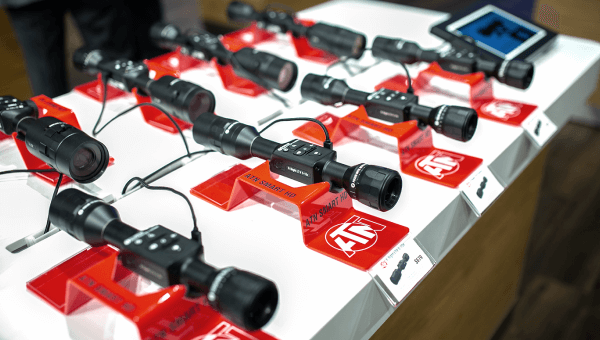
ATN ThOR LT 320 Honest Review for Coyote Hunters 2026:...

If you're hunting coyotes at night and you're trying to spend as little as possible on thermal, the ATN ThOR LT 320 comes up constantly. It's marketed as an entry-level option, it carries the ATN brand name, and the price point makes it tempting. But before you hand over your money, you need an honest breakdown of what this scope actually delivers in the field — and where it falls short. This ATN ThOR LT 320 review 2026 gives you exactly that.
Who Is the ATN ThOR LT 320 Built For?
The ThOR LT 320 is positioned as the cheapest thermal scope for coyote hunting in ATN's lineup. It's aimed at hunters who want to get into thermal imaging without spending four figures on a premium rig. If you're calling coyotes on open pasture land, running a fixed stand, or just want to stop using a flashlight or IR illuminator, this scope gives you a functional entry point.
It's not built for long-range precision shooting. It's not designed for professional predator control operations or tactical use. But for a hunter who wants reliable heat detection out to responsible distances and a manageable price tag, it earns its place on the shelf.
ATN ThOR LT 320 Specs: What the Numbers Actually Mean
Let's break down the ATN ThOR LT 320 specs in plain language, because the spec sheet only tells part of the story.
Sensor Resolution
The ATN ThOR LT 320 sensor resolution is 320x240. That's the core of everything. Resolution determines how much detail you see, how cleanly targets separate from background clutter, and how far you can positively identify what you're looking at before pulling the trigger. At 320x240, you're working with a lower pixel count than ATN's higher-tier offerings.
To put that in perspective, when you look at the thermal scope specifications for ATN's 6th Generation ThOR 6 series, those units run 384x288 or 640x512 resolution with a 12μm pixel pitch and ≤15mK NETD thermal sensitivity. The ThOR LT 320 doesn't match those numbers, and that gap matters at distance.
What 320x240 means practically: at 100 yards, you'll see a coyote as a clear heat blob. You'll know it's an animal. At 200 yards, the image softens. At 300 yards and beyond, positive species identification becomes difficult, and shot placement confidence drops off.
Thermal Sensitivity
NETD — Noise Equivalent Temperature Difference — is the sensor's ability to detect tiny heat differences. Lower is better. The ThOR LT 320 operates in the 50mK range, which is workable but not exceptional. Modern high-end sensors, like those in the ThOR 6 series, push ≤15mK. That gap means the LT 320 will struggle more than a premium unit in low-contrast situations: warm nights, fog, or dense brush where coyotes blend thermally with their surroundings.
Magnification and Field of View
The ThOR LT 320 offers a base magnification of 2x with digital zoom up to 4x or 8x depending on configuration. Digital zoom on a 320x240 sensor degrades the image fast. At 4x digital zoom, you're stretching a lower-resolution image and introducing pixelation. This limits effective engagement range for precise shot placement.
Display
The scope uses an LCOS display rather than OLED. When you compare this to the OLED displays in ATN's 6th Generation lineup — specifically the 0.49-inch 1920x1080 OLED in the ThOR 6 — the difference in contrast, black levels, and overall sharpness is noticeable in a side-by-side comparison. LCOS is not bad technology, but OLED produces deeper blacks and crisper thermal imaging, which directly affects how clearly you see heat signatures at dusk and in total darkness.
Battery Life
ATN rates the ThOR LT 320 at around 10 hours of battery life, which is generous for an entry-level scope. That's enough for a full night of coyote calling without a mid-hunt battery change. It runs on two AA batteries, which is both a limitation and a convenience — you can find AAs anywhere, but they don't deliver the same consistent voltage as 18650 rechargeable cells found in higher-end ATN units.
Refresh Rate
The ThOR LT 320 runs at 30Hz. That's adequate for general scanning and slower target movement, but if you're tracking a coyote that's been spooked and is sprinting across a field, 30Hz can introduce slight motion lag. Premium units like the ThOR 6 run at 50Hz, which provides noticeably smoother motion rendering and better tracking on fast-moving predators.
What the ATN ThOR LT 320 Does Well
Being honest in this coyote hunting thermal scope review means crediting what works, not just cataloging limitations.
- Detection at practical hunting ranges: Within 200 yards, the ThOR LT 320 detects coyotes reliably. On open fields with decent thermal contrast, that extends further for detection, even if identification and shot placement confidence don't.
- Easy to operate: The interface is straightforward. New thermal hunters won't spend 30 minutes fumbling through menus in the dark.
- Lightweight: It won't fatigue your rifle or make a long carry miserable.
- Multiple color palettes: White Hot, Black Hot, and other modes give you basic adaptability across conditions.
- Zeroing system: ATN's one-shot zero process works well even on this entry-level unit.
- Price: This is the defining advantage. For hunters on a strict budget, it gets you into the thermal hunting game without the financial commitment of a ThOR 6 or comparable premium option.

Where the ATN ThOR LT 320 Falls Short
This is the section that matters most if you're deciding between the LT 320 and spending more money on a better unit.
Limited Target Identification Range
Detection range and identification range are not the same thing. You might detect heat at 400 yards, but you cannot confirm species or even reliably determine target size at that distance with a 320x240 sensor. For ethical hunting, especially in areas where non-target animals might be present, this is a real constraint.
No AI Image Enhancement
ATN's ThOR 6 series features SharpIR© AI-enhanced imaging that dynamically sharpens heat signatures, improves edge definition, and enhances target separation in real time without manual adjustments. The ThOR LT 320 has none of that. What you see is raw sensor output with basic processing. In cluttered environments — fence lines, brush, tall grass — this makes it harder to distinguish a coyote from a stump or a deer from a fence post.
No Video Recording
The ThOR LT 320 does not record video. If documenting your hunts matters — either for personal review, content creation, or verifying shot placement — you need an external recorder or you're out of luck. ATN's premium ThOR 6 line offers 64GB internal video and audio recording, recoil-activated video (RAV), and USB-C media output. None of that is available on the LT 320.
No Wi-Fi Connectivity
There's no app integration, no live streaming to a smartphone, no ability to share your view with a hunting partner in real time. The ThOR 6 family connects to iOS and Android via the ATN Connect 6 app through a built-in Wi-Fi hotspot. That's a genuinely useful feature in the field — the LT 320 simply doesn't have it.
No Hot Point Tracking
Hot Point Tracking automatically identifies and highlights the hottest object in your field of view. It speeds up target acquisition significantly in cluttered environments. The ThOR LT 320 lacks this feature entirely, meaning you're doing all the scanning and identification manually.
Digital Zoom Degradation
On a 320x240 sensor, pushing digital zoom past 2x creates visible pixelation. This is a hardware constraint that no firmware update will fix. If you need to zoom in for shot placement on a coyote at 200-plus yards, the image quality drops off in ways that affect confidence and precision.
No Recoil-Activated Video or Internal Gallery
Features that come standard on higher-end ATN scopes — like RAV which captures 10 seconds before and after recoil automatically — are absent on the LT 320. There's no internal gallery to review footage in the field, because there's no recording capability at all.
ATN ThOR LT 320 vs ATN ThOR 6 Series: The Real Comparison
Understanding what you give up by choosing the entry-level option versus stepping up to the 6th Generation platform helps you make a smarter buying decision.
- Sensor resolution: 320x240 (LT 320) vs 384x288 or 640x512 (ThOR 6) — the ThOR 6 delivers substantially more detail and longer effective identification range.
- Thermal sensitivity: ~50mK (LT 320) vs ≤15mK (ThOR 6) — the ThOR 6 detects far smaller heat differences, critical in warm weather and low-contrast conditions where coyote hunting often occurs.
- Pixel pitch: The ThOR 6 uses a 12μm pixel pitch on a VoX uncooled focal plane array — a more advanced sensor architecture that contributes directly to image quality and detection at range.
- Display: LCOS (LT 320) vs 0.49-inch OLED at 1920x1080 (ThOR 6) — OLED wins on every measurable display metric relevant to thermal imaging.
- Refresh rate: 30Hz (LT 320) vs 50Hz (ThOR 6) — faster refresh means smoother tracking of running coyotes.
- Smart features: SharpIR© AI enhancement, Hot Point Tracking, RAV, Wi-Fi, internal video recording, Picture-in-Picture, Reticle Transparency Control — all present in the ThOR 6, all absent in the LT 320.
- Recoil rating: The ThOR 6 is rated to 6000 Joules / 1000g acceleration over 0.4ms. It's built to handle serious rifle platforms without losing zero.
- IP rating: The ThOR 6 carries an IP67 waterproof rating. Verified field durability for rain and wet conditions.
Honest Verdict: Is the ATN ThOR LT 320 Worth It in 2026?
Yes — under specific conditions. No — if you're serious about coyote hunting effectiveness.
If your budget is genuinely fixed and the alternative is hunting with no thermal at all, the ThOR LT 320 as the cheapest thermal scope for coyote hunting makes sense. It will show you coyotes in the dark at close to medium range, it won't break the bank, and it operates reliably enough for stand hunting on open ground.
But if you can stretch the budget, the gap between the LT 320 and a ThOR 6 Mini 325 or ThOR 6 Mini 335 is significant in ways that matter every single time you pull the trigger. The 6th Generation sensor in the ThOR 6 Mini delivers 384x288 at ≤18mK NETD with SharpIR© AI processing, a 0.49-inch OLED display, 64GB video recording, RAV, Wi-Fi, Hot Point Tracking, and a 50Hz refresh rate — all in a compact magnesium alloy body weighing around 528 grams. That's a different class of performance.
For the serious predator hunter calling stands multiple nights a week, the LT 320 will leave you wanting more resolution, more range, and more smart features the moment you encounter a coyote at 250 yards in dense brush on a warm night. The ThOR 6 series was designed precisely for those situations — and it handles them where the LT 320 struggles.
Who Should Buy the ThOR LT 320
- First-time thermal hunters with a strict entry-level budget
- Hunters primarily working distances under 200 yards on open terrain
- Those who want to test thermal hunting before investing in a premium unit
- Occasional use — a few nights per season rather than regular predator control
Who Should Step Up to ATN ThOR 6 or ThOR 6 Mini
- Serious coyote hunters running multiple stands per week
- Hunters working at 200-400+ yard distances where image resolution and NETD directly affect shot confidence
- Those hunting in warm weather where low thermal contrast makes a weaker sensor unreliable
- Hunters who want to document kills, review footage, or stream to a partner
- Anyone who needs Hot Point Tracking for faster target acquisition in brush
- Hunters running multiple weapon platforms who want multiple stored profiles
Final Thoughts on the ATN ThOR LT 320 Review 2026
The ATN ThOR LT 320 review 2026 honest conclusion is this: it's a legitimate starter thermal scope that fulfills a specific role at a specific price point. It will detect coyotes in the dark. It will work on your rifle. It won't let you down catastrophically on a close shot in good conditions.
What it cannot do is match the performance of ATN's 6th Generation thermal engine. The ≤15mK NETD sensors, 12μm pixel pitch, SharpIR© AI imaging, 50Hz refresh, OLED display, and full suite of smart hunting features in the ThOR 6 line represent a fundamentally better technology platform. If coyotes are a serious pursuit, understanding those differences — and the ATN ThOR LT 320 specs relative to what's available above it — helps you spend money once and spend it right.
The cheapest option isn't always the best value. But for the right hunter at the right budget, the ThOR LT 320 gets you in the game. Just know exactly what you're getting into before you mount it and head to the field.