An affordable thermal rifle scope is not the cheapest one on the shelf — it is the one that gives you the reach and image you actually need without paying for glass you will never use. That is the honest way to shop this category. This roundup sorts ATN's 6th-generation thermal scopes by tier — value, mid and flagship — so you can see exactly how much scope your hunting calls for and stop there. The anchor pick is the ATN ThOR 6 640x512 3-24x, and every option below is an ATN model in the same current line.
Best value (value tier): ThOR 6 384x288 2.5-20x — the smart-money entry into a full-featured 6th-gen scope.
Best balance (mid tier): ThOR 6 640x512 2-16x — a 640 sensor and swappable batteries without stepping up to the flagship.
Why ATN's 6th-gen thermal scopes make affordable make sense
Affordable does not mean stripped-down in the ThOR 6 line, because the whole line shares the same core. Every scope here runs a 50 Hz refresh for smooth motion, an NETD rated at 15 mK or better for a clean picture in damp air, SharpIR AI cleaning up the image, and roughly 9 hours of runtime on two 18650 cells. You are not choosing between a good scope and a cheap one — you are choosing how much sensor and reach you pay for on top of that shared foundation. The value tier gives you a real, full-featured thermal scope; the mid tier steps up the sensor; the flagship steps up both sensor and zoom. Where you land depends on how far you shoot and how much detail you need at that distance, not on cutting corners.
Flagship tier: ATN ThOR 6 640x512 3-24x
The ATN ThOR 6 640x512 3-24x is the pick when affordable means you do not want a ceiling on what the scope can do. Its 50mm F/1.0 objective and 640x512 sensor push detection to 3650 m, and the 3-24x zoom band gives you the magnification to positively identify and place a shot at the far edge of that reach. This is the tier for the hunter who takes long shots often enough that reach is worth the step up in price.
Why the 640 sensor earns its tier
Resolution is pixel count, and more pixels means finer detail at distance — the same jump you notice going from an SD picture to an HD one. A 640x512 sensor puts far more dots on a distant heat signature than a 384 sensor does, so a coyote at four hundred yards reads as a coyote instead of a warm smudge. Pair that with the NETD rated at 15 mK or better — NETD is the smallest temperature difference the sensor can detect, and lower is more sensitive — and the flagship pulls a lukewarm body out of a cooling background on a damp night when a lesser sensor would smear it.
What the reach actually buys you
Detection range is the farthest distance a heat signature is spotted, not identified — the 3650 m figure is about finding, not confirming. In practice the flagship's real value is that you detect an animal long before it is a shooting problem, giving you time to climb the 3-24x zoom, use Picture-in-Picture to hold a magnified aiming window while the wide field stays in view, and let Hot Point Tracking flag the warm object while you settle. Zeroing Freeze holds the reticle while you dial a distance zero, and RAV (Recoil Activated Video) rolls the moment the shot breaks so you can review the hit.
Who it is for: hunters who regularly reach past a couple of hundred yards and want the sharpest picture and longest detection in the line. Who it is not for: someone whose shots almost all land inside a hundred and fifty yards — you would be paying flagship price for reach you rarely use, and one of the tiers below is the more affordable, right-sized answer.
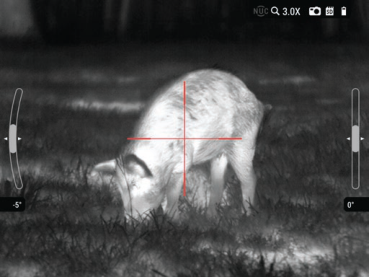
Mid tier: ATN ThOR 6 640x512 2-16x
The ATN ThOR 6 640x512 2-16x is the affordable middle ground — the same 640x512 sensor as the flagship, in a scope that steps back the magnification and reach to land at a lower price. Detection runs to 3100 m, plenty for most real hunting nights, and the wider 2x low end makes it quick to scan a whole field before you settle on anything. If you want full 640 clarity without paying the flagship premium, this is the tier.
The same sensor, a smarter spend
You keep the 640x512 resolution and the 15 mK NETD here, so the picture quality that matters most — how cleanly you can identify what you are looking at — does not drop when you save money moving down from the flagship. What changes is the zoom band and top-end reach, which is exactly the right thing to trade if your shots do not stretch to the flagship's limits. For the money, keeping the sensor and giving up some zoom is the affordable hunter's smart move.
Batteries that outlast the sit
This tier leans on a replaceable 18650 battery system, so a dusk-to-dawn stand never ends because the scope died — you swap cells in the dark and keep hunting. Combined with the roughly 9-hour runtime, the mid-tier scope is built to sit as long as you can. The wider 2-16x band also helps when you are covering ground quickly, keeping more of the field in view at the low end while you glass.
Who it is for: the all-round night hunter who wants 640 image quality and long stands without stepping up to the flagship. Who it is not for: someone who genuinely needs maximum reach and top-end zoom — that is the flagship's job — or a hunter on the tightest budget who does not need a 640 sensor at all, in which case the value tier is the honest pick.
Value tier: ATN ThOR 6 384x288 2.5-20x
The ATN ThOR 6 384x288 2.5-20x is the value-tier entry into a full-featured 6th-gen thermal scope — the most affordable way into the line without dropping to an older, discontinued model. It runs a 384x288 sensor, a 2.5-20x zoom band, six color palettes and detection to 2300 m, at the lightest weight in the group, 790 g / 1.74 lbs. For a hunter whose shots live inside mid-range, this is more than enough scope for less money.
Where a 384 sensor is exactly right
A 384x288 sensor puts fewer dots on the target than a 640, so its finest detail shows up at closer range — but for the hunter working woods edges, feeders and fields inside a couple hundred yards, that is precisely where you need it and precisely where the 384 delivers. You still get the 15 mK NETD, so the picture stays clean and sensitive; you are not buying a worse image, you are buying the right amount of resolution for your distances. That is what affordable is supposed to mean.
Light, flexible, full-featured
At 790 g / 1.74 lbs this is the lightest ThOR 6 here, so a lighter carbine or a walking rig points and handles better with it up top. The six color palettes let you tune the picture to conditions — white hot, black hot, or a color mode to make edges pop — and the same 50 Hz refresh keeps a moving animal smooth. Zeroing Freeze, Hot Point Tracking, RAV and the Connect 6 app all carry over, so the value tier is full-featured, not feature-starved.
Who it is for: budget-minded hunters and anyone whose shots stay inside mid-range who wants a real, full-featured thermal scope for the least outlay. Who it is not for: the hunter who regularly reaches out past two hundred yards and needs to identify at distance — a 640 sensor in the mid or flagship tier is worth the step up in price there.
How the three tiers actually differ in the field
The clearest way to feel the tiers is to picture the same coyote at three distances. Inside a hundred and fifty yards, all three scopes identify it cleanly — the value-tier 384 gives you everything you need, and paying more buys nothing you will notice. Push that coyote out to three hundred yards and the 640 sensors in the mid and flagship tiers start to pull ahead, resolving the shape while the 384 begins to soften. Put it near the edge of what is ethical, and the flagship's 3-24x zoom and 3650 m detection separate from the pack, giving you the magnification and reach to confirm and place the shot. Your typical shot distance is what tells you which tier is truly affordable for you — buying above it is spending, buying below it is a shot you cannot take.
What every tier shares
It is worth being clear about how much these scopes have in common, because it is why the value tier is a genuine scope and not a compromise. Across all three you get the 15 mK NETD sensitivity, the 50 Hz refresh rate, SharpIR AI image processing, the Full-HD OLED display, roughly 9 hours of runtime on two 18650 cells, Wi-Fi with ATN Connect 6, Zeroing Freeze, Picture-in-Picture, Hot Point Tracking and Recoil Activated Video. The features that make a night hunt easier — the ones you touch every time you are behind the rifle — do not change by tier. What you pay more for is sensor resolution and zoom-and-reach, full stop.
- 50 Hz refresh — smooth motion so a walking animal reads fluidly instead of stuttering, on every tier.
- 15 mK NETD — the same thermal sensitivity across all three, so the picture stays clean in damp, cooling air.
- SharpIR AI + Full-HD OLED — the same image processing and display, so clarity per pixel does not drop as you save money.
- ~9-hour runtime — the same long battery life on 2x 18650 cells regardless of tier.
- Zeroing Freeze, PiP, Hot Point Tracking, RAV, Connect 6 — the full feature set carries across the whole line.
How to choose an affordable thermal rifle scope
Choosing an affordable thermal rifle scope starts with your honest shot distance, not the spec sheet. Work out where your shots really land most nights, then buy the tier that covers that distance with a little margin — no more. Spending above your real range is money on reach you will not use; spending below it is a shot you cannot make. Use the list below to size the scope to your hunting.
- Start with distance — mostly inside ~150 yards points to the value-tier 384; regular 200-300 yard work wants a 640 sensor in the mid or flagship tier.
- Weigh detection vs identification — detection range finds the animal, resolution confirms it; longer, more open ground rewards more of both.
- Match the zoom to the shot — a wide low end helps you scan; a high top end helps you confirm at distance. Buy for the shots you actually take.
- Mind the rifle's balance — a lighter carbine or walking rig points better with the 790 g value-tier scope up top.
- Count your hours — long, all-night sits favour the swappable-battery mid tier so power never ends the hunt.
- Do not overpay for a ceiling — the affordable pick is the one that meets your real needs, not the one with the biggest numbers.
How we picked these ATN thermal scopes
This is an in-house comparison of ATN's own current thermal scopes, sorted by tier, not an independent lab review — so use it to size a scope to your budget and hunting, and check the specs against your own needs. We judged sensor resolution, NETD, detection range, refresh rate, weight and battery against the real question behind an affordable scope: how much reach and detail does your typical shot distance actually require. Only the current 6th-generation ThOR 6 line was considered, so nothing here is an older or discontinued model. The honest trade-off is straightforward — the value tier gives up sensor resolution and top-end reach to hit a lower price, and the flagship pays for both. Who this is not for: a hunter looking for one single 'best' with no thought to their own range, because the whole point of tiers is that the affordable answer changes with how far you shoot.
Frequently Asked Questions
What makes a thermal rifle scope affordable rather than just cheap?
Affordable means the scope matches your real hunting needs without paying for reach or resolution you will not use. A cheap scope skimps on the sensor and features that matter; an affordable ATN ThOR 6 keeps the full 6th-gen feature set and lets you choose how much sensor and zoom you pay for. The value-tier 384x288 2.5-20x is a full-featured scope, not a stripped-down one.
Which ATN ThOR 6 is the most affordable?
The value-tier ThOR 6 384x288 2.5-20x is the most affordable entry into the current line. It runs a 384x288 sensor, a 2.5-20x zoom, six color palettes and 2300 m detection at the lightest weight in the group. For shots inside mid-range it is more than enough scope for the least outlay.
Is a 384 sensor good enough, or do I need a 640?
A 384 sensor puts finer detail at closer range, so it is the right call for woods edges, feeders and shots inside a couple hundred yards. If you regularly reach past two hundred yards and need to identify at distance, a 640 sensor in the mid-tier 2-16x or the flagship 3-24x resolves the target far better. Buy the sensor that matches your real shot distance.
What does NETD mean and why does 15 mK matter?
NETD is the smallest temperature difference the sensor can detect, measured in millikelvin, and lower is more sensitive. All three ThOR 6 tiers here are rated at 15 mK or better, so they pull a lukewarm body out of a cooling background on damp nights. Thermal sensitivity does not drop as you move to a more affordable tier.
Do the cheaper tiers lose important features?
No. The 50 Hz refresh, SharpIR AI, Full-HD OLED, Zeroing Freeze, Picture-in-Picture, Hot Point Tracking, RAV and the Connect 6 app carry across every tier. What you pay more for is sensor resolution and zoom-and-reach, not the everyday features you touch behind the rifle.
How far can an affordable ATN thermal scope detect?
It depends on the tier: the value-tier 384 detects to 2300 m, the mid-tier 640x512 2-16x to 3100 m, and the flagship 640x512 3-24x to 3650 m. Detection range is the distance a heat signature is spotted, not identified, so more reach mainly buys you earlier warning and time to set up.
Which tier is best for long, all-night sits?
The mid-tier ThOR 6 640x512 2-16x leans on a replaceable 18650 battery system, so you can swap cells in the dark and keep hunting past the roughly 9-hour runtime. All three tiers share that ~9-hour figure on two 18650 cells, but the mid tier's swappable system is built for dusk-to-dawn stands.
Ready to size an affordable thermal rifle scope to your hunting? Start with the no-ceiling ATN ThOR 6 640x512 3-24x if reach is your priority, or step down a tier if your shots stay closer in. The smartest move is to compare the full range of ATN thermal scopes and match sensor, reach and weight to the shots you actually take. Every tier runs the same 50 Hz refresh, 15 mK NETD, SharpIR AI, Zeroing Freeze and the Connect 6 app, so whichever one fits your budget, you get a full-featured 6th-gen scope built for real nights in the field.
Created: August 10, 2026 · 10:05:21 UTC